


 Posts
Posts


Honoring Those Who Came Before Us, Isaac and Ann Grey Holleman
by Susan White, Holleman Genealogists and Historian
Editor's note, this is the climax of the Isaac and Ann Grey Holleman story which first surfaced in this blog when your editor shared lunch with Sandi Royal in 2013. Descendants of Josiah Holleman of Isle of Wight County, Virgina, both African-American and European American, have been jointly researching this American story for over a decade. On Saturday, March 1, 2025, Isaac Holleman descendants visited the site of Isaac's farm, one mile south of the town of Windsor, Virginia, off Route 608. Susan White explains how the story unfolded. - Glenn N. Holliman
Our white Holleman ancestors in Isle of Wight, Virginia, enslaved people. We don’t know if that practice started with Christopher Holleman (Holliman, Hollyman), our first immigrant, but it could have. Christopher grew tobacco, a labor- intensive crop, and must have needed helpers for his harvest. My fifth great grandfather, Josiah Holleman, (1771-1848) enslaved at least eleven Black men, women, and children during his lifetime, including Isaac Holleman (1818-abt 1898), the main subject of my family genealogical research for years. He fathered Isaac, and at least one other Black man, James (1825-unk) with an enslaved Black woman. Isaac’s story was shared in public at a presentation sponsored by the Isle of Wight Historical Society on June 22, 2024 at the Georgie Tyler Middle School, Windsor, Virginia.
Isaac’s descendants, have been enlarging this story that continues to broaden. Glenn Holliman first mentioned Isaac in his 27 June 2013 blog post where he spoke of Sandi Royal’s research and retelling of family lore, that Isaac “ran off with Ann Gray, a white woman,” whose family was against the relationship. Sandi spoke of a picture of a “white woman” that hung in her family’s house for years. I learned of this story in 2016, from Glenn, at a Smithfield, Virginia Holleman family reunion.

Glenn N. Holliman and Susan White at a 2016 Isle of Wight conference.
At that time, I had just begun to research my own connection with Josiah Holleman, who was my fifth great grandfather. One of his sons, William Henry Holleman (1795-1834), was my own Holleman ancestor, and he was an enslaver, as well. Identifying the relationships between my Holleman enslavers and enslaved people around Isle of Wight county in the eighteenth and nineteenth centuries has been and continues to be difficult. We discovered some of the truth of Ann Gray, however, and where she came from, most likely Nansemond County, VA. Sandi Royal, my daughter Lea Marshall, my brother, Eddie Gallier and I have used the tools of DNA, paper records, National Archives aerial photography, and sometimes pure dumb luck to dig into this story.
Isaac fathered children first with Malinda Pretlow, a free Black woman, and then with his wife, Ann Gray. Descendants from both unions have connected over the past few years to learn more about their roots.

Sandra Royal

Nonnie L. Holliman

Kenya Allmond
The Family Farm in Windsor
The 1880 agricultural schedule reveals his livestock and
crops and the effort Isaac was expending to provide for his family:
1 horse, 1 mule, 1 working ox,
1milch cow and calf, 9 swine and 13 poultry
100 bushels of corn, 20 bushels
of sweet potatoes, 50 bushels of apples, 50 bushels of peaches.
He cut 60 cords of wood the year
previous.
About 2023, in one of those lovely serendipities of genealogical research, Jim Henderson of the Isle of Wight County Historical Society discovered an old file on his computer that another Society member must have shared with him at some point along the way. The file was a part of an environmental impact study undertaken by William and Mary Archaeological Department for the Norfolk and Western railroad (now Norfolk Southern Railway) as it was buying the farm from the Joyner family. Another stroke of good fortune was that the archaeologists met Reverend Arthur Holleman, a great-grandson of Isaac, who knew the farm when it was in the family, and enlisted his help to identify what they were finding in their labors.
To read the report is
to marvel at what Isaac Holleman accomplished.
Unfortunately, as time passed, the farm became lost to the descendants
who lived in the area. No one living
knew exactly where it was. On two different occasions, a group of Hollemans attempted to find it using the maps
in the Norfolk and Western study, but we were not very good at reading the
many-times-copied maps. The third try
was successful, and luck was with us again.
In November, 2023, as the county farmers were harvesting their cotton crops, we discovered the dirt road off of Route 608 in Isle of Wight, and the chain across it was down. We were able to drive down the rutted road and found the farm. About 8 bales of cotton were stored at the edge of the field, waiting to be taken to the cotton gin. Jim and I got out of the car and began to walk the field of cotton stubble. It was a beautiful day and we were very excited. Jim wondered who farmed the field? Maybe we could find out?
It was late in the day, but Jim thought we should drive over to the cotton gin facility, to see what we could find out. Luck prevailed again. The owner of the gin gave us a name of possible farmer, and I called him. He was not the one in this case, but he gave us the name of who he thought might be our man, and Success! Mike Griffin was the farmer who still leases this land from Norfolk Southern Railway. He has been farming the field since about 1995.

In January, 2024, my daughter Lea and her husband, Will Kerner, visited the farm, this time hoping to obtain more pictures. Will has a drone camera, and he was able that day to take aerial pictures. It was a cold, dreary day, and this time the chain at the entrance to the dirt road was in place and locked. We had to walk the long, muddy road to come to the field, rather than driving.

Courtesy of William Kerner, this photograph shows a dirt road separating the field of standing water (left) from the green field in the upper center of the photograph. Windsor is the white border upper right.
Jim Henderson has encouraged us consistently for several years in uncovering Isaac Holleman’s story. In 2024, he invited us to present what we were learning to the Isle of Wight Historical Society. Our group, in particular, Sandi Royal and Nonnie Holliman, who are both Isaac descendants, agreed. My daughter, Lea, my brother, Eddie Gallier, and Glenn Holliman were also eager to share the story.

Eddie Gallier (pictured) is an avid modeler, particularly in constructing model train layouts. The man has skills. I asked if he would help us to create a model of Isaac’s farm. He agreed, and in 2023, in order to learn more about the farm, he contacted the U. S. National Archives to inquire about U. S. Department of Agriculture aerial mapping. Thanks to the generosity of several family members, Eddie obtained the 1930’s-1950’s aerial photos of the Holleman farm from the Archives.

1938 aerial view of farm with structures in the middle of the picture.
He also had the N and W study in which to refer. Eddie then created the farm layout in a HO model railroad gauge showing the house, barn, outbuildings, well,
smokehouse, the family graveyard and the orchard. He photographed them all, so they could be
included in our presentation.
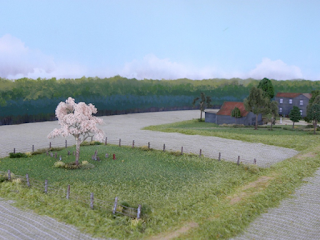
Model of farm by Eddie Gallier
Season and Weather
Our research group has visited various Holleman related
sites in Isle of Wight over the past 3 to 4 years.
One day was in March, bitter cold and snowy. Then a couple of summer days where I got chigger bites in the Tyler Cemetery. Then another beautiful late fall
day, and a dreary, depressing January day.
Doing so, however, revealed another layer in Isaac’s life. He had encountered all kinds of these days during
his life in Isle of Wight. We were
fortunate to encounter them, also.
Now we know where the farm is and can visit, but because the
Holleman farm is an actively cultivated field, we visit with full knowledge of
season and weather and respect the farmer's work. We can visit from
early December until mid-March. We have trudged through mud and crop stubble, as Isaac and his family did. This spring we rescheduled twice a trip due
to snow.
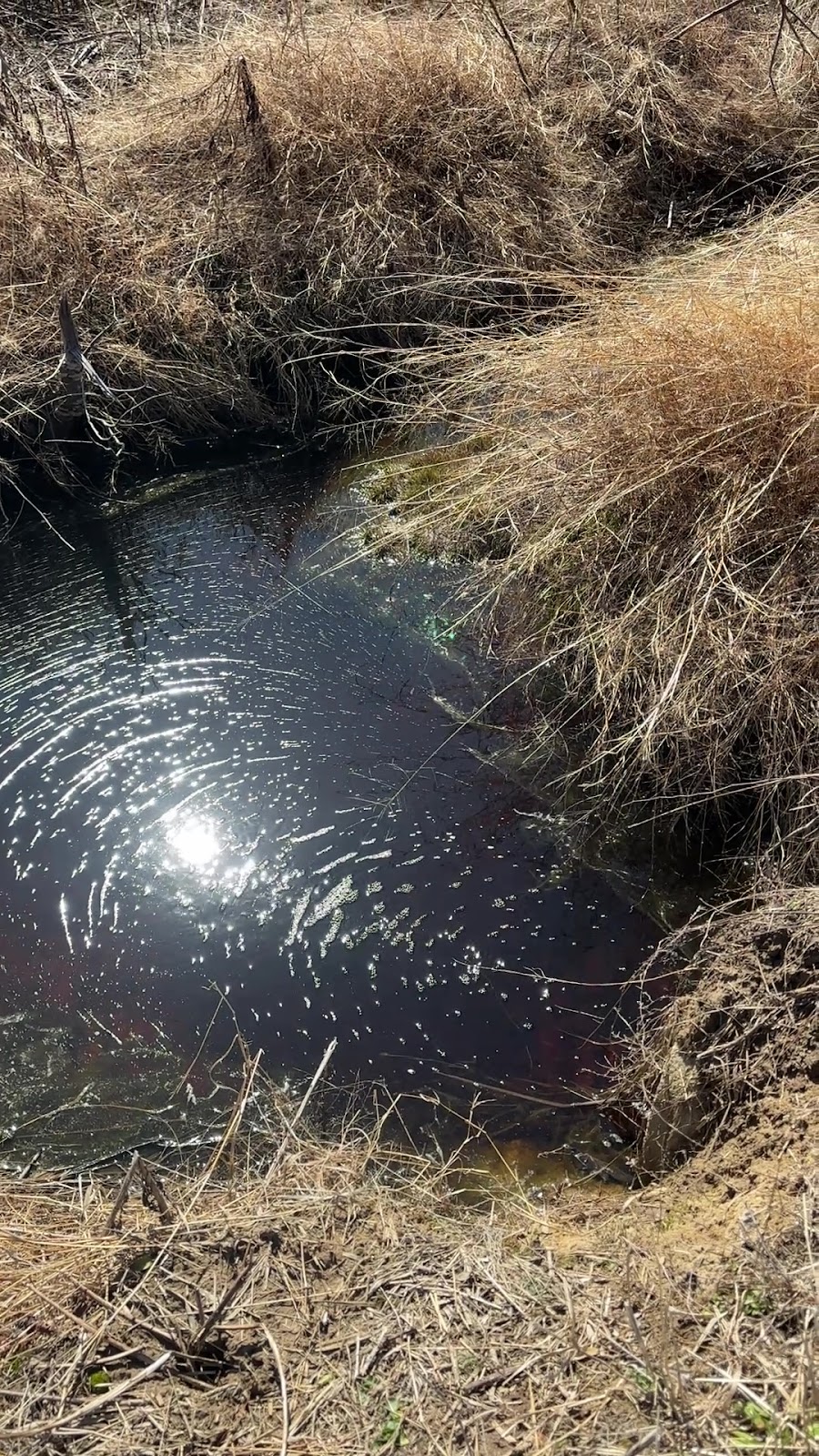
This past March we finally made it on a warm, early spring day, occasionally windy, but not uncomfortable. As we crossed the swampy area at the entrance of the field, we heard frogs. We heard the headwaters of Ely Swamp gurgle. You could hear the wind. Below muddy fields and swampy bogs.


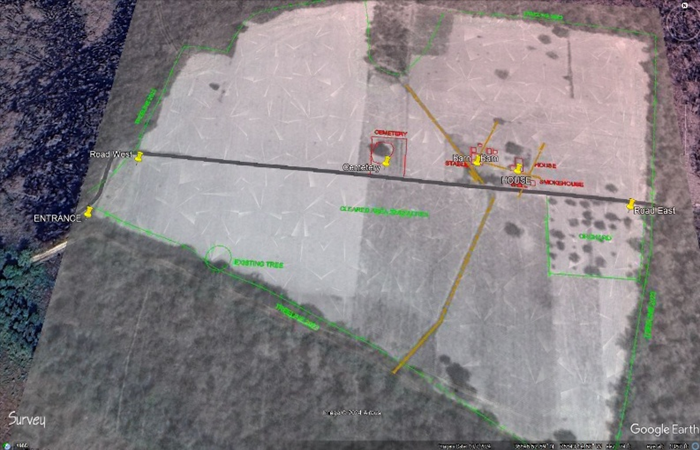
Prior to our trip, my brother had helped me load coordinates into my phone Google map, of the family graveyard, the house, barn, and the orchard.

Right to left: Nashawn Holliman, Alexander Holliman, Kenya Allmond, friend of Kenya, Sandi Royal
A Prayer of Remembrance for Ancestors at the Holliman Farm, March 2025
Dear God and Ancestors,
We gather in reverence and gratitude, remembering your
spirit, your wisdom, and your strength. Your journey through life laid the
foundation upon which we stand, and your legacy continues to guide us with
every step we take. We honor your sacrifices, the dreams you nurtured, and the
love you bestowed upon our lineage. Your stories, though sometimes untold, are
woven into the fabric of our existence, and we cherish the lessons they impart.
May we always strive to live in a way that makes you proud, carrying forward
your virtues and values. As we reflect on your lives, we seek your guidance and
protection. Help us to face our challenges with the same courage you displayed,
and to celebrate our triumphs with the same joy you felt. May we be ever
mindful of the paths you forged, and may our actions today honor your memory. In
moments of doubt, may we feel your presence, and in times of celebration, may
we sense your joy. Your spirits dwell within us, a constant reminder of the
enduring bond we share. We are eternally grateful for the roots you have
planted and the legacy you have left behind.
With deep respect and love, we remember you. Amen.
By
Reverend/Superintendent Nonnie L. Holliman, Great Grandson of Isaac and Ann
That day we could be where Isaac and his family lived and died. It was a very good day.


