Showing posts with label Christopher Hollyman. Show all posts

Friday, June 14, 2024

Where did James Grantson Holliman Live? (1750-1836)

 by Glenn N. Holliman and Sally Campbell

Background

James Grantson Holliman’s great-grandfather, Christopher Hollyman (1618-1691), gave up his home in Bedfordshire, England, and sailed the dangerous Atlantic with his sister, Judith.  They arrived in Jamestown, Virginia in 1650.  Judith married and disappeared from history.  Chris farmed, married, and, by his death, had accumulated over 1,000 acres in Isle of Wight County.

Christopher divided his land among his four sons.  One of them, Richard, chose to stay in the area and expanded his share of the family's legacy by acquiring land in Surry County.  His son, Samuel Holliman (1707-1789), inherited his grandfather’s adventurous spirit and relocated to Edgemore County, North Carolina.  Years later, possibly due to the depletion of his land from years of tobacco farming, Samuel moved again, this time to Johnston County, North Carolina. 

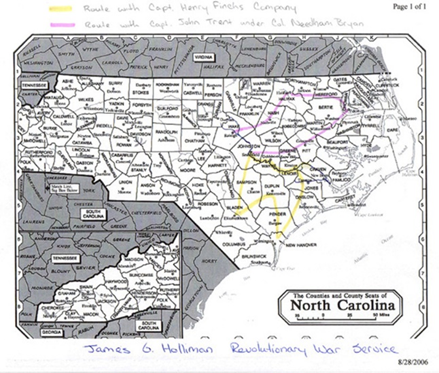
This map was passed along to this writer by the late Rhodes Holliman, Ph.D. It shows in yellow and purple markings where James Grantson Holliman performed his militia service during the American Revolution when he lived in Johnston County, North Carolina. For a copy of his pension application, one may visit Hollyman Tree (Holyman Heritage Group) at Ancestry.com or www.bholliman.com, a virtual archive of associated family materials.
Either in Edgemore or Johnston County, James Gantson Holliman came into this world in 1750 and died in 1836. After service in the North Carolina Militia during the American Revolution, he followed in his ancestors' footsteps and moved to newer, richer farmland. 

James purchased property in what is now Union County, North Carolina, and Lancaster County, South Carolina. There, he prospered. His sons Charles, Warren, and Cornelius married, but like their father, other ancestors and tens of thousands of young Americans, continued the westward movement. Their destination was Fayette County, Alabama. Warren would move on to Arkansas after a few years in Alabama.

Cornelius received a free land grant for his service in the War of 1812.  Perhaps the other brothers migrated in order to establish larger, more productive farms.  Sally reminds us that in order to move family, stock, tools and supplies in a wagon train, migrants had to have a certain amount of cash or trade goods. One did not start a new farm and house penniless.  The people left behind were either financially established, impoverished, or elderly like James Grantson Holliman. His daughters did not move to Alabama.  They stayed in the Carolinas most probably to care for their father in his final months.

New Research

Sally Campbell, a descendant of James Grantson Holliman, has searched land records and traveled the countryside of Lancaster, SC and Union, NC counties to discover precisely where he farmed and raised his family. James owned properties on both sides of the state borders, which confused his descendants as to whether they were South or North Carolinians. 

He took an oath in Anson County (now Union County) for his Revolutionary War service.  In his 80s, it appears that James had a disability, and he went to Monroe (Courthouse), NC, rather than Lancaster (Courthouse), SC, because there were fewer creeks to cross by cart and horse. Does this research clarify the location of his legal residence?  Perhaps his descendants can claim citizenship from either state!

 Sally’s research reveals:

 1. James owned property along Lynches Creek, the boundary between Lancaster and Chesterfield, South Carolina counties.  Anson County, North Carolina, was divided later, and James' property was in what is now Union County.

 2. James also owned land in South Carolina adjacent to Paul Plyler at the fork of Wild Cat Creek, on the south side of Great Lynches Creek, and on the south side of Pole Cat Creek.

 3.  Paul Plyler, a major property owner, had possession of South Carolina land on both sides of Otter Creek and Little Otter, a branch of Lynches Creek, and Wild Cat Creek.

 This map prepared by Sally shows Monroe, NC where James took his Revolutionary War service oath.  Underlined in red in North Carolina is the Pole Cat Creek property area.  In South Carolina underlined in red is Otter Creek. 

This is a close up of the map.  Tradesville, nearer than Monroe, NC, to Holliman property, probably was the village of choice to purchase supplies.  Pole Cat and Otter Creeks are underlined west of the Lancaster and Chesterfield County lines—the county line defined by Lynches Creek.  

Building on the thoroughness of Sally’s research, I pulled up a map that the late Walter Holliman did in the early 1990s before the internet era. Walt, whose family donated his research to this writer, reinforces Sally’s work. He, too, identified South Carolina creek branches where Hollimans and Plylers lived. At the top of Walt’s map, he also shows there were Holliman and Blakeney properties on the North Carolina side.


All three of these families, or at least some of their offspring, moved to Fayette County, Alabama, where some of descendants live to this day.  Cornelius Holliman received his Alabama land as a grant from War of 1812 service.

I want to thank Sally for reaching out to provide this information, her interpretations and catching typos. Not only was James Grantson my fourth GGF, but his neighbor Paul Plyler is also my fourth GGF because his daughter, Elizabeth, married Cornelius Holliman, my third GGF. This story affirms what historians have written: neighbors married neighbors, and neighbors often migrated in families in America’s westward movement. It appears that the Carolina neighborhood caught ‘Alabama Fever’.

Sally Campbell is a descendant of both Cornelius Holliman and Charles Holliman, double-descended from James Grantson Holliman.  Below is her story. - GNH

My parents were from Texas and stationed in Washinton DC during WW2, and that is where I and my twin sister were born.  After WWII, they moved to a suburb of Philadelphia PA, where I grew up.  I graduated from Simmons College in Boston, and married and moved to NY state for 10 years.  Then my husband and I moved  to Charlotte NC, with our three children.  I worked in Computer Services for UNC-Charlotte for about  fifteen years, then my husband and I bought a cruising sailboat which we sailed to the Bahamas and back for 3 or 4 winter months almost every year for 20 years.  

I have always been interested in family history then was started in researching names, dates when I interviewed my paternal grandmother about her 8 siblings. I wish I had interviewed all my grandparents.  I knew my maternal grandfather Elijah J. Holliman was born in Fayette, Fayette County,  north western Alabama.  I discovered Newells' History of Fayette County, which mentioned that Cornelius and his wife Elizabeth Plyler were from South Carolina. I found 'The Plyler Genealogy'  by Monroe, NC.author Herman Starnes.  With the Internet it was easy to communicate with the late Maxine Wright of Arkansas. - Sally Campbell


The sources for this article are based on land abstracts from the book 'Some South Carolina County Records Vol. 1 by Brent Holcomb, printed in 1976, pages 143 through 195, and 'Lancaster County South Carolina, Union County North Carolina metric Topographic Map' by the US Geological Survey printed in 1986.


Friday, December 31, 2021

The Saga of Isaac and Ann Gray Holleman of Isle of Wight, Part 1

by Susan Gallier White

Susan G. White of Virginia is one of the more scholarly writers of  Holleman/Holliman family history of our generation. What follows is the first article of several of the latest information into the fascinating story of an unlikely 19th Century couple, Isaac and Ann Gray Holleman of Isle of Wight County, Virginia. 

In her research, Susan had consultations with Nonnie Holliman and Sandi Royal, who descend from Isaac and Ann, and Troy Jenkins who descends from Isaac's first wife, Malinda Pretlow.  At this site, earlier articles on Isaac and Ann Holleman were published in September 2012 and May/June 2013 by yours truly.  Mrs. White's work greatly enlarges our knowledge of this American story.

Susan wrote August 2016 at this site of her ‘ahead of their time’ Holleman and Faison ancestral grandmothers.  Susan also attended the Spring 2016 Holliman/Holleman in Isle of Wight and later the Spring 2019 Hollyman ancestral exploration in England. - Glenn N. Holliman


Above, Susan and I converse at our opening session of the May 2019 Hollyman gathering in Moreton in Marsh, England.  Back right is cousin Lindsay Holliman, descended as were all Hollimans present, from 15th Century Cuddington, Buckinghamshire, England.  Lindsay lives in Edenborough, Scotland.

Isaac Holleman, a Black man, owned by Josiah Holleman, was born into slavery in 1818 at Mill Swamp district, Isle of Wight County, Virginia.  Emancipated in 1836, he was enslaved again in 1848 to Richard Urquehart, to help pay Josiah Holleman’s estate debts. 

During the Civil War, he fled with his family, including his White wife Ann Gray to Fortress Monroe, Virginia when it was commanded by Union General Benjamin Butler.  Butler, a career Massachusetts politician, regarded Black runaway slaves as contraband, and refused to return them to their owners.  Contrabands by the tens of thousands experienced freedom wherever Union Armies marched.  

One such family was named Holleman.

The 1830s Holleman house is on the original land purchased in 1684 at Mill Swamp, Isle of Wight County, Virginia by Christopher Hollyman, (1618-1691) founder of most of the Hollimans (various spellings) in the United States. This picture taken in 2016 as Hollemans/Hollimans/etc. gathered from all over the country.  The home is owned by Billy Joe Holleman.

After the war, Isaac requested and was granted transportation for himself and his family to Nansemond County, Virginia, in October 1865. He settled in Isle of Wight County, bought a farm of 35 acres, where he lived with his second wife, Ann Gray.  Isaac’s date of death is unknown. His story is only recently discovered by White Holleman descendants but has been in the oral history of his Black family handed down by generations.

 Freed persons with Union Soldiers at Fortress Monroe during the Civil War.

The distance between Mill Swamp Road, Isle of Wight, Virginia, and Fortress Monroe, Virginia is about 36 miles.  The elapse of time between 1619, when slaves were first brought to Jamestown, Virginia and 1818, when slave Isaac Holleman was born, is almost 200 years.

Holleman ancestors were part of that distance and time span beginning in May 1650, when Christopher Hollyman came to Isle of Wight County, Virginia from Bedfordshire, England.  

Thirty-four years later, at age 66, Christopher patented 1020 acres of land in the Mill Swamp area.  The son of an inn keeper and shoemaker, Mr. Holleman undoubtedly succeeded beyond his wildest dreams.  He died at age 73 and divided his plantation which bordered Surrey County among his four sons. Tobacco barns were recorded in his will but no slaves. 

The slave economy grew slowly in the 1600s, but exports of Africans in bondage exploded in 18th Century Virginia.  It was in the 1700s when most likely the ancestors of Isaac arrived in Virginia.  This tragic plantation economy ironically supported many founders of the new United States – for example, Patrick Henry, Thomas Jefferson, George Washington, James Madison and James Monroe.

Fortress Monroe, Hampton Roads, Virginia in the 19th Century where Confederate President Jefferson Davis was imprisoned in chains after the Civil War.  The Isaac Hollemans at the same fort experienced the opposite – freedom!

Four generations after Christopher’s death, one of his second great grandsons, Josiah Holleman, lived on the patented land, in the northwest corner of Isle of Wight, near Mill Swamp.  

Reflecting the growth of human bondage as a norm, Josiah owned 9 slaves on the 1810 Isle of Wight census; no other information listed.  One year later, he bought Negro woman Harty and Negro girl Levinia in a complicated 3-way transaction.

For decades, the plantation economy built on slavery at Mill Swamp prospered, but eventually farming practices at the time depleted Virginia soil and led to economic destress such as experienced when Josiah Holleman died in debt in 1840s.  This situation would affect the future of Isaac. - Susan G. White

Part II of the Saga of Isaac and Ann Gray Holleman by Susan G. White follows in our next blog.  


Tuesday, October 20, 2020

Connecting the Hollyman Lineages, Part 2

 by Glenn N. Holliman

This is the second in a series of articles by professional genealogist Anne Holmes of Buckinghamshire, England.  In this blog she seeks chiefly to discover kinship ties between Hollymans living in London of the 16th and 17th centuries with the Hollymans who lived in Cuddington, Buckinghamshire.  Cuddington which lies east of London, south of Aylesbury, is an ancestral home of most Hollymans (various spellings) who reside in the United States. 

This research is also valuable to the descendants of Hollymans who departed from London in the 19th Century for New Zealand, Australia, other parts of the British Empire and of course, those who remain in the United Kingdom. - GNH

Part 2 by Anne Holmes

Rather than going backwards in time, one approach to solve some of the London HOLLYMAN lineage challenges is to look at the male HOLLYMANS present in London in the 17th Century and earlier and then to work through possible male descendants, looking for further clues.  From past research, for example, it is known that some Cuddington HOLLYMANS did move to London.


Above Hollymans (various spellings) in Cuddington in front of the late 1600s thatch cottage at the Hollyman farm, May 2019.  Fortunately this sojourn to our native land occurred ten months before the Pandemic of 2020.

John, a son of Thomas HOLYMAN of Cuddington, Buckinghamshire (d1558) lived in London. John died there in 1578, unmarried and therefore no descendants. His nephew John, son of Christopher HOLYMAN his brother, was a beneficiary of this John’s Will.

Note both these Thomas and Christopher Holymans of Cuddington are direct great grand fathers of the American Hollymans.  This Christopher Holyman married Margaret Lee of Dinton, and they lived most of their lives in Sherington, Buckinghamshire.  They are the grandparents of the Christopher Hollyman who migrated from Bedford, Bedfordshire in 1650 to Virginia. - GNH

Another son of Thomas HOLYMAN, Richard, also died in London 1603. Richard can be found liable for tax in Middlesex in the 1590s where previously he had been liable for tax in the Hundred of Aylesbury in Buckinghamshire. This Richard HOLYMAN lived in the parish of St. Giles Cripplegate, London but kept his property interests back in Cuddington. 


Above the Medieval tower of St. Giles, Cripplegate with the Barbican complex in the left background.  The church was largely destroyed by the Blitz in World War II, and damaged in several earlier London fires.  Buried in the church were John Foxe who wrote the Book of Martyrs and John Milton who wrote Paradise Lost.  Oliver Cromwell married here in 1620.  

Below as Richard Holyman of Cuddington and London would have known St. Giles in earlier centuries.


This Richard had two surviving sons, Francis and Thomas. Francis died in Middlesex in 1633 but he too kept his links to Buckinghamshire. Like his father, Francis was liable for tax in 1623/4 in London where previously liability had been Buckinghamshire.  It has been difficult to trace any descendants of Francis’ brother Thomas.

This Francis who died in 1633 had three sons, Richard, Thomas and Simon, alive at the time of his death. Francis’ widow Margaret died after her husband in 1647 in Winslow, Buckinghamshire. At the time her Will was written (1643) only sons Richard and Thomas were surviving but their resident location not given.

 And then there is the Francis HOLLIMAN, Silk Weaver and Thrower who died in the parish of St. Mary’s Whitechapel, Middlesex in 1678. The administration of Francis estate was applied for by his daughter in law Mary, wife of Francis’ deceased son William. William had died in Marhalsea, south of the River Thames, in 1676 leaving behind two children.


Above St. Mary's Whitechapel in the Middlesex district of London, 
located approximately 3 miles east of Charing Cross. 

In 1666, the Hearth Tax for St. Mary’s Whitechapel lists a Francis HOLLYMAN as having a house with six hearths (fireplaces) so quite a big house to inherit.

Apparently, Francis had dictated a written Will before he died to an Ann HAWKE bequeathing his estate to the two children of his deceased son William. It looks as though from notes against the administration document (written later in 1693) there was a problem with this bequest. Unfortunately, the genders of Francis two grandchildren are not known as again suitable baptisms not found. 

There is evidence Francis HOLLIMAN, Silk Weaver of St. Mary’s Whitechapel was a nonconformist, a member of the Whitechapel Independent Church, hence the lack of baptismal evidence for his family. It is not impossible this Francis’ ancestry had its origins in Cuddington. - Anne Holmes


It is interesting that Anne's research reveals Hollimans belonged to two churches in London with Non-Conformist ties (i.e. not Anglican or Roman Catholic).  One Holliman known to history as a Non-Conformist is Stephen Holliman of Bedfordshire, a member in the late 1600s of a Bedford parish pastored by John Bunyan, author of Pilgrim's Progress.  Stephen was a brother of Christopher Hollyman, the 1650 immigrant to Jamestown, Virginia.  

The second Non-Conformist would be Ezekiel Holliman, born in Buckinghamshire, who immigrated to New England in the early 1630s and baptized the establisher of the Baptist Church in American, Roger Williams, founder of Rhode Island and advocate of religious freedom.- GNH

More research of Ms. Holmes in our next blog!


Monday, July 8, 2019

The Hollyman English Ancestry Quest 2019, Part 7

by Glenn N. Holliman


Our 5th Stop
 The Lathbury School of Thomas Hollyman
May 18, 2019

The day was getting long toward 5:00 pm when we arrived at Lathbury, a 16th and 17th Century school and church not far from Sherington.  We know from a history of Sherington that Thomas Holliman, the father of Christopher Hollyman, 1618-1691, matriculated here in 1596, probably about 15 years of age.

The school closed a century later and the stones were used to restore the church and acquired by others in the village.  Today, a raised mound of dirt and a few markers occupy the space where my 8th great grand father would have studied the classics.

Below on the site, left to right, Kathleen Holliman, Dr. Jim Holliman, Rob Fenske, Mary Holliman Fenske, Becky Holliman Payne, Glenn Joiner with his wife, Kathy, behind him, and finally Susan G. White.

Murals from the Middle Ages still hold to the surface of the 13th Century church adjacent to the now vacant school site.  No doubt Thomas Hollyman worshiped here often and gazed at the then visible paintings.


The lane to Lathbury was narrow and our careful driver took some time to back up.  This photograph is from Sherington and one can see the size of the coach.  Many  English village streets such as in Lathbury are narrow, often only one lane.  This photograph shows a considerably wider street.


 It had been a long day and after a ride back to Moreton in Marsh, we dispersed, had supper and called it a day, because the Sunday would be filled with more stops and another step back in history!


The Hollyman English Ancestry Quest 2019, Part 6


by Glenn N. Holliman

Our Fourth Stop – St. Laud’s and the Old Rectory

 Sherington, Buckinghamshire
May 18, 2019

Fortified by lunch, our coach driver took us to Sherington, over the Bedfordshire line into Buckinghamshire.  This beautiful village is filled with lovely gardens and thatched cottages.  

It was here that by 1575, the grand parents of Christopher Hollyman, 1618-1691, lived and raised a family including Thomas Hollyman of Bedford, Bedfordshire, the father of our Virginia immigrant Christopher.  

Alice Holliman Murphy reads about the parish's program of saving wild grass and flowers.  St. Laud's is in the back ground.

These grandparents were named Christopher, 1537-1589, (guess where our Virginia Christopher obtained his name?) and Margaret Lee Hollyman, born abt 1548, death date unknown.  We went through the lychgate (below) and inspected the interior of the church.


Kindly church wardens, below, greeted us and pointed out the interior of the facility where Christopher Hollyman, Sr. served as a warden himself.  We know this as our great grandfather and another church leader complained to the bishop about the indolence of the priest. 


Left Kathy Joiner (in black) and Dr. Jim Holliman, in glasses, in the chancel of St. Laud with other Hollymans.


Above genealogist Anne Holmes explained that Christopher and Margaret Lee were born in Cuddington and Dinton, Buckinghamshire and probably moved to Sherington to look after Lee family lands.  The Lees were moving up the English social and economic ladder and the Hollymans peaked also in the 16th Century. 

Probably because of Lee connections, Christopher was made a member of Queen Elizabeth's guard and wore a Tudor uniform similar to those worn by the yeomen at the Tower of London, shown in the photograph. Try to imagine our great grandfather dressed accordingly when mustering the local militia!


The church yard at Sherington most probably holds the remains of my 9th great grandfather, Christopher, named after his grandfather, Christopher Clark of Cuddington, Buckinghamshire. 


Below, nine to eleven generations later the immediate descendants of Walter O. Holliman, 1927 - 2003, gather at St. Laud's on a chilly day in May 2019. 


Before we left Sherington, we stopped at the Old Rectory, no longer where the priest lives and now privately owed.  This 'Old Rectory' was constructed in 1711.  On this site in an earlier rectory, Christopher and Margaret raised Thomas Hollyman, the father of the Christopher who migrated to Virginia in 1650.  Evidently the Hollymans assumed possession of the rectory when the bishop dismissed the errant priest who Christopher, d 1589, had complained about.  Hmmmm.....


There was one more stop on May 18th, the school where Thomas Hollyman, abt. 1581 - abt 1650 attended.


Wednesday, June 19, 2019

The Hollyman English Ancestry Quest 2019, Part 4


by Glenn N. Holliman

Our Second Stop – St. Mary’s Parish,
Now the Albion Archaeology Centre

Bedford, Bedfordshire
May 18, 2019

Thomas Hollyman, most likely born in the early 1580s, grew up in a wealthy home in Sherington, Buckinghamshire, some 10 or so miles from his adult home of Bedford.  The second son (of a third son), he inherited 40 pounds but no land, when his father died in 1589.  His parents were Christopher and Margaret Lee Hollyman of families from Cuddington and Dinton, Buckinghamshire.


Did his inheritance eventually fund an apprenticeship in Bedford?  We know from Anne Holmes’ research that Thomas worked as a cordwainer or leather maker before he took a lease-hold on the Blue Boar Inn, on Cauldwell Street, several hundred yards to the west of St. Mary’s Church.  Later his son-in-law, Barnabas Crash, seems to have gone into business with him.

As a cordwainer, he must have fashioned shoes, leather garments and harnesses for horses.   Undoubtedly his second son, Christopher, was exposed to this occupation, and perhaps supported himself as a leather worker when he arrived in Jamestown, Virginia in 1650. 

Below, Elisabeth Krueger Ahrens and her mother, Anne Holliman Krueger, daughter of Walter O. Holliman (1927-2003) who did so much to research and capture the stories of the Holliman and allied families in the USA.  Both Elisabeth and Anne are international teachers.

The files in this photograph's background are of archaeological investigations in the Bedfordshire area, research often required before new construction in the United Kingdom.  This picture was taken in the interior of St. Mary's Parish which held its last service in 1975 and in 1991 became a research centre.  


Did Thomas curse his fate? 

The nephews and nieces of his mother, Margaret Lee Hollyman, were on the rise socially and financially.  Margaret’s brother, one Thomas Lee, married Eleanor Hampden who inherited Hartwell House, now a National Trust property which I will write about later.  

The Lees were rising and the Hollymans declining. Thomas Lee died a knight in 1626.  Our Thomas Hollyman, Lee's nephew, mended shoes and served ale at a Bedford Inn.  

One can imagine the envy felt by Thomas.  Unlike he, one of his sisters, Ursala, inherited well from her grandmother of the same name, Ursala Yates Lee.


 Above, Anne Holmes inside St. Mary’s Church, now an archaeological office, discussing the history of the building while the Albion manager, center, looks on as does Jim Holliman, right, of Alabama. 

Did his mother Margaret help support Thomas and get him started as an inn keeper in Bedford?  We do not know.

What impact did the English Civil War, which began in 1642 and did not end until 1652, have on the family?  Did our Christopher (1618-1691) serve in the Parliamentary forces which were supported by the Hampden family? 

Bedford citizenry were generally pro-Parliament and Anti-Royalist.  Young John Bunyan, a Bedford resident, and later a charismatic preacher and author of ‘Pilgrims Progress’, served in the Cromwellian forces. Christopher’s younger brother, Steve, later associated with Bunyan's Meeting House services.

Or did Christopher join the King’s army? 

We know the priest at St. Mary’s, Dr. Giles Thorne, from 1630 to 1671, was arrested by Parliament and jailed for four years in 1640s.  This royalist was accused of ill vices such as maypole dancing and praying for the King!  St. Mary’s was the Hollyman family’s parish.  

Also Christopher’s grandfather, an earlier Christopher Hollyman (d 1589) served as a member of Queen Elizabeth’s Guard, an elite royalist honor probably obtained through Lee family connections.

The interior of St. Mary's in 1851, now lined with files and books, but the monuments and stained glass windows remain.

What we do know is our Christopher along with his spinster sister, Judith, left Bedford in early 1650 and arrived in Virginia in May 1650.  Did they flee the chaos of civil war?  Had Christopher fought on the losing side, as King Charles I was beheaded in January 1649? Had his father, Thomas, died and why leave an elderly mother (age 60 or so) to cross the ocean?

The Birth and Grave Sites of Christopher Hollyman, 1618-1691, have now been Visited by Descendants

In April 2016 at the Hollyman gathering in Isle of Wight, Virginia, Billy Joe Holleman, owner of some of the original plantation of Christopher (d 1691) took our group to what is believed to be the original burial plot of the Hollymans of Virginia.  There we assembled and asked ourselves, is this the final resting spot of the immigrant who left England in 1650 and with his sister Judith braved the Atlantic and settled in the New World founding our American family?

Below Susan White, center, in April 2016 with Holleman cousins at the possible grave of Christopher Hollyman (1618-1691) in Isle of Wight, Virginia.  This site, cleared for us by Billy Joe Holleman, is part of the original plantation of Christopher.


 And below three years later, the same Susan White, left, talking with Dr. Jim Holliman, Di Holliman (back to camera) and Tony Pryce, English friend and guide at the burial site of Thomas and Helena Hollyman, Christopher Hollyman’s parents, and one block from where Christopher was born in 1618 in Bedford, Bedfordshire.


 This picture, taken in May 2019, represents an odyssey of discovery taken full circle from the birthplace in England to grave site in Virginia of the ancestor who dared to come to America and founded our family in the New World.


Next blog, a lunch break at the historic Swan Hotel in Bedford.


The Hollyman English Ancestry Quest 2019, Part 3

by Glenn N. Holliman


Our Second Stop – St. Mary’s Parish,
The 17th Century Church of the Thomas Hollyman Family
Now Re-purposed as  the Albion Archaeology Centre

Bedford, Bedfordshire
May 18, 2019


Approximately 3/4ths mile south of St. Peters de Merton, across the River Ouse, is St. Mary’s Church which is one of the oldest and most beautiful buildings in Bedford.  Even before the 1066 Norman Conquest there was a church on this spot.  The four-stage tower has been a major landmark to travelers for more than one thousand years.


It may have been founded by King Alfred the Great’s son, Edward the Elder, circa 915, when Bedford was a key stronghold in the Viking wars.  For fifty generations it was the center of community life. Tens of thousands of town folk were baptized, married and buried here, including our Hollyman families.  
  
In the 12th Century a hermit took up residence in the Church for whom King Henry II made a grant of a penny a day for food which was passed to the religious recluse under his cell door.


Among those resting here are our Hollyman descendants, Thomas and Helena Poynard Holliman, and undoubtedly several of their children.  Baptized here was Christopher Hollyman [1618-1691], the immigrant ancestor of most American Hollimans.


Who were the children of Thomas and Helena Hollyman?
 
Genealogist Anne Holmes provides this information:

John Holliman, 1610-1645

Ellenora Holiman, 1612-1612

Jone or Jane Holliman, 1613-?, m. Barnabas Crash in 1631

Thomas Hollyman, 1616-?

Christopher Hollyman, 1618-1691 (d. in Virginia)

Judith Holliman, 1621-? (d. in Virginia)

Eleanor Hollyman, 1623-?

Stephen Hollyman, 1625-? (Member of John Bunyan’s Meeting House)

Mary Holyman, 1628-?

All the children were baptized at St. Mary’s and records indicate Ellenora and John are buried in the church cemetery.  Eight children grew to adulthood, unusual for the time when infant and childhood deaths were common.

Below, across from the now Albion Centre (St. Mary’s Church) on Cauldwell Street is a digital internet company, as a representation of 21st Century as one can get. The Blue Boar Inn would have stood where the two buildings meet.  This is where Christopher Hollyman, our American founder, first saw the light of day.


In the 1800s, Cauldwell Street looked as drawn below.  St. Mary's Parish is at the end on the street.  On the right would have stood the Blue Boar Inn, where now late 20th Century buildings, as pictured above, fill the block.


On this site in 1618, Christopher Hollyman was born at a tavern and inn known as the Blue Boar. 

He was the fifth child and third son of Thomas and Helena, and along with his sister Judith he would leave Bedford at age 32 and immigrate to America. 

For a detailed family tree of the Hollymans of England (and tens of thousands of other Hollymans and associated families) visit the Ancestry.com site: Hollyman Tree, created and maintained by Jeanette Holiman Stewart.  Jeanette has entered over 52,000 Hollyman names (many spellings) and works closely with Anne Holmes to fine tune our English ancestry.  Jeanette’s email address is Htreekeeper@gmail.com.

Next blog, more on St. Mary's, the Albion Centre, Thomas Hollyman, his life, and the forces that may have led to his son, Christopher, immigrating to American in 1650.