Showing posts with label James Monroe Holliman. Show all posts

Thursday, November 22, 2012

From the Galaxy of Holliman Cousins and Great Uncles and Aunts, 2

by Glenn N. Holliman

This continues the series on Dr. Rhodes B. Holliman and his ancestors and associated families....I am grateful to him for access to his historic photographs of Fayette, Alabama and family.

Below James Monroe Holliman (1878-1938), third son of Civil War veteran, John Thomas Holliman (1844-1930).  The photograph below is dated 1896, when James was 18, three years away from marriage to Anne Elizabeth Baker.  They would have two boys who lived to maturity - Cecil Rhodes Holliman and Charles Baker Holliman. 


The year before James married Anne Elizabeth Baker, the Baker family which lived in Newtonville, Alabama posed for this photograph which caught the a southern family in 1898 wearing their Sunday best.  Note James Mutius Baker on the far right in wing tip collar and hat.


Back row, left to right: Frances Hillman Baker, George Washington Baker, Anne Elizabeth Baker, Belzy Ann Blakeney Baker, Georgia Bell Baker (babe in arms).  Front row,  left to right: Guyton Baker, Pearl Baker, Frederick Coleman Baker, Montie Lea Baker, Allie Mac Baker, James Mutius Baker.


Below, the Fayette County, Alabama courthouse in 1898.  It was destroyed in the town fire of 1911.


Fayette in 1898 was still captured by the cotton culture of the old South as this picture taken in front of the Court House suggests.  Family farmers all over the nation suffered in the 1890s giving rise to the Populist movement which flowered briefly and then faded in Alabama. 
 
Two of James's brothers would work as farmers all their lives. Not James. He first practised law in Fayette, Alabama serving as county solicitor in the 1910s. A horrible fire swept through Fayette in 1911 destroying much of the downtown.

The fire, the inability to advance in a political career running as a Republican in the solid Democratic South and the lure of the Magic City of Birmingham, must have moved James to make an important move around age 40. As with millions of other Americans, north or south, James Monroe Holliman would head to the big city. 

In the future more on James Monroe Holliman and his brother,  however, next post, back to England and our European roots....

Friday, November 9, 2012

From the Galaxy of Holliman Cousins and Great Uncles and Aunts

by Glenn N. Holliman

This continues the series on Dr. Rhodes B. Holliman and his ancestors and associated families....

Below in 2002, my son, Christopher S. Holliman rendezvoused in Virginia with Dr. Rhodes Holliman, who passed along to Chris a book shelf constructed by Ulyss S. Holliman  (1884-1965) in the 1920s.  Ulyss was Chris's great grandfather and Rhodes's great, great uncle.  Chris is a librarian and Rhodes, a Ph.D. in biology, who chronicles the history of the Holliman family with emphasis on Alabama since 1836.

 
 Rhodes's great grandfather was James Monroe Holliman.  James was the first of the Holliman sons of John Thomas and Martha Jane Walker Holliman to leave farming as a profession and enter a service industry - an attorney-at-law.  Until 1920, half of all Americans, according to the Census of that year, lived in a rural environment.  But the industrialization of the country, the decline in farm prices and more than anything, the rise of modern transportation, revolutionised how people earned their livings,
 
 In the lives of sons of John Thomas Holliman, four of the six left farming for other pursuits at the turn of the 20th Century.  Their father, caught up in the seemingly never ending farm crisis's of the 1890s and 1920s  died in near poverty in 1930 at a time of no Social Security and no modern safety net for seniors.
 
James Monroe Holliman (1878- 1938) was determined to earn his living by his mind and mental talents. He also married well - Elizabeth Ann Baker, a descendant of another Fayette County, Alabama pioneer family.
 
Below, James Monroe and Elizabeth Baker Holliman in October 1899 leave Newtonville, Alabama for their honey moon.  Note the clothing styles and the buggy that carried them away to married life.
 
.  

The 19th Century pictures above are from the collection of Dr. Rhodes Holliman, who received them from his father, Cecil and grandfather, James Monroe Holliman.  In 1899, the horse and buggy world was about to give way to gasoline and automobiles.  Cruelly, James would die of infection when his finger were caught in a slamming car door in 1938.  He was only age 60, but he left behind a legacy of descendants to carry on the family names and service to the communities in which they lived.

Next post...more on Fayette, Alabama and one of its citizens....

Tuesday, October 30, 2012

From the Galaxy of Holliman Cousins and Great Uncles and Aunts

by Glenn N. Holliman

The Biology Professor who became the Alabama Holliman Family Expert....

No one living knows as much about the Cornelius Holliman (1792-1862) family that migrated from South Carolina to Alabama in 1836 than Dr. Rhodes Burns Holliman of Virginia.  When I started writing this blog 2 1/2 years ago, the first articles on John Thomas Holliman (1844-1930), Martha Jane Walker Holliman (1846-1931) and James Franklin Holliman (1839-1911) were by Rhodes.

Earlier this year I posted a three part series by Rhodes on his summers in Fayette County, Alabama in the 1930s and how different life was then than now in the country.  According to my blog counter, this is one of the most read series that has been posted in this space.

Below, Rhodes at his desk, composing articles and saving photographs of 19th Century family members such as the Hollimans, Blakeneys and Bakers of central Alabama.


Last posting in this space, I wrote of Rhodes' dedicated physician son, Jim Holliman.  Jim, as does Rhodes, follows in a line of talented ancestors.  Jim's grandfather was Cecil Rhodes Holliman (1902-1986), a distinguished Birmingham, Alabama attorney, who eagerly collected family stories and wrote a major manuscript on the Samuel T. Walker (1821-1900) families. One of Cecil's grandfathers was Samuel Taylor Walker, a Confederate Civil War veteran.
 
Below Cecil Rhodes Holliman as a 1921 cadet at the Marion Military Institute, Marion, Alabama.  Dr. Rhodes Holliman, a specialist in exotic diseases and retired professor from Virginia Tech, acquired his love of family history from his father, Cecil.  This photograph and the one below are from the Rhodes Holliman collection.
 
Cecil's father was the dynamic pioneer of this branch, James Monroe Holliman (1878-1938), who married a Fayette County girl, Elizabeth Ann Baker in 1899.  James studied law, served as county solicitor, and later moved to Birmingham to set up a law practice that continues to this day under his great and great, great nephews, Jim and John Holliman, attorneys at law.

Below, James Monroe Holliman in a 1924 photograph, who left the farm run by his father, John Thomas Holliman, and by his wits and enterprise became a successful Alabama attorney.  He sired a distinguished prodigy of children, grandchildren and great grandchildren.

Next post, more on my cousins, great aunts and uncles from this distinguished and successful branch of the Holliman family....

Friday, March 30, 2012

Those Were the Days!  
by Dr. Rhodes B. Holliman, Dublin, Virginia


Dr. Rhodes Holliman, a descendant of pioneer families in Fayette County, Alabama, concludes his reflections on visiting his aunts and uncles in Newtonville, Alabama in the 1930s, a time gone by. - GNH

"These wonderful kinfolks never owned a gas or electric stove, a refrigerator or even an ice box; there was no washing machine or dryer and electric lights. No running water, tub or shower.  No indoor plumbing whatsoever.  If you wanted water there was a hand-dug well in the back yard."


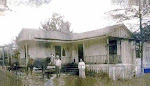
Below is a Fayette County example of a 'dog trot' home prevalent in the 19th Century.  While not his Uncle Eura's home, this rustic building has a middle hall way with an enclosed room on each side.  Usually one built first one cabin and then as one prospered added a second side.  Often one side was a kitchen. The wood stove made it extremely hot in Alabama summers, so the family lived in the opposite room.  Photo courtesy of Dr. Rhodes Holliman and his niece, Glenda Norris


"Needed to wash clothes?  There was a big, cast iron, 3 legged pot in the back yard, in which you put water and under which you built a fire. When the water was hot, you would put the dirty clothes in the pot with some homemade lye soap. You would pull out the wet garments and scrub them over a wash board and then rinse with cold water.

Needed a cook stove?  There was a chop block near the well where you would split stove wood. Needed a bath?  There was a 16 gallon washtub in front of the hearth or wood stove. Needed lights?  Kerosene lamps did the trick.  Needed to store cooked food? There was the pie safe. Needed heat in the winter?  Back to the chop block or cross cut saw.  Needed air conditioning?  Get out your cardboard church fan.

Needed to go somewhere? There was a buggy and a horse or mule in the barn. A few wealthy folk had a Model T or A Ford. Needed groceries?  Go to the storm cellar and pick up home canned vegetables and/or take a sack of corn or grain to the local grist mill and come back with meal or flour.  Needed meat?  Go out to the smokehouse and cut down a ham, bacon or sow belly." 
Above, approximately 1905, James Monroe Holliman, Cecil Rhodes Holliman and Elizabeth Baker Holliman at their turn of the 20th Century home in Newtonville, Alabama.  James Monroe Holliman, the writer's grandfather, would become a lawyer, and as many during World War I, he took his family to an urban area, in this case Birmingham, Alabama and became a successful attorney.  Many of  his grandchildren and great grandchildren follow the same profession today in Birmingham.

"Needed a doctor?  Dr. Blakeney could be reached on your crank phone and he would come to your house in his antique car or on horseback.  Need to satisfy a sense of visceral urgency?  There was a path to the outhouse.  It could be a one holer or a two holer. Worried about cholesterol?  What was cholesterol?

In my boyhood mind, everyone was happy and did not seem to miss anything in life and always looked forward to family visiting, family reunions, church homecomings and revivals and all day singing and ‘eating on the grounds’.  It was in this wonderful world of simplicity that I grew to manhood never feeling that I missed anything."

Next posting, a return to our English roots....

Thursday, December 30, 2010

Our Family's Colonial Era, Part XIII

by Glenn N. Holliman

A Holyman Family from Isle of Wight, Virginia to North Alabama
A Closing Observations as the Old Year Slips Away....

1650 - 2010: 360 Years of American History in one Family

Christopher Holyman, Sr. arrived in Jamestown, Virginia in 1650. He and his immediate descendants lived approximately a century in Isle of Wight County and adjacent counties. However, around 1740, my direct Holliman descendants from this multiple great grandfather began moving south and west searching for land and increased fortune.

For my line of Hollimans, the chronology is approximately this, and of course, sons and daughters were always splitting off and moving to other parts of what is the United States. Many in the late 1700s and early 1800s would move to Tennessee and Kentucky. For the most part, my branch of this colonial family would migrate to the southern states, although there are exceptions.

Prior to 1650 - Origin of American family is England, with Christopher Holliman, Sr. born 1618 in Bedford, Bedfordshire, England with possible other relatives in Tring, Hertfordshire, England.
Research to date does not support the reported John Holyman (d 1650) of Tring, England and Southampton, Virginia as the father of Christopher Sr. The parents of Christopher Sr. appear to be Thomas (b 1576) and Helene Poynard of Bedford.


The map below traces my Holyman family migrations from Isle of Wight, Virginia to Birmingham, Alabama. Numerals are printed adjacent to each 'stop' . Below the map, the numerals are next to copy about each family historic home. As the map is copied from a history book on the westward movement, no part of this map may be used for commercial purposes. Click on the map twice to enlarge. The large red arrows indicate the forced migration of Native Americans from their tribal lands as European - Americans and African -Americans advanced westwardly.


1. 1650 to 1740s - Most of my direct descendants lived in Isle of Wight County and adjoining counties in Virginia. Naturally, many descendants under the names of Holleman, Hollomon, etc. reside in southern Virginia to this day.

2. 1740s to 1790s - Through the parents and relatives of James Grantson Holliman, the Johnston County, North Carolina area became home for my branch of the family.

3. 1790s to 1836 - In the 1790s Anson County, North Carolina and Lancaster County, South Carolina (border counties) became the location of this James Grantson Holliman family.

4. 1836 - 1918 - In 1836, three sons of James Grantson Holliman moved their families to Fayette County, Alabama. The families of Charles and Cornelius Holliman stayed in Alabama and descendants live in the area to this day. Warren Holliman moved with others to Arkansas, and there remain many Hollimans. Others of these extended families moved to Mississippi, Texas, Louisiana and other parts of the southwest and middle Great Plains.

5. 1918 - 1960s - My generation's grandfather, Ulyss S. Holliman (1884 - 1965), a son of John Thomas, grandson of Uriah and great grandson of Cornelius, moved his family from Fayetteville, Alabama to Irondale, Alabama, a suburb of Birmingham. Several other families migrated to the economic attractions of the 'Magic City' also, including James Monroe Holliman, a brother of Ulyss, and his children. Others of Ulyss' brothers scattered throughout North Alabama; one Bill Holliman, remained in Fayette County, dieing there in 1940.

1960s to the present - While many of my first cousins remain in the Birmingham and North Alabama region, and 2nd and 3rd cousins in Fayette Country area, many grand and great grand children of Ulyss and Pearl Caine Holliman, have relocated across the country living in Chicago, Boston, Pennsylvania, South Carolina, Texas, Virginia, North Carolina, Tennessee, Alaska, Arizona and other states. As with many families, advances in education, transportation and career opportunities have led to the dispersion of formally regionally located kinfolk to every part of the country.

Next Posting, a close examination of life in Isle of Wight County in the 17th Century, and its influence on our family today....

Saturday, February 13, 2010

Welcome Family!

Important Notice:

Since composing this article in February 2010, additional research has failed to identify John Holyman (1572 - 1650) of Tring as the father of Christopher Holyman, Sr., the believed first generation of Hollimans in America. My interpretation at this time is that Christopher Holyman, Sr. was born in Bedford, Bedfordshire, England in 1618. We have data that he arrived in Virginia in 1650 and died in 1691. (Last updated April 13, 2014)

This is the story of the Christopher Holyman families from Jamestown, Virginia to the present day. All family members, and those who have married into this family, are invited to join in the exploration.

Through this blog we plan to include interesting facts, family trees, lore, geographical information and first hand memories. This blog is a work in progress. Your comments, insights, corrections, articles, photographs, diaries and old letters are most welcome. In this format we plan to hand off our past, and present, to the future.

Glenn N. Holliman, Complier
Grace A. Hollilman, Editor

Family Lineage
What follows is a baseline genealogy of a Holliman paternal family tree through the life of John Thomas Holliman of Fayette County, Alabama and his sons. John Thomas is the father of six sons (photo below). Most of the persons receiving this email are descendents of two of the sons: James Monroe Holliman and Ulysses (usually spelled and pronounced Ulyss) Selman Holliman.

Jim Monroe Holliman, an attorney, and his wife Anna Elizabeth Baker, had two sons who grew to maturity: Cecil Rhodes and Charles Baker Holliman. Ulyss and his wife, Pearl Caine, had seven children: Melton, Vena Holliman Daly, Euhal, Loudelle Holliman Ferrell, Bishop, Virginia Holliman Cornelius and Ralph Holliman.

All the above, and most of you reading this, are descended from an immigrant from a Bedford, England immigrant with probable additional grandparents from Cuddington and Sherington, Buckinghamshire, England.

Christopher Hollyman (b 1618 Bedford, England – d 1691, Isle of Wight Co., Virginia)

Richard Holyman (b 1660 ca - d 1711)

Samuel Holliman - (b 1707 - 1781), Johnston County, NC.

James Grantson Holliman (b 1750, Johnston Co., North Carolina – d 1836, Mecklenburg Co., North Carolina). Wife was Elizabeth Bryant.

Cornelius Holliman (b 1792, Anson Co., North Carolina - d 1862, Fayette Co., Alabama) First wife and mother of Uriah, Mary Elizabeth Plyler (1793-1835).

Uriah Holliman ( b 1817, Lancaster, Co., South Carolina - d 1862, Okolona, Mississippi after the Battle of Corinth). Wife was Mary Polly Lucas (1819-1913).

John Thomas Holliman (b 1844, Fayette Co., Alabama – d 1930, Fayetteville, Alabama)
Of the marriage to Sarah Corbett, William Perry Holliman (1871-1941) was the surviving child. Of the marriage to Martha Jane Walker, five sons were born: Silas Green Holliman (1876-1943), James Monroe (1878-1938), Thomas Leland (1880-1970), Andrew Eckford (1882-1926) and Ulysses Selman Holliman (1884-1965).

Sons of John Thomas and Martha Jane Walker Holliman


Left to right are: Bill, Green, James Monroe, Leland and Ulysses. The vacant spot is for Eckford who died in 1926.

The photo was taken at Fayette Co., Alabama May 1934 by Cecil Rhodes Holliman with an old bellows Kodak on 120 film. Rhodes Holliman, his son, remembers the photo and observes the following:

I remember the sense of necessity that pervaded the crowd to get this historic family photo. It was made at the annual Holliman reunion and ‘eating on the grounds’. With Eck dead, everyone wanted to preserve the remaining family image. I used to play under this old church while services were in progress. I'm surprised that the building didn't collapse while full of people. The ferruginous rock pilings did not have any mortar! The building was literally balanced on these pilings! Uncle Bill’s son, Grady, played the guitar to accompany the singing. This is where I fell in love with the hymn, "Just a Little Talk with Jesus". 

I remember an over-weight lady whose name was Cousin Maggie Thornton. She came to the reunion in a wagon pulled by a team of mules. She had an old steamer trunk full of food: pies, fried chicken, potato salad, you name it. She was famous for her cooking. I think that she was a spinster. She was distantly related -- collateral family. I think that she is buried at Caine’s Ridge. Uncle Bill could walk to church; his old shack was across the road and a little south, back in the woods. I think that his house site still shows on the USGS Topo maps.

Bishop Holliman (b 1919), a son of Ulyss, was also present at this reunion, and remembers Maggie Thornton. Ulyss, Euhal and Bishop drove from Irondale (a suburb of Birmingham) to Fayette for the day, a major drive in 1934.


Mary Polly Lucas Holliman (1819-1913)
The Story of Her Father and Grandfather
Contributions from Glenda Norris, Rhodes Holliman and S. Emmett Lucas, Jr. Prepared by Glenn Holliman.

Mary Polly Lucas, was the daughter of Charles Daniel Lucas (1778- 1853) and Mary Hastings (9/10/1786 - 1/21/1867), all originally from South Carolina. Polly Lucas became the wife of Uriah Holliman on 8/29/1836 in Tuscaloosa, AL. Uriah and Polly had many children, one being John Thomas Holliman, the direct ancestor of most persons reading this information.

Charles Lucas Sr. (1755 - 1810?) was the grandfather of Polly Lucas. Charles was probably a tailor who lived in Marlboro County, SC, along the Pee Dee River near the North Carolina line. Glenda Norris reports that Charles was married to Dorcus (maiden name unknown) who is thought to have been an American Indian. One of their sons was Charles Daniel Lucas, Polly’s father.

Charles Daniel Lucas (1771-1853) stood six-foot-four and according to Polly, he once killed a panther with his bare hands. In 1819 Charles Daniel moved his family from South Carolina to the new state of Alabama (just as the Holliman family did in 1836).

Rhodes Holliman, a great great great grandson of Charles Daniel, reports that Charles had a fierce temper yet managed to serve as a deacon in the 1830s at the Springhill Baptist Church near Moore’s Bridge, Fayette County. Family lore states that Charles Daniel hit one of his sons causing his wife, Mary Hastings Lucas, to move herself and children from Newtonville to the Bluff Community northwest of Fayette.

Charles Daniel died in 1853 after having served as a Federal Indian agent. He is buried in an Indian burial site seven miles from Fayette toward Newtonville. In death, as in life, Charles Daniel Lucas was not completely at peace. In 1870 grave robbers attempted to disinter him but were scared off in the process.

Charles Daniel’s wife, Mary, is buried in an unmarked grave at the Springhill Baptist Church Cemetery in Fayette Co., along with their daughter, Mary Polly Lucas Holliman, and John Thomas Holliman’s first wife, Sarah E. Corbett.


In the picture below Glenda Norris (Alabaster, AL) and her uncle, Dr. Rhodes Holliman (Dublin, VA), visit the gravesite of Charles Daniel Lucas in Fayette Co., AL near Newtonville in 2007.


Glenda (b 1959), is the daughter of Cecile Eugenia Holliman Youngblood (b 1937), who is the daughter of Cecil Rhodes Holliman, (1902 – 1986), who is the son of James Monroe Holliman (1878 – 1938) who is the son of John Thomas Holliman (1844 – 1930) who is the son of Uriah and Mary Polly Lucas Holliman. Rhodes (b 1928) is the son of Cecil Holliman, the grandson of James Monroe Holliman, and great grandson of John Thomas Holliman.