


 Posts
Posts


By Glenn N.
Holliman
Cousin Allen Holleman, one of our
serious family historians, continues to write of his Holleman ancestors who left
Isle of Wight, Virginia for the Raleigh, North Carolina area in the early
1800s. Christopher Hollyman, arrived in Jamestown, Virginia from Bedfordshire, England in 1650, and by 1661 purchased land in Isle of Wight County, Virginia. He had two daughters and at least four sons.
By the 3rd and 4th generations, many of the grandchildren and great grandchildren of colonial founder Christopher Hollyman were leaving the 'burned out' tobacco lands of southeast Virginia and migrating to the Carolinas. This southwestern migration was typical of our many Holliman (various spellings) ancestral branches. Below is Allen's lineage.
Christopher Hollyman, Sr. (1618-1691), father of:
Christopher Hollyman, Jr. (1660-1731), father of:
John Holleman (1700-1751), father of:
Jesse Holleman, Sr. (1735-1825), father of:
John Holleman (1766-1850), subject of this article who moved from Virginia to Wake County, North Carolina, where his descendant, Allen Holleman lives to this day.
By the 3rd and 4th generations, many of the grandchildren and great grandchildren of colonial founder Christopher Hollyman were leaving the 'burned out' tobacco lands of southeast Virginia and migrating to the Carolinas. This southwestern migration was typical of our many Holliman (various spellings) ancestral branches. Below is Allen's lineage.
Christopher Hollyman, Sr. (1618-1691), father of:
Christopher Hollyman, Jr. (1660-1731), father of:
John Holleman (1700-1751), father of:
Jesse Holleman, Sr. (1735-1825), father of:
John Holleman (1766-1850), subject of this article who moved from Virginia to Wake County, North Carolina, where his descendant, Allen Holleman lives to this day.
A
Strong Willed Second Wife by Allen Holleman

Right, Joe Barlow and Allen Holleman at the original Holleman farm at Mill Swamp, Isle of Wight County, Virginia. Both are direct descendants of Christopher Hollyman, Sr. Joe's family remained in Isle of Wight County. Allen's family moved to North Carolina from Isle of Wight County around 1805.
In July 2014, I posted
an article on my 4th Great Grand-Father,
John Holleman (B 4 Feb 1766 Isle of Wight Co, Virginia), son of Jesse
Holleman (1737-1824), planter, surveyor, minister and patriot in the American
Cause. I recommend re-reading that here
for background:
http://hollimanfamilyhistory.blogspot.com/search/label/John%20Holleman
http://hollimanfamilyhistory.blogspot.com/search/label/John%20Holleman
As so often happens in
genealogy, new information comes to light that adds to and sometimes even
changes what we knew earlier. And such
is the case here.
John and his brother Jesse (Jr.) moved with
their families to Wake County, North Carolina and settled in the Buckhorn
District SW of Raleigh between New Hill and Holly Springs. I stated that I couldn't place him solidly
there before 1810, but we now have tax records as early as 1805. Likely they
were there earlier as it takes time to get established and be recognized as a
citizen of the community.
John and Nancy (nee
Womble) were married in 1783 in Virginia and had five sons and three daughters
before moving south. Nancy was evident
in the 1840 census but died soon after.
And he married another Nancy (nee Utley;
1792-1858) 19 Mar 1844. She was born in
Wake, the 2nd child of Britain Utley (1765-1813) and Mary Huckaby (b 1770-) and
had five brothers and five sisters. Her
Grandfather was John (Capt. Jack) Utley, Revolutionary hero
John passed away six years later in August
1850 and very clearly limited what his 2nd wife was to inherit, via his
will.
"To
beloved wife NANCY HOLLEMAN the interest of $500, to be paid by executor during
life tenure or widowhood then the $500 to be divided among my heirs. Wife
Nancy HOLLEMAN to have all of property she brought to my house when I married
her.
It
is my will and desire that my beloved wife NANCY HOLLEMAN have the interest of
five hundred dollars as before named and what property she brought to my house
as before named and no more. It is my will and desire that she have that much
of my estate as her only shear (sic) in my estate in any way what ever"
North Carolina, as with the other colonies had
mainly English law until after the Revolution. Much of that was not so much
legislated as determined by judicial
decisions in court and based on custom of the times. Even after, the old legal custom remained
that a married couple became one entity that was represented (controlled
actually) by the husband as the head.
That remained as a cultural custom, though not a legal demand well into
our times. Then a married woman could not own property separately nor devise nor
will property she 'owned' without consent of her husband.
It was custom but not legally required to provide
an abode and 1/3 of all real property to the widow for her life or widowhood -
unless she remarried. This was not an
inheritance with title and ownership but a 'life estate' that reverted to the
heirs, usually the children upon her death, mainly an interest in the income
the property produced as well as a home.
Nancy
thought she deserved more and filed suit to get it. She was twice awarded a
year's support in food and supplies, but the will was direct enough that the
courts determined she wasn't due any of the property. I now suspect Nancy wasn't an innocent
know-little.
I now see her as a strong-willed, intelligent woman, a powerful person who didn't marry until in her 50's because she was an ugly duckling. It was by her own choice and it took a man as strong and able as John Holleman to change her mind. I'd bet they had some lively conversations and discussions and I'd also bet he listened to her as well.
I now see her as a strong-willed, intelligent woman, a powerful person who didn't marry until in her 50's because she was an ugly duckling. It was by her own choice and it took a man as strong and able as John Holleman to change her mind. I'd bet they had some lively conversations and discussions and I'd also bet he listened to her as well.
We
had thought she was poorly treated in John's will and I speculated on the
reasons. But he gave her back all that
she rightfully owned. I now understand
the reasons after finding her will and probate of 1858.
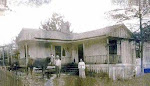
Below, 2015 Joe Barlow and Billy Joe Holleman inspect an out building on the Holleman farm in Isle of Wight, Virginia, a structure probably similar to the John Holleman house in Wake County, North Carolina.

Below, 2015 Joe Barlow and Billy Joe Holleman inspect an out building on the Holleman farm in Isle of Wight, Virginia, a structure probably similar to the John Holleman house in Wake County, North Carolina.

She
didn't need John's house. Nancy Utley
was a rather wealthy woman for the place and time. She already had a house, property, livestock
and money. Nancy didn't cook or do housework because she owned slaves who did that for
her. John did not own slaves. And I further think all of this was taken
into account by the courts in their rulings.
I
wouldn't go so far as to call her greedy, but we can wonder if perhaps marrying a wealthy older man, with an idea of adding to her own through
inheritance, might have been an influence - as indicated by the
lawsuit. She likely already had some
understanding that John intended to preserve his own wealth and pass it along
to his own children, which was certainly understandable.
I
also see Nancy as a good person who willed much of her property and wealth to
her own kin, mainly three nieces whom she cared about. She devised the house to them "to live
in during their single hood as long as they should agree". Further she left to them her old
"servant Issac to do for them" . And even more, left funds to provide for him "should he get past
laboring for support". How about
that - a retirement plan for a slave!?
Nancy
didn't just go back to live with her Utley relatives. She made her own way.
Nancy
did not inherit wealth from her father - just one young slave girl. Her brothers got the property and money. She
made it herself in a man's world and is to be admired for that.
I
wish I could tell you how she did it - I can only see the result.- Allen Holleman
An important announcement below:
An important announcement below:
THE CHRISTOPHER HOLLYMAN, SR.
HISTORICAL SOCIETY
Executive Committee
Tina Peddie (California) Jeanette Holiman Stewart (Texas), Allen Holleman (North Carolina), Glenn N. Holliman (Pennsylvania), Lynn Holliman (Texas) Glenda Norris (Alabama), Sue Jones (Wyoming), Joseph Parker (Texas), Denise Goff (Virginia) and Sandra Torbert French (Florida)
CORDIALLY INVITE YOU
to
The Inaugural Meeting of the Society
at
SMITHFIELD
ISLE OF WIGHT COUNTY
VIRGINIA
MARCH 31- APRIL 2, 2016
FOR
A ONCE IN A LIFETIME TOUR TO THE CHRISTOPHER HOLLYMAN'S PLANTATION CA 1682
AND
OTHER HISTORIC HOLLYMAN SITES
AND
TWO DAYS OF SEMINARS
and Round Table Discussions
ON
THE HOLLYMANS of ENGLAND
AND
SUBSEQUENT MIGRATIONS
THROUGH OUT THE USA
PLUS
SESSIONS ON HOW TO TRACE YOUR HOLLYMAN DNA, THE MASSIVE FAMILY TREE (at www.Ancestry.com), HOLLYMAN WEB SITES, THE JAMESTOWN SOCIETY AND THE NEW HOLLIMAN ARCHIVES FOR HOLLYMANS (ALL SPELLINGS) AND ASSOCIATED FAMILIES!
If you trace your ancestry to Christopher Hollyman, Sr. (1618-1691) you will not want to miss this national gathering of his descendants in the ancestral home of almost all North American Hollemans, Hollimans (and various spellings).
Our Registration Center and Gathering Place for Seminars and Dinners will be the Smithfield Inn, 112 Main Street, Smithfield, VA (757-357-1732).
As the Smithfield Inn is sold out for lodging, a special rate has been secured at the near-bye Hampton Inn. Guests may book individual reservations under the name of Holliman Family Reunion. One may call the hotel direct at 757-365-4760 or go to www.smithfieldsuitesva.hamptoninn.com.
· Enter the dates ranging from March 31-April 2, 2016.
· Click on Add Special Rate Code and enter the Group Code (HFR).
· Click on Check Rooms and Rates.
Guests will be able to select their room type and proceed to make their own reservation using a credit card to guarantee their room.
The rates are as follows:
· Standard King room at $109.00 plus tax.
The cut-off date is March 1, 2016 for this special rate.
The program begins with a Meet and Greet, Thursday, March 31, 5 pm - 6:30 pm, Smithfield Inn followed by order-from-the-menu dinner. Sessions and field trips held and/or originated at the Smithfield Inn on Friday and Saturday, April 1 and 2, 2016. Please call your lodging choice directly BUT let us know if you plan to attend as space is limited. Location could be moved subject to enrollment.
The Holleman House and Smithfield are located approximately 1 hour from Jamestown (by ferry across the James River) where Christopher and his sister, Judith Hollyman landed after their long and weary sailing from England, May 1650! Williamsburg and Yorktown are near Jamestown, making it possible to treat yourself and family to a delightful spring vacation while learning more about your English and Virginia roots.
For information and a complete schedule of the program and times, email Allen Holleman, Program Reservations, at jallen.holleman2@gmail.com or call (919-210-6862).


