Showing posts with label Josiah Holleman. Show all posts

Monday, May 30, 2022

Reflections Concerning Isaac Holleman, Part 3

by Glenn N. Holliman

This continues the saga of Isaac Holleman, born in 1818 into slavery at the Josiah Holleman plantation in Mill Swamp, Isle of Wight County, Virginia.  This time line prepared by Susan G. White, direct descendant of Josiah and major historian of the life and times of Isaac Holleman and his wives.  The words in italics are mine, reflecting on the confusion of the Civil War era.- GNH


A picket fence stands before the current house at Stawberry Plains, the original Urquhart plantation in Isle of Wight County, Virginia.

1848    Josiah Holleman died.  Isaac Holleman sold back into slavery for $355 by executor Isaac Cofer, to Richard A. Urquhart, a wealthy slave owner who lived at Strawberry Plains, about 6 miles from Josiah’s home.

            Malinda Pretlow’s father, Moses Pretlow, is on a list of Josiah Holleman’s debts, in Josiah’s handwriting, of being owed $2.76.  Malinda was the mother of Isaac's first three children.

           Moses and Malinda were free; Isaac was enslaved.  The nuances of Virginia society in the antebellum South are fascinating and puncture the 'Gone with the Wind' concept of a static society.  Free African-Americans lived side by side with enslaved persons and European-Americans, some slave owners, others yeoman farmers working the land with family members or hired hands.  

1850       One black male slave, age 30, Richard Urquhart’s slave schedule (believed to Isaac)

1852       Birth of Isaac’s son Robert Holleman, to mother Malinda Pretlow

1854       Birth of daughter Ada, to mother Malinda Pretlow

1858       Birth of son Moses to mother Malinda Pretlow

1860       Richard Urquhart dead.  His widow continued to own slaves.  Census schedule shows 133 slaves, of whom 2 males are ages 45 and 40.  Isaac would be 42 by then.  He would know the domestic slave quarters still standing on Strawberry Plains Farm.

            Census records reveal that Stawberry Plains was the second largest community of enslaved persons in Isle of Wight County prior to the Civil War.  Enslaved plantations of this magnitude were the exception in American slavery.  One can scarcely imagine the sub-cultures within a population of this size.

                Free Negro Malinda Pretlow is listed on the 1860 census, shown a few dwellings down from R. Pretlow.  She lived on Proctor’s Bridge Road, in Southampton County, west of Proctor’s Bridge.

           During the Civil War, Fortress Monroe located on the north side of the James River, some miles east of Isle of Wight County, became a haven for 'contrabands', former enslaved persons who escaped to the freedom of the Union Army.  One of these persons was Isaac.  There is a mystery here because his three children of Malinda Pretlow, all born free, either went with him or joined him at Fortress Monroe.  At some point in the Civil War, Malinda, who lived long after the war, and Isaac separated.  Isaac must have met Ann Gray during the confusion of this turbulent period and made her his second wife while at Fortress Monroe.


1866       Freedman’s Bureau records show Isaac petitioning for money October 1866 to return home to Nansemond County, along with Ann Gray Holleman, Robert, Ada, and Moses Holleman, to “escape destitution.”  He also petitions for money due his son Robert for work son did for Mrs. Binford, who lived just west of Proctor’s Bridge in Southampton County.

            Nonnie Holliman and Sandi Royal, descendents of Isaac and Ann Gray at the Stawberry Plains farm March 2022 where their ancestor worked and from which he escaped to freedom during the Civil War.                                                               

 1867       Birth of daughter Luzerne.  Mother is Ann (Gray) Holleman

 1870       Malinda Pretlow listed on Southampton County 1870 census.

1871       January 1.  Isaac and Ann buy farm from Nathaniel P. Phillips, made payment of $50.  Farm previously owned by Cary Eley. This farm located a few miles south of Windsor.

1873       November 11.  Isaac pays remainder of farm money, 194.01, to Phillips’ executor, John R. Kilby, and receives deed to the 50-acre farm.

1876       Birth of son Nonnie

1878       Birth of son Jeremiah

1879       Birth of son Joshua

1880       Isaac, Ann, and children on census

Census farm schedule identified Isaac’s farm and its assets

1881       Birth of son Joseph, who died in infancy, about age 1 yr

1883       Birth of son Joshua

1885       Birth of son John Henry, Sr.

1888       Birth of daughter Joanna

1889       Dec. 23 document of Isaac and Ann paying $50 to trustee George T. Atkins, presumably for a debt to neighbor Richard F. Eley.  Debt was satisfied.

1890       U. S.  census burned.  No records.

1897       Last time Isaac paid taxes on farm.

1898       Farm then in name of “Holleman, Isaac, estate”.

1900       Wife Ann on census, with children living with her.  She owned her own home/farm. The date of her death is unknown.  Both Isaac and Ann are buried on the farm, now in unmarked graves.  The property has been part of the Norfolk Southern Railroad since the 1950s.

So here we have the incrediable, tragic, heroic story of Isaac Holleman who born a slave, freed, taken back into bondage, escaped to freedom, became a land owner during Reconstruction, raised children from two wives and whose descendents today are scattered across the USA.   

Abraham Lincoln in his Gettysburg Address spoke of a 'new birth of freedom' in America.  Isaac perservered in conditions and circumstances unimaginable today.  He bears the name Holleman.  And all, descendants and those of the same surname, salute him for his courage and steadfastness in adversity.  - GNH


Saturday, April 30, 2022

Reflections Concerning Isaac Holleman, Part 2

 by Glenn N. Holliman

This reflection continues our exploration into the life and times of Isaac and Ann Gray Holleman, a biracial couple who challenged the strict norms and laws of post Civil War Virginia.  In my previous article I acknowledged and do so again the serious research by Susan G. White, a descendant of Josiah Holleman (1771-1848), who has discovered new facts about this amazing story.  

Susan has prepared a valuable timeline of the events in the life of Isaac.  With this information, I have integrated photographs from a visit of Isaac descendants and several of us in the lineage of Christopher Hollyman (1618-1691), the ancestor of most Hollimans (various spellings) in the United States.  

The parents of Isaac are not known.  At least one Federal census records him as of a mixed race.  Was his mother an African American held in bondage and his father, a man, perhaps a slave owner?  DNA tests have not yet provided us that information.  As early as the 1680s, Virginia law forbade sexual relations between those enslaved and White persons.  As historical and DNA records show, numerous White males through the generations ignored this restriction.

Timeline for Isaac Henry Holleman (1818-1897 ca) by Susan G. White, Hollyman Family Historian

1810       Josiah Holleman owned 9 enslaved people

1811       He bought 2 more, woman Harty and girl Lavinia

1818      Birthdate of Isaac Henry Holleman, according to Freedman’s Bureau record

1820       Josiah Holleman owned 15 enslaved persons, including 9 males

Isaac was born on the original property purchased by Christopher Hollyman in 1684, land that remains in the Holleman family to this day.  The current owner, Billy Joe Holleman, opened wide this ancestral property to a large gathering of Hollemans in 2016 and again he graciously welcomed our group in March 2022.  Josiah Holleman was a 4th great grandson of Christopher's.  One of Josiah's sons, Joel, served as a U.S. Congressman.

Left to right, Tammy Hunt, Susan White, Billy Joe Holleman and Isle of Wight historian, Jim Henderson, on the Holleman farm near the Mill Swamp Baptist Church in IOW county.  This stop one of several on March 12, 2022.  


1823      Malinda Pretlow born, Free Person of Color, daughter of Free Black parents             

1830      Josiah owned 14 enslaved persons, including 8 males, 3 ages 10-23

The Holleman House constructed in the 1830s by Josiah Holleman on original land of Christopher Hollyman (1618-1691). It is not unrealistic to imagine young Isaac Holleman had a hand in constructing this federal period structure.     

 1836       Isaac, age 18, emancipated, via Josiah’s petition to the court.  

1840       Josiah’s census listing shows 1 male Free Person of Color, age 10-23, 1 female Free Person of Color under 10, and 8 enslaved beings.   

1848      Josiah died with many debts.  Isaac sold back into slavery for $355 by executor Isaac Cofer, to    Richard A. Urquhart, a very wealthy plantation owner who lived at Strawberry Plains,  8 miles from Josiah’s home.  Malinda’s father, Moses Pretlow, is on list of Josiah   Holleman’s  debts, in Josiah’s handwriting, of being owed $2.76. 

            Fear and Stress in Pre-Civil War Society

            A decade before Josiah's death, the 1831 Nat Turner slave rebellion occurred in nearby Southampton County resulting in the death of any many as 55 persons.  This incident terrorized the White south as it fulfilled the greatest fear of slave owners!  Night patrols of anxious local authorities road at night insured no enslaved persons stirred from their homes without permission.

            A generation prior to the Civil War, the tobacco economy of Virginia suffered as the soil worked in earlier generations was exhausted of nutrients.  Josiah's indebtedness at death is a vivid example of the increasing economic challenges of Virginia enslavement plantations to be profitable.  Nearby Richmond had become a slave trading mecca where tens of thousands of human beings were sold at auction.  

            In many. many cases persons were separated from their families and homes and literally in chains marched hundreds of miles to the newer, soil rich plantations in Alabama and Mississippi. This nefarious system shattered the unity of African-America families, their security and fragile culture.  The ramifications of this evil institution ricochet through American society to this day.        

          Questions and Thoughts to be Considered

                                                   Nonnie Holliman and Sandi Royal

            On our way back to Richmond, Susan White, Sandi Royal, Nonnie Holliman and I speculated  on several issues in this story.  As I wrote years ago (click on name of Isaac Holleman in left column), pre-Civil War IOW of Wight County was an uneasy, largely agrarian, society of slave plantations, yeoman White farmers with no persons held in bondage and numerous Free Persons of Color. 

         1. Why, when Isaac received emancipation in 1836, he was again enslaved by 1848 and sold to pay Josiah's estate debts?  Had Isaac, who as a Free Person of Color with very limited civil rights after legal emancipation, violated a law, a slave code of the time, and as punishment forced back into to bondage?  There are cases of this happening.

            2. We noted Josiah owed money at his death to Moses Pretlow, a free person and father of Malinda, Isaac's first wife.  There then was some integrity in a system that recognized contract law even with free African-Americans who navigated a precarious legal and societal existence.

            3. Moses was the father of Malinda Pretlow, who 'jumped the broomstick' with Isaac and bore him at least three children, perhaps two others.  'Jumping the brook stick' literally was the folk custom of marriage of enslave persons prior to establishing legal rights after the Civil War.   

            Left to right at the Pretlow farm near where Malinda Pretlow lived are Doris Knox and Tammy Hunt, direct descendants from Isaac and his first wife Malinda.  Far right is Nonnie Holliman, descended from Isaac and Ann Gray Holleman.  The empty house in the background was constructed ca 1870 during the Reconstruction Period.

               Malinda lived approximately a mile (as the crow flies) from the Holleman plantation eventually living separately from her father.   This couple had three children before the Civil War which evidently led to their separation. 

At the Pretlow farm, current owners Mary Leatherwood and Adrian West shared an aerial photograph of the property as it looked in the early 20th Century

How did the couple sustain a relationship that resulted in children, separated as they were by some distance and legal status?  At age 30, Isaac had to move to Strawberry Plains, a farming community of over 100 enslaved African-Americans, miles away from Malinda.  Perhaps this doomed the marriage?


Next article more information and yet more questions on this story of 19th Century America, an America that had yet to live into its creed of liberty and justice for all. Only a Civil war would give Isaac and millions of others 'a new birth of freedom.'-GNH


Wednesday, February 16, 2022

The Saga of Isaac and Ann Gray Holleman, Part 3


The story of the biracial couple of 19th Century Isle of Wight, Virginia continues, written by Susan G. White (pictured right), a family historian known for her research and careful conclusions. We are grateful to her for sharing her insights and gathering information thoughtfully from the ancestors of this courageous couple. - Glenn N. Holliman

Enter Ann Gray, a White woman. Ann has been the subject of much speculation and interest in current-day Holleman researchers.  For generations, Black Hollemans have told of Isaac and Ann’s complicated relationship in their oral history, that Isaac and Ann fled from her angry family in their initial love.  

White Holleman researchers have tried to connect Ann with Gray ancestors who were closely connected with Josiah Holleman, or to other Ann Grays in Isle of Wight, but to no avail.   Sandi Royal, a descendent of Isaac’s son Joshua, Denise Keeter Goff, an excellent Holleman researcher, and I worked hard this past summer of 2021 to track down Ann’s parents.  

Sandi finally summed it up perfectly, “We will probably never know who Ann’s parents were.”  Be that as it may, somehow, Isaac and Ann met and found a life together.

Above, Glenn N. Holliman and Sandi Royal discussing the Isaac and Ann Gray Holleman story in 2012 in Chester, Virginia.

We know of Isaac and Ann’s life first by way of Freedman’s Bureau records.  Isaac petitioned the Freedman’s Bureau in October 1865, from Fort Monroe, Virginia, to request money for him, Ann, and his three children Robert, Ada, and Moses, to return to Nansemond county, Virginia, to “escape destitution.”  

He also requested help from the Bureau that his son Robert Holleman be reimbursed for the money owed to him for working for the “Widow Binford.”  Mrs. Binford and her husband lived one dwelling away from Malinda Pretlow in the 1860 Southampton County census.  Isaac was working to get what he felt he was due after the war, in order to survive.  

We can wonder how it was that Isaac, Ann, and the 3 children ended up at Ft. Monroe?  The fort was under Union control during the Civil War, and commanded by General Benjamin Butler.  

The general famously would not return slaves who had fled to Ft. Monroe to Confederate owners; he called the slaves “contraband of war.”  Large numbers of slaves found the destination of Ft. Monroe to be sanctuary, and we can guess that Isaac and family were no different. 

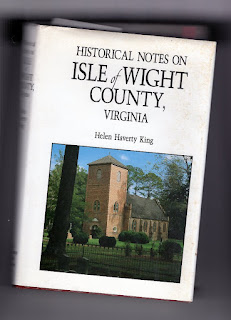
In her famous book on the history of Isle of Wight County, Helen Harverty King wrote the following:

'The county was in desperate circumstances by the end of 1863. The season had been bad, almost the entire slave population was gone, the call came for more recruits for the army, the insecurity of persons and property was made greater by frequent enemy visits and there was a great scarcity of necessities for life on the home front."

 Isaac’s three children with his first wife Malinda Pretlow were Robert, Ada, and Moses, all who have been well documented.  Robert married Cassandra Daughtry, and had 10 children; he stayed in the Isle of Wight area.  Ada  married Jacob Ely, and after she died, Jacob married her half-sister Lucerne Holleman, a daughter of Isaac and Ann.  Moses married first Eugenia Randal/Randolph, and after she died, he married her sister, Ann Eliza Randal/Randolph.

Above on an excursion in Isle of Wight County, Virginia in 2012 are left to right: Tammy Hunt, Cyndi Barnett, Doris Knox, Robert Royal and in the background, Sandi Royal. Tammy is a descendant of Isaac and Malinda; Cyndi, Doris and Sandi all are descendants of Isaac and Ann Gray Holleman. Robert is Sandi’s husband.  They are all standing on Proctor’s Bridge overlooking the Blackwater River, not far from the ancestral farms of the Binfords, Pretlows and Hollemans.

Census records have been fruitful in uncovering Isaac’s story, with one exception.  We cannot find Isaac and family anywhere in the 1870 census that would explain where they moved to after Ft. Monroe.  


Why did they request transportation to Nansemond county, southeast of Isle of Wight, instead of back to Isle of Wight?  

All comes well, though, in the 1880 census and farm schedule, where Isaac, Ann, and family owned a 50-acre farm in the Windsor district of Isle of Wight.  They had a total of 10 children:  Luzerne, Roxanna, or Roxie, Addie Lou, Nonnie James, Isaac Thomas, Sr., Jeremiah, Joseph, Joshua Sr., John H. Sr., and Joanna. 

Recent examination of Isle of Wight land tax records revealed that Isaac paid tax on his farm located 9 miles south of the county courthouse until 1897, and we know that he fathered daughter Joanna, also in 1897.  His land entry was entitled “Holleman, Isaac, estate” in 1898, so we can safely assume he died in 1897 or 1898.  Ann shows on the 1900 census as a farmer, owning her home, and widowed.   Further land tax records continue to refer to the farm as Isaac’s estate.

This story of Isaac Holleman and his remarkable life in Isle of Wight county, Virginia, shows resilience, persistence, and honor in achieving his freedom in ways we find difficult to fathom.  

He survived slavery twice, gained emancipation, survived the Civil War, Reconstruction, and Jim Crow.  Isaac’s proximity to Fort Monroe, Virginia and Isle of Wight, Virginia illustrate the geographical, political, and historical connections of slavery in our Holleman family.

Isaac’s children’s stories continue, with descendants Black and White uncovering and sharing them.  Perhaps we can share them later. -Susan G. White 


Friday, December 31, 2021

The Saga of Isaac and Ann Gray Holleman of Isle of Wight, Part 1

by Susan Gallier White

Susan G. White of Virginia is one of the more scholarly writers of  Holleman/Holliman family history of our generation. What follows is the first article of several of the latest information into the fascinating story of an unlikely 19th Century couple, Isaac and Ann Gray Holleman of Isle of Wight County, Virginia. 

In her research, Susan had consultations with Nonnie Holliman and Sandi Royal, who descend from Isaac and Ann, and Troy Jenkins who descends from Isaac's first wife, Malinda Pretlow.  At this site, earlier articles on Isaac and Ann Holleman were published in September 2012 and May/June 2013 by yours truly.  Mrs. White's work greatly enlarges our knowledge of this American story.

Susan wrote August 2016 at this site of her ‘ahead of their time’ Holleman and Faison ancestral grandmothers.  Susan also attended the Spring 2016 Holliman/Holleman in Isle of Wight and later the Spring 2019 Hollyman ancestral exploration in England. - Glenn N. Holliman


Above, Susan and I converse at our opening session of the May 2019 Hollyman gathering in Moreton in Marsh, England.  Back right is cousin Lindsay Holliman, descended as were all Hollimans present, from 15th Century Cuddington, Buckinghamshire, England.  Lindsay lives in Edenborough, Scotland.

Isaac Holleman, a Black man, owned by Josiah Holleman, was born into slavery in 1818 at Mill Swamp district, Isle of Wight County, Virginia.  Emancipated in 1836, he was enslaved again in 1848 to Richard Urquehart, to help pay Josiah Holleman’s estate debts. 

During the Civil War, he fled with his family, including his White wife Ann Gray to Fortress Monroe, Virginia when it was commanded by Union General Benjamin Butler.  Butler, a career Massachusetts politician, regarded Black runaway slaves as contraband, and refused to return them to their owners.  Contrabands by the tens of thousands experienced freedom wherever Union Armies marched.  

One such family was named Holleman.

The 1830s Holleman house is on the original land purchased in 1684 at Mill Swamp, Isle of Wight County, Virginia by Christopher Hollyman, (1618-1691) founder of most of the Hollimans (various spellings) in the United States. This picture taken in 2016 as Hollemans/Hollimans/etc. gathered from all over the country.  The home is owned by Billy Joe Holleman.

After the war, Isaac requested and was granted transportation for himself and his family to Nansemond County, Virginia, in October 1865. He settled in Isle of Wight County, bought a farm of 35 acres, where he lived with his second wife, Ann Gray.  Isaac’s date of death is unknown. His story is only recently discovered by White Holleman descendants but has been in the oral history of his Black family handed down by generations.

 Freed persons with Union Soldiers at Fortress Monroe during the Civil War.

The distance between Mill Swamp Road, Isle of Wight, Virginia, and Fortress Monroe, Virginia is about 36 miles.  The elapse of time between 1619, when slaves were first brought to Jamestown, Virginia and 1818, when slave Isaac Holleman was born, is almost 200 years.

Holleman ancestors were part of that distance and time span beginning in May 1650, when Christopher Hollyman came to Isle of Wight County, Virginia from Bedfordshire, England.  

Thirty-four years later, at age 66, Christopher patented 1020 acres of land in the Mill Swamp area.  The son of an inn keeper and shoemaker, Mr. Holleman undoubtedly succeeded beyond his wildest dreams.  He died at age 73 and divided his plantation which bordered Surrey County among his four sons. Tobacco barns were recorded in his will but no slaves. 

The slave economy grew slowly in the 1600s, but exports of Africans in bondage exploded in 18th Century Virginia.  It was in the 1700s when most likely the ancestors of Isaac arrived in Virginia.  This tragic plantation economy ironically supported many founders of the new United States – for example, Patrick Henry, Thomas Jefferson, George Washington, James Madison and James Monroe.

Fortress Monroe, Hampton Roads, Virginia in the 19th Century where Confederate President Jefferson Davis was imprisoned in chains after the Civil War.  The Isaac Hollemans at the same fort experienced the opposite – freedom!

Four generations after Christopher’s death, one of his second great grandsons, Josiah Holleman, lived on the patented land, in the northwest corner of Isle of Wight, near Mill Swamp.  

Reflecting the growth of human bondage as a norm, Josiah owned 9 slaves on the 1810 Isle of Wight census; no other information listed.  One year later, he bought Negro woman Harty and Negro girl Levinia in a complicated 3-way transaction.

For decades, the plantation economy built on slavery at Mill Swamp prospered, but eventually farming practices at the time depleted Virginia soil and led to economic destress such as experienced when Josiah Holleman died in debt in 1840s.  This situation would affect the future of Isaac. - Susan G. White

Part II of the Saga of Isaac and Ann Gray Holleman by Susan G. White follows in our next blog.  


Monday, December 1, 2014

Further Exploring Holleman History in Old Virginia (and North Carolina) Part 14

by Glenn N. Holliman


With this post, we continue the series of articles by Allen Holleman of North Carolina, USA who explores the lives of his ancestors.  Readers may have noticed a series of posts for 19th Century Virginia and then the next article, 19th Century England.  Both branches descend from Thomas Holyman, d. 1558 in Cuddington, Buckinghamshire, England. It is interesting to note the differing lives, but perhaps similar occupations of these distant cousins, separated by time and space.

Left, Allen Holleman, family historian and his latest Mustang


Below from Terrine Holleman Woodlief , the GGG-Daughter of Jordan Holleman; she a teacher in Cary, North Carolina (1896-2001). 1 and 2 footnotes


"As kids we would listen, open-mouthed, to the tales Dad told us which his grandfather, Jordan Holleman, told him about the trip from Isle of Wight County, Virginia, the home of Jordan's father, Jesse Holleman.  They cut trees, for there were no roads in 1815 to where they wanted to go.    Trees and mud were a pest most of the way to Wake County, where Jordan settled on farmland in what is now Apex (North Carolina).  He and then his son, Wiley Wilkins Holleman, became a stabilizing part of the community.  They helped found Salem Baptist Church in 1840 and started a Masonic group."

Allen Holleman writes Part 1 of his Story of Jordan Holleman, his 4th great uncle....


Terrine's great-great-grandaddy may have embellished the tales a bit as there were certainly roads to, in and through Wake County as folks had been moving there for years from Virginia.  But they might have needed to clear a path or two.  I have found that Uncle Jordan (he was a 4th Great-Uncle of mine) was a bit of a character and we'll see he had quite a sense of humor.

Jordan Holleman, (22 November 1782 - 1875), was the 3rd Great-Grandson of 
Christopher Hollyman (1618-1691) who arrived in Virginia in 1650, settled in Isle of Wight County and amassed a farm of 1020 acres.  Jordan’s father was Jesse Holleman (1737-1824), the patriarch of our Wake County, North Carolina lines, though he never left Virginia.

As with all of Jesse’s sons, Jordan had a basic education, could read and write and knew some math, as well.  And certainly had experience in farming.

JORDAN HOLLEMAN, PLANTER

We find him in the 1810 census at 28, with his own farm in Isle of Wight County, VA. (IOW).  This would seem to be a larger farm than a young man could acquire; perhaps Jordan was running the family farm.  Though divided by inheritances, the farm was part of the original 1020 acres patented by Christopher Hollyman (d 1691).  This portion had passed to Jordan's father, Jesse.  However, the Census has parents, Jesse and Charity, living some distance away.

Jordan seems to have liked having lots of folks around him as the 1810 census shows him head of household with another male 16-25, two females 16-25, seven other “free white” and two slaves. We cannot account for the others with any certainty as only the head of house was named before 1850. More than likely they were relatives - cousins perhaps as they were listed as part of the household.  His younger brother, Jonathan, and bride of one year were listed two houses/farms away.   The other seven free persons would likely be field-hands living on the farm.3

We have not found the marriage record but that census leads us to think he and Mary Simmons (1790-1850), known as Polly of Southampton County, had married before the 1810 census, accounting for the other young woman  They then began their own family. In November 1812 Wyatt Jack Holleman (1812-1892) was born in the year of a major event in our country's history –  The War of 1812.

The War of 1812


Jordan Holleman had been serving as a sergeant in the 29th Regiment of the Virginia Militia, known as Ballard's Regiment under the commander, Major Joseph W. Ballard. His company commander was Capt. Simmons Gwaltney.   In January 1813, the 29th came under the command of the US Army, but an April 1813 poll in IOW, indicates they were not deployed, and remained at home as reserves with farms and families to protect from the evil Brits. 

Capt. Simmons Gwaltney (1765-1820) was married to Jordan's sister, Sarah (1776-1823) and also in the company were Jordan's brothers: Lt. Josiah Holleman (1771-1848), the 2nd in command and Corporal Jonathan Holleman (1787-1854).   Along with them were several other Gwaltneys and Cofers, Dews, Delks, Stringfield, Crocker, Gray, names we know and are related to some of them, a Who's Who of Isle of Wight County, Virginia. 

The British warship,  HMS Plantagenet, a 74 gun frigate, for several months lay off the "Rocks"5  in the James River.  Her very presence and occasional changing of position kept the 29th busy watching her movements.  It must be presumed that this ship was to intercept any vessels sailing from the James.

In June 1813 the British attempted a landing, and were soundly beaten back by the accurate and well-placed fire from the excellent riflemen of the 29th who had almost been born with a rifle and developed great accuracy in hunting. With the aborted landing at the "Rocks" the Royal Navy re-learned a lesson from the Revolution about how good the Americans were with firearms.  Although the Plantagenet remained at her station, they never made another attempt at a landing. 6

After the war, in 1815 Jordan and Mary decided to follow his older brothers, John and Jesse (Jr.) to North Carolina and first settled in western Wake County near them.  This was close to Chatham County, and land must have been less costly there as they bought additional properties across the line on the New Hope River. 7
Jordan's first property in Wake County seems to have been purchased from the estate of Stephen Mann in 1815.  Over the years there are records of him buying and selling properties in Wake and Chatham, some involved his older brother John, as well.  It seems they were partners in the land business.

  One 1818 deed says,  “Jordan HOLLEMAN of Chatham Co to Archibald Haralson of Orange County, for seven hundred and fifty cents, tract on the waters of New Hope, adj. .. containing 168 acres”.  I have found a copy of that deed and it does look like 'seven hundred and fifty cents but there is a tick on the left edge where I suspect the clerk added a '$' as he left off the word 'dollars', but that was not clear on the copy.

He did sell 54 acres in Chatham Co. for $216 in 1819 that was likely his youngest brother Jonathan’s first property in North Carolina.  That was prime land on a stream for irrigation, at $4.00 an acre. - Allen Holleman

Part 2 to be continued...on the story of Jordan Holleman

Footnotes
1 (From: HISTORY OF WAKE COUNTY, NC, 1983, pg.373: Elizabeth Murray Reid) 
2The Masonic Lodge that Jordan helped found would have been the Western Sun Lodge, that existed from 1817 to 1827 at New Hill.  Jordan's oldest son, Wyatt J. Holleman, helped to found the Cary Masonic Lodge about 25 years later and served as Grand master for over 10 years and his son, Joel was Secretary .  He was also part of the founding of the Town of Cary - if a city of 150,000, that stretches from Raleigh on the east side to a portion in Chatham County to the west can be called a town, as it is even today.  
3 Of Jordan’s older brothers were two whom we know nothing of besides birthdate and probably died young,  Josiah was living in Smithfield, VA in public service and his family was with him.  The two eldest, John and Jesse, Jr. were already in North Carolina.
4  Mary Simmons was the daughter of Sprately Simmons (1740-1800) and Ann Drewry.  He was a Sergeant in the 15th Virginia Regiment active in the American Revolution and was at Valley Forge in 1778.
5 The "Rocks" refers to a shore lined with natural marl, made up of petrified oyster shells.
6From a history of IoW by Col. W. M. Morrison   
7Which in the 1970's, for flood control and water supply, was dammed where it joined the Cape Fear River to become Jordan Lake.  

More in a later Posting on an amazing episode in the life of Jordan Holleman....  

Have questions about Holliman family history? You are invited to join the Hollyman Email List at Hollyman-Subscribe@yahoogroups.com and the Hollyman Family Facebook Page located on Facebook at "Hollyman Family". Post your questions and perhaps one of the dozens Holyman cousins on the list will have an answer. For more information contact Tina Peddie at desabla1@yahoo.com, the list and Facebook manager for Hollyman (and all our various spellings!).

There is also a massive Ancestry.com Holyman and Associated Families Tree available for review.  For an invitation to this collection of over 20,000 individuals, please write glennhistory@gmail.com.  

I also have a collection of associated family manuscripts and research collected by the late Walt Holliman, Cecil Holliman and Rhodes Holliman.  Happy to send these materials by email and to insure their research is available.  The surnames: Alexander, Baldwin, Barham, Bass, Beall, Blakeney,  Baker, Bond, Bostick, Brewer, Bryan, Bryant, Bullock, Calvert, Carter, Champion, Chew,Cofer, Cole, Crafford, Crockett, Curtis, Dale, Daniel, Davidson, Davies, De Mallpas, Douglas, Duckett, Edwards, Edgerton, Emerson, Fitzhugh, Fowlehurst, Fox, Gains, Garrison, Gonson, Graves, Gray, Guyton, Guins, Hall, Hamby, Hawkins,Hendrix, Hill, Hogg, Holliman, Holt, Howard, Jackson, Jones, Judkins, Love, Lucas, Maget, Mansfield, Manwaring, McBee, McComas, McCurdy, McNewsome, Nicholson, Norsworthy, Noyall, O'dell, Oliver, Pearce, Peerce, Pettigrew, Petway, Pitman, Plow, Plyler, Porten, Prather, Petite, Ridgely, Riggan, Roberts, Smith, Spencer, Sprigg, Standley, Stanyard, Swan, Strother, Thompson, Thornton, Thrope, Trelawney, Turpin, Underhill, Underwood, Wallace, Walters, Weedon, Whitherspoon, Whitten,Williams,Wilmot,Wilson, Whitaker and Yerby.  These are mainly Alabama families and their ancestors from the Carolinas and Virginia. Materials vary from one page to 200. - GNH at glennhistory@gmail.com.


Saturday, May 3, 2014

Exploring further Holleman History in Old Virginia, Part 12

by Glenn N. Holliman

Note in previous articles, I have written of Josiah Holleman and his sons, Joel and Wilson who lived in 19th Century Isle of Wight County, Virginia.  In this posting, Allen Holleman of North Carolina writes of Jesse Holleman, the father and grandfather of the before noted Hollemans.  Allen's lineage is profiled in our October 4, 2012 article in the Archives of this blog. Take a look at Allen's blue convertible! GNH


Jesse Holleman, a Man Among Men 
by descendant Allen Holleman (photograph below)
 
Jesse Holleman (1735 ca - 1825) is a great grandson of Christopher Holyman (1618-1691), the patriarch of most of the Hollyman (various spellings) clans in America.  Christopher, Sr. arrived in Jamestown in 1650, and fathered Christopher, Jr. who parented John Holleman, the father of Jesse Holleman of this article.  All lived in Isle of Wight County, VA and had extensive land holdings in this Tidewater area of southeast Virginia. 

We don't know much about Jesse's early life other than he was born about 1735-37. His mother was named Elizabeth but we know less about her except that she was named as heir and executrix of John's will dated and applied in 1751 when John died. 

Below a Google photograph of the Holleman Farm at Mill Swamp today.  Approximately 100 acres remain of the original 1,020 acres Christopher Holyman, Sr. patented in 1684.  The Mill Swamp Cemetery land and possibly the land for the Mill Swamp Baptist Church, adjacent to the Cemetery, were donated by the Holleman family.  The Holleman House and remaining farm are located on the left center of this picture on Highway 621.


Jesse inherited 200 acres beside the Mill Swamp as a teenager, and it is safe to say he began farming the land as he grew into manhood.  He was educated well enough to read and write as he signed his name, not using an 'X'.  Also in his later professions of surveyor and land appraiser, many documents and other written works were necessary.  Even later, as a Baptist minister he needed not only to read and quote the Bible but to deal with the records and documents required.

Jesse acquired other properties and expanded his farming, mainly tobacco which leeches the soils so badly that land could be used only for a few seasons.  He, and later his sons, must have worked the farms themselves as census records show him having only one slave.  Although the slave population grew rapidly in Virginia in the 1700s, Jesse probably could not afford bonded servants in his early years.  Tobacco demands skill to raise, cure and transport, and he may have been able to hire some help among the numerous free blacks in Isle of Wight County.

What was Jesse like, what sort of man was he?  Farming demands dedication and hard work so he would have been self-directed and even driven.  By learning a new profession, he showed determination to succeed and proposer. He surely had high standards for himself and expected no less for his children.  

And they did not disappoint. A son, Josiah, became a member of the House of Delegates and a long time commissioner of Isle of Wight County.  A grandson, Joel Holleman, became a U.S. Congressman and Speaker of the House of Delegates.

The Holleman family was reasonably prosperous and prominent in the area among such neighbors as the Wombles, Gwaltneys, Burwells, Wrenns and Cofers.  And in marrying Charity Cofer (m. ca 1766), Jesse did very well indeed.  He was held in such regard that he was co-executor of her father's will along with her brother and was trusted to value the land and divide it according to the senior Thomas Cofer's wishes.

There are records of Jesse's father, John, being a land appraiser, and one wonders if John might also have been a surveyor.  Jesse had probably learned much from John, even at a young age, as children grew up quite early in colonial times.  Jesse became a highly-regarded surveyor, an exacting science even in that more "primitive" time.  Land appraisal is more of an art, but requires trust in one whose judgement and experience can be relied upon for sale or inheritance purposes.  There was little circulating money, so property and the cash crop tobacco were the basis for wealth.

Jesse and Charity had three daughters: Mary "Polly", Sarah and another whose name is lost to history.  I have read that they had twelve sons but we can only identify seven.  All the boys names started with 'J': John, Josiah, Jesse (Jr.), Jordan and Jonathan we know quite well and some about Jeremiah but nothing about Jeptha.  He might have died at a young age - as possibly others?

And none named James. It was written by early genealogists that  James Grantson Holliman (1750-1836) of North Carolina was a son of Jesse, but Joseph Parker, Maxine Wright, Jeanette Holiman Stewart and Glenn N. Holliman have demonstrated otherwise earlier at this blog site.  Charity would have been only 10-12 years old if she had birthed James Grantson, and she never lived in North Carolina as did he.

Charity was in the 1810 census and died before 1816 when Jesse married a prominent widow, Frances Dews Stringfield, when he was about 70 years old. 

And no, there were no more children, but Jesse took up another profession, that of minister of the oldest Baptist church in Virginia - Mill Swamp Baptist that is still a thriving congregation today.  There was a previous congregation that met at Burleigh Plantation, but this group never had a building per se.  MSBC grew from this first Virginia attempt at organized Baptist worship. When he was in his 80's, Jesse again served the church as minister.  Below, Mill Swamp Baptist Church as it looks in the 21st Century.


And what might seem strange today....Jesse was also a distiller of spirits.  It was common practice to have a toddy before dinner, and Jesse, who evidently had no use for temperance, made apple brandy, his favorite.  It probably helped him live longer and surely made the journey more enjoyable.  My how the Baptists have changed!

Many researchers have stated that Jesse was a patriot in the American Revolution (true) - as a soldier in the army. That part is not accurate.  He would have been about 40 and too old for field service - except maybe as a senior officer and the records would exist for that. 

No, he had a large farm and family to look after as well as his other professions. As all able-bodied men were expected to serve in the local militia, Jesse might have served there, probably along with his teen-aged sons.

 Alas, when the British officer, Banister "Bloody" Tarleton, burned the Isle of Wight courthouse, many of the militia records were lost along with many other documents. (This is why we have lost so much information on our antecedents.)

Jesse did something equally important as being a soldier.  In 1779 he was appointed Surveyor of Roads for Isle of Wight county, building and maintaining roads used by the citizens, militia and army. Unfortunately the area roads were utilized by the British as well, who made excursions into the region burning, pillaging and thieving, before being driven back to their ships by the militia. 

This service is the important basis for a number of DAR and SAR applications - including my own.  Jesse Holleman was truly ‘A Man Among Men’.

Jesse died in December of 1824, and his will was proved with an inventory on January 3, 1825.  It has long been written that he was buried in the Mill Swamp Baptist church cemetery, but that land was not given until later.  It is almost certain that Jesse was laid to rest in the existing cemetery on the Holleman farm, possibly with John, and Christophers Sr. and Jr.  Wooden markers of the time did not last long, and Wilson's is the earliest carved in stone. - Allen Holleman of North Carolina


  I am grateful to Allen for this article, and encourage all who have an ancestral story to send it along so we may share it with others. GNH

Next posting...back to our English Roots, some new research....

Have questions about Holliman family history? You are invited to join the Hollyman Email List at Hollyman-Subscribe@yahoogroups.com and the Hollyman Family Facebook Page located on Facebook at "Hollyman Family". Post your questions and perhaps one of the dozens Holyman cousins on the list will have an answer. For more information contact Tina Peddie at desabla1@yahoo.com, the list and Facebook manager for Hollyman (and all our various spellings!).

Join your many cousins at MyFamily.com and view an expanded Holliman family tree and many files on the history of the family.  Just write to glennhistory@gmail.com for an invitation. Or go to the HOLLYMAN GENEALOGY MyFamily site at http://myfamily.com/group/hollyman. Then click on "Request to Join" in upper righthand corner!