Showing posts with label Susan G. White. Show all posts

Monday, May 30, 2022

Reflections Concerning Isaac Holleman, Part 3

by Glenn N. Holliman

This continues the saga of Isaac Holleman, born in 1818 into slavery at the Josiah Holleman plantation in Mill Swamp, Isle of Wight County, Virginia.  This time line prepared by Susan G. White, direct descendant of Josiah and major historian of the life and times of Isaac Holleman and his wives.  The words in italics are mine, reflecting on the confusion of the Civil War era.- GNH


A picket fence stands before the current house at Stawberry Plains, the original Urquhart plantation in Isle of Wight County, Virginia.

1848    Josiah Holleman died.  Isaac Holleman sold back into slavery for $355 by executor Isaac Cofer, to Richard A. Urquhart, a wealthy slave owner who lived at Strawberry Plains, about 6 miles from Josiah’s home.

            Malinda Pretlow’s father, Moses Pretlow, is on a list of Josiah Holleman’s debts, in Josiah’s handwriting, of being owed $2.76.  Malinda was the mother of Isaac's first three children.

           Moses and Malinda were free; Isaac was enslaved.  The nuances of Virginia society in the antebellum South are fascinating and puncture the 'Gone with the Wind' concept of a static society.  Free African-Americans lived side by side with enslaved persons and European-Americans, some slave owners, others yeoman farmers working the land with family members or hired hands.  

1850       One black male slave, age 30, Richard Urquhart’s slave schedule (believed to Isaac)

1852       Birth of Isaac’s son Robert Holleman, to mother Malinda Pretlow

1854       Birth of daughter Ada, to mother Malinda Pretlow

1858       Birth of son Moses to mother Malinda Pretlow

1860       Richard Urquhart dead.  His widow continued to own slaves.  Census schedule shows 133 slaves, of whom 2 males are ages 45 and 40.  Isaac would be 42 by then.  He would know the domestic slave quarters still standing on Strawberry Plains Farm.

            Census records reveal that Stawberry Plains was the second largest community of enslaved persons in Isle of Wight County prior to the Civil War.  Enslaved plantations of this magnitude were the exception in American slavery.  One can scarcely imagine the sub-cultures within a population of this size.

                Free Negro Malinda Pretlow is listed on the 1860 census, shown a few dwellings down from R. Pretlow.  She lived on Proctor’s Bridge Road, in Southampton County, west of Proctor’s Bridge.

           During the Civil War, Fortress Monroe located on the north side of the James River, some miles east of Isle of Wight County, became a haven for 'contrabands', former enslaved persons who escaped to the freedom of the Union Army.  One of these persons was Isaac.  There is a mystery here because his three children of Malinda Pretlow, all born free, either went with him or joined him at Fortress Monroe.  At some point in the Civil War, Malinda, who lived long after the war, and Isaac separated.  Isaac must have met Ann Gray during the confusion of this turbulent period and made her his second wife while at Fortress Monroe.


1866       Freedman’s Bureau records show Isaac petitioning for money October 1866 to return home to Nansemond County, along with Ann Gray Holleman, Robert, Ada, and Moses Holleman, to “escape destitution.”  He also petitions for money due his son Robert for work son did for Mrs. Binford, who lived just west of Proctor’s Bridge in Southampton County.

            Nonnie Holliman and Sandi Royal, descendents of Isaac and Ann Gray at the Stawberry Plains farm March 2022 where their ancestor worked and from which he escaped to freedom during the Civil War.                                                               

 1867       Birth of daughter Luzerne.  Mother is Ann (Gray) Holleman

 1870       Malinda Pretlow listed on Southampton County 1870 census.

1871       January 1.  Isaac and Ann buy farm from Nathaniel P. Phillips, made payment of $50.  Farm previously owned by Cary Eley. This farm located a few miles south of Windsor.

1873       November 11.  Isaac pays remainder of farm money, 194.01, to Phillips’ executor, John R. Kilby, and receives deed to the 50-acre farm.

1876       Birth of son Nonnie

1878       Birth of son Jeremiah

1879       Birth of son Joshua

1880       Isaac, Ann, and children on census

Census farm schedule identified Isaac’s farm and its assets

1881       Birth of son Joseph, who died in infancy, about age 1 yr

1883       Birth of son Joshua

1885       Birth of son John Henry, Sr.

1888       Birth of daughter Joanna

1889       Dec. 23 document of Isaac and Ann paying $50 to trustee George T. Atkins, presumably for a debt to neighbor Richard F. Eley.  Debt was satisfied.

1890       U. S.  census burned.  No records.

1897       Last time Isaac paid taxes on farm.

1898       Farm then in name of “Holleman, Isaac, estate”.

1900       Wife Ann on census, with children living with her.  She owned her own home/farm. The date of her death is unknown.  Both Isaac and Ann are buried on the farm, now in unmarked graves.  The property has been part of the Norfolk Southern Railroad since the 1950s.

So here we have the incrediable, tragic, heroic story of Isaac Holleman who born a slave, freed, taken back into bondage, escaped to freedom, became a land owner during Reconstruction, raised children from two wives and whose descendents today are scattered across the USA.   

Abraham Lincoln in his Gettysburg Address spoke of a 'new birth of freedom' in America.  Isaac perservered in conditions and circumstances unimaginable today.  He bears the name Holleman.  And all, descendants and those of the same surname, salute him for his courage and steadfastness in adversity.  - GNH


Saturday, April 30, 2022

Reflections Concerning Isaac Holleman, Part 2

 by Glenn N. Holliman

This reflection continues our exploration into the life and times of Isaac and Ann Gray Holleman, a biracial couple who challenged the strict norms and laws of post Civil War Virginia.  In my previous article I acknowledged and do so again the serious research by Susan G. White, a descendant of Josiah Holleman (1771-1848), who has discovered new facts about this amazing story.  

Susan has prepared a valuable timeline of the events in the life of Isaac.  With this information, I have integrated photographs from a visit of Isaac descendants and several of us in the lineage of Christopher Hollyman (1618-1691), the ancestor of most Hollimans (various spellings) in the United States.  

The parents of Isaac are not known.  At least one Federal census records him as of a mixed race.  Was his mother an African American held in bondage and his father, a man, perhaps a slave owner?  DNA tests have not yet provided us that information.  As early as the 1680s, Virginia law forbade sexual relations between those enslaved and White persons.  As historical and DNA records show, numerous White males through the generations ignored this restriction.

Timeline for Isaac Henry Holleman (1818-1897 ca) by Susan G. White, Hollyman Family Historian

1810       Josiah Holleman owned 9 enslaved people

1811       He bought 2 more, woman Harty and girl Lavinia

1818      Birthdate of Isaac Henry Holleman, according to Freedman’s Bureau record

1820       Josiah Holleman owned 15 enslaved persons, including 9 males

Isaac was born on the original property purchased by Christopher Hollyman in 1684, land that remains in the Holleman family to this day.  The current owner, Billy Joe Holleman, opened wide this ancestral property to a large gathering of Hollemans in 2016 and again he graciously welcomed our group in March 2022.  Josiah Holleman was a 4th great grandson of Christopher's.  One of Josiah's sons, Joel, served as a U.S. Congressman.

Left to right, Tammy Hunt, Susan White, Billy Joe Holleman and Isle of Wight historian, Jim Henderson, on the Holleman farm near the Mill Swamp Baptist Church in IOW county.  This stop one of several on March 12, 2022.  


1823      Malinda Pretlow born, Free Person of Color, daughter of Free Black parents             

1830      Josiah owned 14 enslaved persons, including 8 males, 3 ages 10-23

The Holleman House constructed in the 1830s by Josiah Holleman on original land of Christopher Hollyman (1618-1691). It is not unrealistic to imagine young Isaac Holleman had a hand in constructing this federal period structure.     

 1836       Isaac, age 18, emancipated, via Josiah’s petition to the court.  

1840       Josiah’s census listing shows 1 male Free Person of Color, age 10-23, 1 female Free Person of Color under 10, and 8 enslaved beings.   

1848      Josiah died with many debts.  Isaac sold back into slavery for $355 by executor Isaac Cofer, to    Richard A. Urquhart, a very wealthy plantation owner who lived at Strawberry Plains,  8 miles from Josiah’s home.  Malinda’s father, Moses Pretlow, is on list of Josiah   Holleman’s  debts, in Josiah’s handwriting, of being owed $2.76. 

            Fear and Stress in Pre-Civil War Society

            A decade before Josiah's death, the 1831 Nat Turner slave rebellion occurred in nearby Southampton County resulting in the death of any many as 55 persons.  This incident terrorized the White south as it fulfilled the greatest fear of slave owners!  Night patrols of anxious local authorities road at night insured no enslaved persons stirred from their homes without permission.

            A generation prior to the Civil War, the tobacco economy of Virginia suffered as the soil worked in earlier generations was exhausted of nutrients.  Josiah's indebtedness at death is a vivid example of the increasing economic challenges of Virginia enslavement plantations to be profitable.  Nearby Richmond had become a slave trading mecca where tens of thousands of human beings were sold at auction.  

            In many. many cases persons were separated from their families and homes and literally in chains marched hundreds of miles to the newer, soil rich plantations in Alabama and Mississippi. This nefarious system shattered the unity of African-America families, their security and fragile culture.  The ramifications of this evil institution ricochet through American society to this day.        

          Questions and Thoughts to be Considered

                                                   Nonnie Holliman and Sandi Royal

            On our way back to Richmond, Susan White, Sandi Royal, Nonnie Holliman and I speculated  on several issues in this story.  As I wrote years ago (click on name of Isaac Holleman in left column), pre-Civil War IOW of Wight County was an uneasy, largely agrarian, society of slave plantations, yeoman White farmers with no persons held in bondage and numerous Free Persons of Color. 

         1. Why, when Isaac received emancipation in 1836, he was again enslaved by 1848 and sold to pay Josiah's estate debts?  Had Isaac, who as a Free Person of Color with very limited civil rights after legal emancipation, violated a law, a slave code of the time, and as punishment forced back into to bondage?  There are cases of this happening.

            2. We noted Josiah owed money at his death to Moses Pretlow, a free person and father of Malinda, Isaac's first wife.  There then was some integrity in a system that recognized contract law even with free African-Americans who navigated a precarious legal and societal existence.

            3. Moses was the father of Malinda Pretlow, who 'jumped the broomstick' with Isaac and bore him at least three children, perhaps two others.  'Jumping the brook stick' literally was the folk custom of marriage of enslave persons prior to establishing legal rights after the Civil War.   

            Left to right at the Pretlow farm near where Malinda Pretlow lived are Doris Knox and Tammy Hunt, direct descendants from Isaac and his first wife Malinda.  Far right is Nonnie Holliman, descended from Isaac and Ann Gray Holleman.  The empty house in the background was constructed ca 1870 during the Reconstruction Period.

               Malinda lived approximately a mile (as the crow flies) from the Holleman plantation eventually living separately from her father.   This couple had three children before the Civil War which evidently led to their separation. 

At the Pretlow farm, current owners Mary Leatherwood and Adrian West shared an aerial photograph of the property as it looked in the early 20th Century

How did the couple sustain a relationship that resulted in children, separated as they were by some distance and legal status?  At age 30, Isaac had to move to Strawberry Plains, a farming community of over 100 enslaved African-Americans, miles away from Malinda.  Perhaps this doomed the marriage?


Next article more information and yet more questions on this story of 19th Century America, an America that had yet to live into its creed of liberty and justice for all. Only a Civil war would give Isaac and millions of others 'a new birth of freedom.'-GNH


Wednesday, March 23, 2022

Reflections concerning Isaac Holleman, 1818-1898 ca

 by Glenn N. Holliman

Daffodils tell a Story

On March 12, 2022, a Holleman/Holliman family group, all descended from ancestors of Isle of Wight County, Virginia, finished a late lunch in Windsor, Virginia. It had rained 'cats and dogs' that morning but after the sky had emptied several inches of rain, a nasty, windy cold front moved in, and later a wet snow fell.  We were a three, sometimes a four, car convoy visiting Holleman ancestry sites, on a blustery day in late winter.


Above, at an earlier stop before lunch near Windsor.  Susan White, our leader, shivering in blue, Tammy Hunt, Sandi Royal, Kimberly Holliman and her father Paul Holliman listening to a lecture at a century old country store by Jim Henderson (not visible) of the IOW Historical Society.  

Refreshed by a quick meal, our convoy headed east on Old Suffolk Road. The rain eased, although not the wind chill.  We turned south on Tyler Road, drove a half mile or so, stopped at the Tyler Cemetery.  

Here we visited the resting places of the African-American Hollemans, often spelled Holliman, many descendants of Isaac Holleman.  

Isaac Holleman was our reason for this trip.  He had been born a slave into the household of Josiah Holleman of Mill Swamp, IOW, in 1818.  His story has intrigued me since I heard it in 2012 from Sandi Royal, a descendant of Isaac.

Isaac's great grandson, Nonnie Holliman, pictured here visiting his grandfather's resting place, was in our group, as well as others who descended from Isaac.  Nonnie, retired from Federal service,  drove all the way from his home in Syracuse, New York to make this pilgrimage to the town in which he grew up.  

The genealogist who had arranged the trip, Susan White, of Richmond, descendent of Josiah, has gathered in the past year a monumental amount of research on Isaac and his two wives, Malinda Pretlow and Ann Gray

Susan has written the past three blogs on Isaac and his incredible story.  She is an often visitor to the Library of Virginia, the Virginia Baptist Historical Society Library, and the archives of IOW county.  Those of us studying the Hollyman families in Virginia owe her a great debt of gratitude.

Utilizing her research and that of historian Jim Henderson of IOW Historical Society who also accompanied us, I add my own reflections and tip my hat to both of them.

At the Tyler Cemetery, Kimberly Holliman, Sandi Royal, this writer, Tammy Hunt and Doris Knox

The water table in this part of southeast Virginia is close to the surface hence the concrete tablets to secure the grave sites.  

Isaac escaped bondage during to the Civil War and found sanctuary at Fortress Monroe, a Union outpost. There he must have met and married the mysterious Ann Gray.  Destitute after the war and with children from his first wife, Malinda, and now children with Ann, somehow he was able to purchase a 50 acre farm in 1871.  Susan believes he died there before 1899 and his wife, a few years later.  In her research Susan discovered the location of the farm near Tyler Cemetery.

Are this biracial couple buried in Tyler Cemetery?  No, that is not their resting place.  Nonnie, who had spent time on the farm in childhood (it stayed in the Holleman family until 1954), believes the couple is buried on their farm.  

We boarded our automobiles, studied our maps and headed further south along Tyler Road, past the turn off at Dunston Road, and drove a bit further.  The farm had been purchased by the railroad and now the land along Tyler was now brush, trees and shrub.  We could find no entrance into where we knew from the map that the farm had been located.

And then we spotted the daffodils.


Daffodils are not native to North America.  They have to be planted.  According to author Kelly Gamey, who photographs and writes of forsaken southern properties, a clump of isolated daffodils in the spring are 'ghost gardens', bulbs buried in previous decades by former inhabitants of abandoned sites.  You might check out her site at kelly@theforgottensouth.com.

There were no other daffodils along the road.  This had to be the lost entrance to the Isaac and Ann Gray farm.  Somewhere in the bush probably lay the foundations of a home and graves.  But we were not equipped for an exploratory hike in the marshy woodlands that cold afternoon. 

We stopped, took photos, and chilled as we were, called it a day.  I rode with Susan, our driver and historian, and Sandi and Nonnie, all of us returning to Richmond.  We said goodbye to Tammy and Doris of Southampton County.  And also Paul, Teresa and Kimberly Holliman, residents of Williamsburg and alumni of our 2019 Hollyman excursion to England.  They ferried across the James River, coming and going to be with us that day.

On the way back it snowed several inches and the temperature kept dropping.  But our hearts were warmed by what we had seen and heard that day.

And more on the trip in the next blog as we explore further the life and times of Isaac Holleman.....


Wednesday, February 16, 2022

The Saga of Isaac and Ann Gray Holleman, Part 3


The story of the biracial couple of 19th Century Isle of Wight, Virginia continues, written by Susan G. White (pictured right), a family historian known for her research and careful conclusions. We are grateful to her for sharing her insights and gathering information thoughtfully from the ancestors of this courageous couple. - Glenn N. Holliman

Enter Ann Gray, a White woman. Ann has been the subject of much speculation and interest in current-day Holleman researchers.  For generations, Black Hollemans have told of Isaac and Ann’s complicated relationship in their oral history, that Isaac and Ann fled from her angry family in their initial love.  

White Holleman researchers have tried to connect Ann with Gray ancestors who were closely connected with Josiah Holleman, or to other Ann Grays in Isle of Wight, but to no avail.   Sandi Royal, a descendent of Isaac’s son JoshuaDenise Keeter Goff, an excellent Holleman researcher, and I worked hard this past summer of 2021 to track down Ann’s parents.  

Sandi finally summed it up perfectly, “We will probably never know who Ann’s parents were.”  Be that as it may, somehow, Isaac and Ann met and found a life together.

Above, Glenn N. Holliman and Sandi Royal discussing the Isaac and Ann Gray Holleman story in 2012 in Chester, Virginia.

We know of Isaac and Ann’s life first by way of Freedman’s Bureau records.  Isaac petitioned the Freedman’s Bureau in October 1865, from Fort Monroe, Virginia, to request money for him, Ann, and his three children Robert, Ada, and Moses, to return to Nansemond county, Virginia, to “escape destitution.”  

He also requested help from the Bureau that his son Robert Holleman be reimbursed for the money owed to him for working for the “Widow Binford.”  Mrs. Binford and her husband lived one dwelling away from Malinda Pretlow in the 1860 Southampton County census.  Isaac was working to get what he felt he was due after the war, in order to survive.  

We can wonder how it was that Isaac, Ann, and the 3 children ended up at Ft. Monroe?  The fort was under Union control during the Civil War, and commanded by General Benjamin Butler.  

The general famously would not return slaves who had fled to Ft. Monroe to Confederate owners; he called the slaves “contraband of war.”  Large numbers of slaves found the destination of Ft. Monroe to be sanctuary, and we can guess that Isaac and family were no different. 

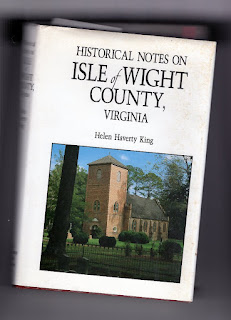
In her famous book on the history of Isle of Wight County, Helen Harverty King wrote the following:

'The county was in desperate circumstances by the end of 1863. The season had been bad, almost the entire slave population was gone, the call came for more recruits for the army, the insecurity of persons and property was made greater by frequent enemy visits and there was a great scarcity of necessities for life on the home front."

 Isaac’s three children with his first wife Malinda Pretlow were Robert, Ada, and Moses, all who have been well documented.  Robert married Cassandra Daughtry, and had 10 children; he stayed in the Isle of Wight area.  Ada  married Jacob Ely, and after she died, Jacob married her half-sister Lucerne Holleman, a daughter of Isaac and Ann.  Moses married first Eugenia Randal/Randolph, and after she died, he married her sister, Ann Eliza Randal/Randolph.

Above on an excursion in Isle of Wight County, Virginia in 2012 are left to right: Tammy Hunt, Cyndi Barnett, Doris Knox, Robert Royal and in the background, Sandi Royal. Tammy is a descendant of Isaac and Malinda; Cyndi, Doris and Sandi all are descendants of Isaac and Ann Gray Holleman. Robert is Sandi’s husband.  They are all standing on Proctor’s Bridge overlooking the Blackwater River, not far from the ancestral farms of the Binfords, Pretlows and Hollemans.

Census records have been fruitful in uncovering Isaac’s story, with one exception.  We cannot find Isaac and family anywhere in the 1870 census that would explain where they moved to after Ft. Monroe.  


Why did they request transportation to Nansemond county, southeast of Isle of Wight, instead of back to Isle of Wight?  

All comes well, though, in the 1880 census and farm schedule, where Isaac, Ann, and family owned a 50-acre farm in the Windsor district of Isle of Wight.  They had a total of 10 children:  Luzerne, Roxanna, or Roxie, Addie Lou, Nonnie James, Isaac Thomas, Sr., Jeremiah, Joseph, Joshua Sr., John H. Sr., and Joanna. 

Recent examination of Isle of Wight land tax records revealed that Isaac paid tax on his farm located 9 miles south of the county courthouse until 1897, and we know that he fathered daughter Joanna, also in 1897.  His land entry was entitled “Holleman, Isaac, estate” in 1898, so we can safely assume he died in 1897 or 1898.  Ann shows on the 1900 census as a farmer, owning her home, and widowed.   Further land tax records continue to refer to the farm as Isaac’s estate.

This story of Isaac Holleman and his remarkable life in Isle of Wight county, Virginia, shows resilience, persistence, and honor in achieving his freedom in ways we find difficult to fathom.  

He survived slavery twice, gained emancipation, survived the Civil War, Reconstruction, and Jim Crow.  Isaac’s proximity to Fort Monroe, Virginia and Isle of Wight, Virginia illustrate the geographical, political, and historical connections of slavery in our Holleman family.

Isaac’s children’s stories continue, with descendants Black and White uncovering and sharing them.  Perhaps we can share them later. -Susan G. White 


Friday, December 31, 2021

The Saga of Isaac and Ann Gray Holleman of Isle of Wight, Part 1

by Susan Gallier White

Susan G. White of Virginia is one of the more scholarly writers of  Holleman/Holliman family history of our generation. What follows is the first article of several of the latest information into the fascinating story of an unlikely 19th Century couple, Isaac and Ann Gray Holleman of Isle of Wight County, Virginia. 

In her research, Susan had consultations with Nonnie Holliman and Sandi Royal, who descend from Isaac and Ann, and Troy Jenkins who descends from Isaac's first wife, Malinda Pretlow.  At this site, earlier articles on Isaac and Ann Holleman were published in September 2012 and May/June 2013 by yours truly.  Mrs. White's work greatly enlarges our knowledge of this American story.

Susan wrote August 2016 at this site of her ‘ahead of their time’ Holleman and Faison ancestral grandmothers.  Susan also attended the Spring 2016 Holliman/Holleman in Isle of Wight and later the Spring 2019 Hollyman ancestral exploration in England. - Glenn N. Holliman


Above, Susan and I converse at our opening session of the May 2019 Hollyman gathering in Moreton in Marsh, England.  Back right is cousin Lindsay Holliman, descended as were all Hollimans present, from 15th Century Cuddington, Buckinghamshire, England.  Lindsay lives in Edenborough, Scotland.

Isaac Holleman, a Black man, owned by Josiah Holleman, was born into slavery in 1818 at Mill Swamp district, Isle of Wight County, Virginia.  Emancipated in 1836, he was enslaved again in 1848 to Richard Urquehart, to help pay Josiah Holleman’s estate debts. 

During the Civil War, he fled with his family, including his White wife Ann Gray to Fortress Monroe, Virginia when it was commanded by Union General Benjamin Butler.  Butler, a career Massachusetts politician, regarded Black runaway slaves as contraband, and refused to return them to their owners.  Contrabands by the tens of thousands experienced freedom wherever Union Armies marched.  

One such family was named Holleman.

The 1830s Holleman house is on the original land purchased in 1684 at Mill Swamp, Isle of Wight County, Virginia by Christopher Hollyman, (1618-1691) founder of most of the Hollimans (various spellings) in the United States. This picture taken in 2016 as Hollemans/Hollimans/etc. gathered from all over the country.  The home is owned by Billy Joe Holleman.

After the war, Isaac requested and was granted transportation for himself and his family to Nansemond County, Virginia, in October 1865. He settled in Isle of Wight County, bought a farm of 35 acres, where he lived with his second wife, Ann Gray.  Isaac’s date of death is unknown. His story is only recently discovered by White Holleman descendants but has been in the oral history of his Black family handed down by generations.

 Freed persons with Union Soldiers at Fortress Monroe during the Civil War.

The distance between Mill Swamp Road, Isle of Wight, Virginia, and Fortress Monroe, Virginia is about 36 miles.  The elapse of time between 1619, when slaves were first brought to Jamestown, Virginia and 1818, when slave Isaac Holleman was born, is almost 200 years.

Holleman ancestors were part of that distance and time span beginning in May 1650, when Christopher Hollyman came to Isle of Wight County, Virginia from Bedfordshire, England.  

Thirty-four years later, at age 66, Christopher patented 1020 acres of land in the Mill Swamp area.  The son of an inn keeper and shoemaker, Mr. Holleman undoubtedly succeeded beyond his wildest dreams.  He died at age 73 and divided his plantation which bordered Surrey County among his four sons. Tobacco barns were recorded in his will but no slaves. 

The slave economy grew slowly in the 1600s, but exports of Africans in bondage exploded in 18th Century Virginia.  It was in the 1700s when most likely the ancestors of Isaac arrived in Virginia.  This tragic plantation economy ironically supported many founders of the new United States – for example, Patrick Henry, Thomas Jefferson, George Washington, James Madison and James Monroe.

Fortress Monroe, Hampton Roads, Virginia in the 19th Century where Confederate President Jefferson Davis was imprisoned in chains after the Civil War.  The Isaac Hollemans at the same fort experienced the opposite – freedom!

Four generations after Christopher’s death, one of his second great grandsons, Josiah Holleman, lived on the patented land, in the northwest corner of Isle of Wight, near Mill Swamp.  

Reflecting the growth of human bondage as a norm, Josiah owned 9 slaves on the 1810 Isle of Wight census; no other information listed.  One year later, he bought Negro woman Harty and Negro girl Levinia in a complicated 3-way transaction.

For decades, the plantation economy built on slavery at Mill Swamp prospered, but eventually farming practices at the time depleted Virginia soil and led to economic destress such as experienced when Josiah Holleman died in debt in 1840s.  This situation would affect the future of Isaac. - Susan G. White

Part II of the Saga of Isaac and Ann Gray Holleman by Susan G. White follows in our next blog.  


Monday, July 8, 2019

The Hollyman English Ancestry Quest 2019, Part 5

by Glenn N. Holliman

Our travelogue of Hollyman ancestral sites continues....

Our Third Stop – The Swan Hotel

Bedford, Bedfordshire
May 18, 2019


On Saturday, May 18th after visiting the former St. Mary’s church and the location of Thomas and his son Christopher’s home, we crossed back north over the River Ouse, observing the sculling boat as we walked to the historic Swan Hotel for lunch.


The above photo of the Swan Hotel, constructed in 1794, shows in the lower left corner a statue of a soldier from the Boer War, 1899-1902.  The hotel fronts the River Ouse.

A wedding reception was going on at one end of the restaurant, but we found tables and began chatting about what we had seen already.  Here are photographs of the lunch and some of our cousins, but not all, who were on the trip with us.  My apologies for the omissions as the camera failed to 'snap' everyone.


Allen Holleman of Raleigh, North Carolina shared a meal with new found cousins and friends, Di and Rod Holliman of Cheltenham, England.  Allen coordinated our 2016 Hollyman gathering in Isle of Wight, Virginia.


Right, Glenn Joiner, of Winter Garden, Florida, a descendant of Uriah Holliman, 1820-1862, of Alabama. To Glenn's left is Jim Holliman of Marion Junction, Alabama, a retired Auburn professor and cattleman.  Both these cousins share James Grantson Holliman, 1750-1836, as a common great grandfather.


Far left, cousin Mary Lippo from New Jersey joined a table of Texas cousins. Clockwise behind Mary is Marcia Holliman of San Antonio, Texas, founder of the city’s ballet company and Rob and Mary Ann Holliman Fenske also from Texas.  The young man is Marshall Cocke, formally of Oklahoma and now of San Antonio.  He is a grandson of Marcia.


Children and grandchildren of genealogist Walter O. Holliman, a descendant of James Grantson Holliman, shared a table.  Above, left to right, Paul and Teresa Holliman and their daughter Kimberly, from the Los Angeles area.  Far right is Ann Holliman Krueger, an international teacher now resident in Sicily. 

Below beginning left clockwise, Elisabeth Ahrens, Alison Marlowe, Matthew and Bryan Holliman (obscured).   In the back ground is a wedding reception.  Cousins on the right identified in the former photograph.


Above foreground is Dr. Jim Holliman and wife Karen of Hershey, Pennsylvania.  Jim is the son and grandson of genealogists Dr. Rhodes B. and Cecil Rhodes Holliman.  Background is Susan G. White (in a white sweater) and her friend Diane Gilkenson, traveling together exploring Gallier and Holliman ancestral venues.  The stories of Susan’s dynamic ancestral Virginia grandmothers have been published in the blog: http://hollimanfamilyhistory.blogspot.com. 


Just to prove I was along on the trip, I include a picture of my sister, Becky of Tennessee, and moi from Newport, Pennsylvania.  Our father was Homer Bishop Holliman (1919-2018). He descended in order from Ulyss, John Thomas, Uriah, Cornelius, James Grantson, Samuel, Richard and finally Christopher (1618-1691) and his father Thomas of Sherington and Bedford.

Let’s close with a photograph of the English swans (all owned by the Queen) swimming in the River Ouse under a Horse Chestnut tree in bloom.


Next Article, we venture further back in time to Sherington, Buckingshire to learn more about Thomas and his father, the first Christopher Hollyman!


Wednesday, June 19, 2019

The Hollyman English Ancestry Quest 2019, Part 4


by Glenn N. Holliman

Our Second Stop – St. Mary’s Parish,
Now the Albion Archaeology Centre

Bedford, Bedfordshire
May 18, 2019

Thomas Hollyman, most likely born in the early 1580s, grew up in a wealthy home in Sherington, Buckinghamshire, some 10 or so miles from his adult home of Bedford.  The second son (of a third son), he inherited 40 pounds but no land, when his father died in 1589.  His parents were Christopher and Margaret Lee Hollyman of families from Cuddington and Dinton, Buckinghamshire.


Did his inheritance eventually fund an apprenticeship in Bedford?  We know from Anne Holmes’ research that Thomas worked as a cordwainer or leather maker before he took a lease-hold on the Blue Boar Inn, on Cauldwell Street, several hundred yards to the west of St. Mary’s Church.  Later his son-in-law, Barnabas Crash, seems to have gone into business with him.

As a cordwainer, he must have fashioned shoes, leather garments and harnesses for horses.   Undoubtedly his second son, Christopher, was exposed to this occupation, and perhaps supported himself as a leather worker when he arrived in Jamestown, Virginia in 1650. 

Below, Elisabeth Krueger Ahrens and her mother, Anne Holliman Krueger, daughter of Walter O. Holliman (1927-2003) who did so much to research and capture the stories of the Holliman and allied families in the USA.  Both Elisabeth and Anne are international teachers.

The files in this photograph's background are of archaeological investigations in the Bedfordshire area, research often required before new construction in the United Kingdom.  This picture was taken in the interior of St. Mary's Parish which held its last service in 1975 and in 1991 became a research centre.  


Did Thomas curse his fate? 

The nephews and nieces of his mother, Margaret Lee Hollyman, were on the rise socially and financially.  Margaret’s brother, one Thomas Lee, married Eleanor Hampden who inherited Hartwell House, now a National Trust property which I will write about later.  

The Lees were rising and the Hollymans declining. Thomas Lee died a knight in 1626.  Our Thomas Hollyman, Lee's nephew, mended shoes and served ale at a Bedford Inn.  

One can imagine the envy felt by Thomas.  Unlike he, one of his sisters, Ursala, inherited well from her grandmother of the same name, Ursala Yates Lee.


 Above, Anne Holmes inside St. Mary’s Church, now an archaeological office, discussing the history of the building while the Albion manager, center, looks on as does Jim Holliman, right, of Alabama. 

Did his mother Margaret help support Thomas and get him started as an inn keeper in Bedford?  We do not know.

What impact did the English Civil War, which began in 1642 and did not end until 1652, have on the family?  Did our Christopher (1618-1691) serve in the Parliamentary forces which were supported by the Hampden family? 

Bedford citizenry were generally pro-Parliament and Anti-Royalist.  Young John Bunyan, a Bedford resident, and later a charismatic preacher and author of ‘Pilgrims Progress’, served in the Cromwellian forces. Christopher’s younger brother, Steve, later associated with Bunyan's Meeting House services.

Or did Christopher join the King’s army? 

We know the priest at St. Mary’s, Dr. Giles Thorne, from 1630 to 1671, was arrested by Parliament and jailed for four years in 1640s.  This royalist was accused of ill vices such as maypole dancing and praying for the King!  St. Mary’s was the Hollyman family’s parish.  

Also Christopher’s grandfather, an earlier Christopher Hollyman (d 1589) served as a member of Queen Elizabeth’s Guard, an elite royalist honor probably obtained through Lee family connections.

The interior of St. Mary's in 1851, now lined with files and books, but the monuments and stained glass windows remain.

What we do know is our Christopher along with his spinster sister, Judith, left Bedford in early 1650 and arrived in Virginia in May 1650.  Did they flee the chaos of civil war?  Had Christopher fought on the losing side, as King Charles I was beheaded in January 1649? Had his father, Thomas, died and why leave an elderly mother (age 60 or so) to cross the ocean?

The Birth and Grave Sites of Christopher Hollyman, 1618-1691, have now been Visited by Descendants

In April 2016 at the Hollyman gathering in Isle of Wight, Virginia, Billy Joe Holleman, owner of some of the original plantation of Christopher (d 1691) took our group to what is believed to be the original burial plot of the Hollymans of Virginia.  There we assembled and asked ourselves, is this the final resting spot of the immigrant who left England in 1650 and with his sister Judith braved the Atlantic and settled in the New World founding our American family?

Below Susan White, center, in April 2016 with Holleman cousins at the possible grave of Christopher Hollyman (1618-1691) in Isle of Wight, Virginia.  This site, cleared for us by Billy Joe Holleman, is part of the original plantation of Christopher.


 And below three years later, the same Susan White, left, talking with Dr. Jim Holliman, Di Holliman (back to camera) and Tony Pryce, English friend and guide at the burial site of Thomas and Helena Hollyman, Christopher Hollyman’s parents, and one block from where Christopher was born in 1618 in Bedford, Bedfordshire.


 This picture, taken in May 2019, represents an odyssey of discovery taken full circle from the birthplace in England to grave site in Virginia of the ancestor who dared to come to America and founded our family in the New World.


Next blog, a lunch break at the historic Swan Hotel in Bedford.