Showing posts with label Glenn Holliman. Show all posts

Monday, April 7, 2025

Honoring Sacrifices, Dreams you nurtured, and the Love you bestowed upon our Lineage.


Honoring Those Who Came Before Us, Isaac and Ann Grey Holleman

by Susan White, Holleman Genealogists and Historian

Editor's note, this is the climax of the Isaac and Ann Grey Holleman story which first surfaced in this blog when your editor shared lunch with Sandi Royal in 2013.  Descendants of  Josiah Holleman of Isle of Wight County, Virgina, both African-American and European American, have been jointly researching this American story for over a decade.  On Saturday, March 1, 2025, Isaac Holleman descendants visited the site of Isaac's farm, one mile south of the town of Windsor, Virginia, off Route 608. Susan White explains how the story unfolded. - Glenn N. Holliman

 Family

Our white Holleman ancestors in Isle of Wight, Virginia, enslaved people.  We don’t know if that practice started with Christopher Holleman (Holliman, Hollyman), our first immigrant, but it could have.  Christopher grew tobacco, a labor- intensive crop, and must have needed helpers for his harvest.  My fifth great grandfather, Josiah Holleman, (1771-1848) enslaved at least eleven Black men, women, and children during his lifetime, including Isaac Holleman (1818-abt 1898), the main subject of my family genealogical research for years.  He fathered Isaac, and at least one other Black man, James (1825-unk) with an enslaved Black woman. Isaac’s story was shared in public at a presentation sponsored by the Isle of Wight Historical Society on June 22, 2024 at the Georgie Tyler Middle School, Windsor, Virginia. 

Isaac’s descendants, have been enlarging this story that continues to broaden.  Glenn Holliman first mentioned Isaac in his 27 June 2013 blog post where he spoke of Sandi Royal’s research and retelling of family lore, that Isaac “ran off with Ann Gray, a white woman,” whose family was against the relationship.  Sandi spoke of a picture of a “white woman” that hung in her family’s house for years.  I learned of this story in 2016, from Glenn, at a Smithfield, Virginia Holleman family reunion.

 Glenn N. Holliman and Susan White at a 2016 Isle of Wight conference. 

At that time, I had just begun to research my own connection with Josiah Holleman, who was my fifth great grandfather.  One of his sons, William Henry Holleman (1795-1834), was my own Holleman ancestor, and he was an enslaver, as well.  Identifying the relationships between my Holleman enslavers and enslaved people around Isle of Wight county in the eighteenth and nineteenth centuries has been and continues to be difficult. We discovered some of the truth of Ann Gray, however, and where she came from, most likely Nansemond County, VA.  Sandi Royal, my daughter Lea Marshall, my brother, Eddie Gallier and I have used the tools of DNA, paper records, National Archives aerial photography, and sometimes pure dumb luck to dig into this story.                

Isaac fathered children first with Malinda Pretlow, a free Black woman, and then with his wife, Ann Gray.  Descendants from both unions have connected over the past few years to learn more about their roots.

Sandra Royal 


                                                               Nonnie L. Holliman


Kenya Allmond


The Family Farm in Windsor                       

 After their escape from enslavement during the Civil War, Isaac and Ann Holleman bought a 50 acre farm in 1871, about a mile south of the town of Windsor, Virginia.  This was no small feat.  They owned their farm, did not sharecrop, and the farm stayed in the family until 1963, when  James Trueheart Holliman, a grandson of Isaac, sold the farm to W. T. Joyner.  It was sold one more time before the Norfolk and Western Railroad bought it in the early 1990’s.   

The 1880 agricultural schedule reveals his livestock and crops and the effort Isaac was expending to provide for his family:

1 horse, 1 mule, 1 working ox, 1milch cow and calf, 9 swine and 13 poultry

100 bushels of corn, 20 bushels of sweet potatoes, 50 bushels of apples, 50 bushels of peaches.

He cut 60 cords of wood the year previous.

About 2023, in one of those lovely serendipities of genealogical research, Jim Henderson of the Isle of Wight County Historical Society discovered an old file on his computer that another Society member must have shared with him at some point along the way. The file was a part of an environmental impact study undertaken by William and Mary Archaeological Department for the Norfolk and Western railroad (now Norfolk Southern Railway) as it was buying the farm from the Joyner family.  Another stroke of good fortune was that the archaeologists met Reverend Arthur Holleman, a great-grandson of Isaac, who knew the farm when it was in the family, and enlisted his help to identify what they were finding in their labors. 

 To read the report is to marvel at what Isaac Holleman accomplished.  Unfortunately, as time passed, the farm became lost to the descendants who lived in the area.  No one living knew exactly where it was.  On two different occasions, a group of Hollemans attempted to find it using the maps in the Norfolk and Western study, but we were not very good at reading the many-times-copied maps.  The third try was successful, and luck was with us again. 

In November, 2023, as the county farmers were harvesting their cotton crops, we discovered the dirt road off of Route 608 in Isle of Wight, and the chain across it was down.  We were able to drive down the rutted road and found the farm.  About 8 bales of cotton were stored at the edge of the field, waiting to be taken to the cotton gin.  Jim and I got out of the car and began to walk the field of cotton stubble.  It was a beautiful day and we were very excited.  Jim wondered who farmed the field?  Maybe we could find out?  

It was late in the day, but Jim thought we should drive over to the cotton gin facility, to see what we could find out.  Luck prevailed again.  The owner of the gin gave us a name of possible farmer, and I called him.  He was not the one in this case, but he gave us the name of who he thought might be our man, and Success!  Mike Griffin was the farmer who still leases this land from Norfolk Southern Railway.  He has been farming the field since about 1995.  

                                                     Susan White and Lea Marshall

In January, 2024, my daughter Lea and her husband, Will Kerner, visited the farm, this time hoping to obtain more pictures.  Will has a drone camera, and he was able that day to take aerial pictures.  It was a cold, dreary day, and this time the chain at the entrance to the dirt road was in place and locked.  We had to walk the long, muddy road to come to the field, rather than driving.


Courtesy of William Kerner, this photograph shows a dirt road separating the field of standing water (left) from the green field in the upper center of the photograph.  Windsor is the white border upper right. 

Jim Henderson has encouraged us consistently for several years in uncovering Isaac Holleman’s story.  In 2024, he invited us to present what we were learning to the Isle of Wight Historical Society.  Our group, in particular, Sandi Royal and Nonnie Holliman, who are both Isaac descendants, agreed.  My daughter, Lea, my brother, Eddie Gallier, and Glenn Holliman were also eager to share the story.   


 Eddie Gallier (pictured) is an avid modeler, particularly in constructing model train layouts.  The man has skills.  I asked if he would help us to create a model of Isaac’s farm.  He agreed, and in 2023, in order to learn more about the farm, he contacted the U. S.  National Archives to inquire about U. S. Department of Agriculture aerial mapping.  Thanks to the generosity of several family members, Eddie obtained the 1930’s-1950’s aerial photos of the Holleman farm from the Archives. 


1938 aerial view of farm with structures in the middle of the picture.

He also had the N and W study in which to refer. Eddie then created the farm layout in a HO model railroad gauge showing the house, barn, outbuildings, well, smokehouse, the family graveyard and the orchard.  He photographed them all, so they could be included in our presentation.
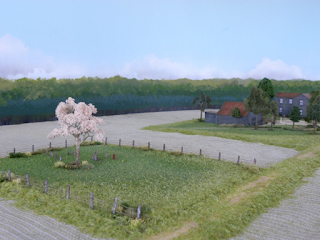

                                                        Model of farm by Eddie Gallier

 On June 22, 2024, as part of Isle of Wight Historical Society’s Juneteenth observation, we told “The Extraordinary Life of Isaac H. Holleman” at Georgie Tyler Middle School.  About eighty people attended, many of them descendants of Isaac, Malinda, and Ann. 

Season and Weather

Our research group has visited various Holleman related sites in Isle of Wight over the past 3 to 4 years.  One day was in March, bitter cold and snowy. Then a couple of summer days where I got chigger bites in the Tyler Cemetery. Then another beautiful late fall day, and a dreary, depressing January day.  Doing so, however, revealed another layer in Isaac’s life.  He had encountered all kinds of these days during his life in Isle of Wight.  We were fortunate to encounter them, also.

Now we know where the farm is and can visit, but because the Holleman farm is an actively cultivated field, we visit with full knowledge of season and weather and respect the farmer's work. We can visit from early December until mid-March.  We have trudged through mud and crop stubble, as Isaac and his family did.  This spring we rescheduled twice a trip due to snow. 

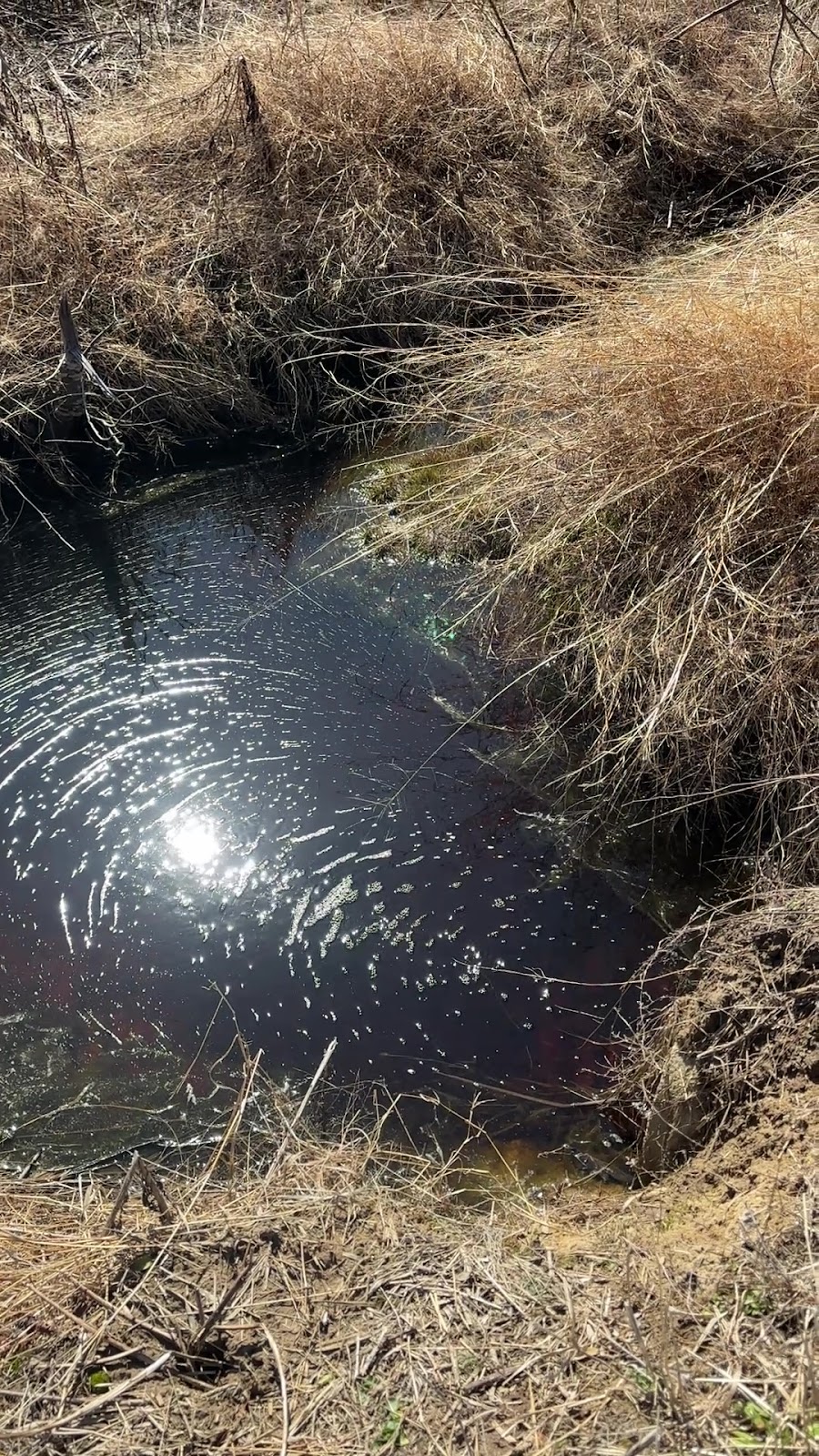
This past March we finally made it on a warm, early spring day, occasionally windy, but not uncomfortable.  As we crossed the swampy area at the entrance of the field, we heard frogs.  We heard the headwaters of Ely Swamp gurgle.  You could hear the wind.  Below muddy fields and swampy bogs.                                                 

Prior to our trip, my brother had helped me load coordinates into my phone Google map, of the family graveyard, the  house, barn, and the orchard.                               
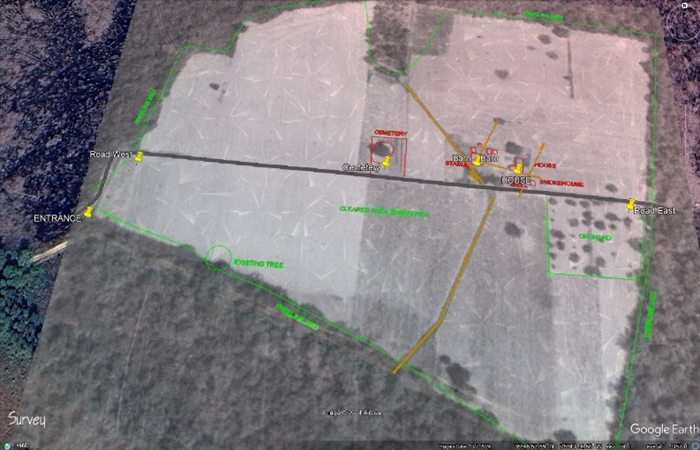
 

 We made our way across the field, hammered stakes into those sites. We stopped at the graveyard site and prayed a prayer that Nonnie Holliman had written for us.


Right to left: Nashawn Holliman, Alexander Holliman, Kenya Allmond, friend of Kenya, Sandi Royal

A Prayer of Remembrance for Ancestors at the Holliman Farm, March 2025

Dear God and Ancestors,

We gather in reverence and gratitude, remembering your spirit, your wisdom, and your strength. Your journey through life laid the foundation upon which we stand, and your legacy continues to guide us with every step we take. We honor your sacrifices, the dreams you nurtured, and the love you bestowed upon our lineage. Your stories, though sometimes untold, are woven into the fabric of our existence, and we cherish the lessons they impart. May we always strive to live in a way that makes you proud, carrying forward your virtues and values. As we reflect on your lives, we seek your guidance and protection. Help us to face our challenges with the same courage you displayed, and to celebrate our triumphs with the same joy you felt. May we be ever mindful of the paths you forged, and may our actions today honor your memory. In moments of doubt, may we feel your presence, and in times of celebration, may we sense your joy. Your spirits dwell within us, a constant reminder of the enduring bond we share. We are eternally grateful for the roots you have planted and the legacy you have left behind.

With deep respect and love, we remember you. Amen.

By Reverend/Superintendent Nonnie L. Holliman, Great Grandson of Isaac and Ann

 That day we could be where Isaac and his family lived and died.  It was a very good day.

Wednesday, March 23, 2022

Reflections concerning Isaac Holleman, 1818-1898 ca

 by Glenn N. Holliman

Daffodils tell a Story

On March 12, 2022, a Holleman/Holliman family group, all descended from ancestors of Isle of Wight County, Virginia, finished a late lunch in Windsor, Virginia. It had rained 'cats and dogs' that morning but after the sky had emptied several inches of rain, a nasty, windy cold front moved in, and later a wet snow fell.  We were a three, sometimes a four, car convoy visiting Holleman ancestry sites, on a blustery day in late winter.


Above, at an earlier stop before lunch near Windsor.  Susan White, our leader, shivering in blue, Tammy Hunt, Sandi Royal, Kimberly Holliman and her father Paul Holliman listening to a lecture at a century old country store by Jim Henderson (not visible) of the IOW Historical Society.  

Refreshed by a quick meal, our convoy headed east on Old Suffolk Road. The rain eased, although not the wind chill.  We turned south on Tyler Road, drove a half mile or so, stopped at the Tyler Cemetery.  

Here we visited the resting places of the African-American Hollemans, often spelled Holliman, many descendants of Isaac Holleman.  

Isaac Holleman was our reason for this trip.  He had been born a slave into the household of Josiah Holleman of Mill Swamp, IOW, in 1818.  His story has intrigued me since I heard it in 2012 from Sandi Royal, a descendant of Isaac.

Isaac's great grandson, Nonnie Holliman, pictured here visiting his grandfather's resting place, was in our group, as well as others who descended from Isaac.  Nonnie, retired from Federal service,  drove all the way from his home in Syracuse, New York to make this pilgrimage to the town in which he grew up.  

The genealogist who had arranged the trip, Susan White, of Richmond, descendent of Josiah, has gathered in the past year a monumental amount of research on Isaac and his two wives, Malinda Pretlow and Ann Gray. 

Susan has written the past three blogs on Isaac and his incredible story.  She is an often visitor to the Library of Virginia, the Virginia Baptist Historical Society Library, and the archives of IOW county.  Those of us studying the Hollyman families in Virginia owe her a great debt of gratitude.

Utilizing her research and that of historian Jim Henderson of IOW Historical Society who also accompanied us, I add my own reflections and tip my hat to both of them.

At the Tyler Cemetery, Kimberly Holliman, Sandi Royal, this writer, Tammy Hunt and Doris Knox

The water table in this part of southeast Virginia is close to the surface hence the concrete tablets to secure the grave sites.  

Isaac escaped bondage during to the Civil War and found sanctuary at Fortress Monroe, a Union outpost. There he must have met and married the mysterious Ann Gray.  Destitute after the war and with children from his first wife, Malinda, and now children with Ann, somehow he was able to purchase a 50 acre farm in 1871.  Susan believes he died there before 1899 and his wife, a few years later.  In her research Susan discovered the location of the farm near Tyler Cemetery.

Are this biracial couple buried in Tyler Cemetery?  No, that is not their resting place.  Nonnie, who had spent time on the farm in childhood (it stayed in the Holleman family until 1954), believes the couple is buried on their farm.  

We boarded our automobiles, studied our maps and headed further south along Tyler Road, past the turn off at Dunston Road, and drove a bit further.  The farm had been purchased by the railroad and now the land along Tyler was now brush, trees and shrub.  We could find no entrance into where we knew from the map that the farm had been located.

And then we spotted the daffodils.


Daffodils are not native to North America.  They have to be planted.  According to author Kelly Gamey, who photographs and writes of forsaken southern properties, a clump of isolated daffodils in the spring are 'ghost gardens', bulbs buried in previous decades by former inhabitants of abandoned sites.  You might check out her site at kelly@theforgottensouth.com.

There were no other daffodils along the road.  This had to be the lost entrance to the Isaac and Ann Gray farm.  Somewhere in the bush probably lay the foundations of a home and graves.  But we were not equipped for an exploratory hike in the marshy woodlands that cold afternoon. 

We stopped, took photos, and chilled as we were, called it a day.  I rode with Susan, our driver and historian, and Sandi and Nonnie, all of us returning to Richmond.  We said goodbye to Tammy and Doris of Southampton County.  And also Paul, Teresa and Kimberly Holliman, residents of Williamsburg and alumni of our 2019 Hollyman excursion to England.  They ferried across the James River, coming and going to be with us that day.

On the way back it snowed several inches and the temperature kept dropping.  But our hearts were warmed by what we had seen and heard that day.

And more on the trip in the next blog as we explore further the life and times of Isaac Holleman.....


Wednesday, February 16, 2022

The Saga of Isaac and Ann Gray Holleman, Part 3


The story of the biracial couple of 19th Century Isle of Wight, Virginia continues, written by Susan G. White (pictured right), a family historian known for her research and careful conclusions. We are grateful to her for sharing her insights and gathering information thoughtfully from the ancestors of this courageous couple. - Glenn N. Holliman

Enter Ann Gray, a White woman. Ann has been the subject of much speculation and interest in current-day Holleman researchers.  For generations, Black Hollemans have told of Isaac and Ann’s complicated relationship in their oral history, that Isaac and Ann fled from her angry family in their initial love.  

White Holleman researchers have tried to connect Ann with Gray ancestors who were closely connected with Josiah Holleman, or to other Ann Grays in Isle of Wight, but to no avail.   Sandi Royal, a descendent of Isaac’s son Joshua, Denise Keeter Goff, an excellent Holleman researcher, and I worked hard this past summer of 2021 to track down Ann’s parents.  

Sandi finally summed it up perfectly, “We will probably never know who Ann’s parents were.”  Be that as it may, somehow, Isaac and Ann met and found a life together.

Above, Glenn N. Holliman and Sandi Royal discussing the Isaac and Ann Gray Holleman story in 2012 in Chester, Virginia.

We know of Isaac and Ann’s life first by way of Freedman’s Bureau records.  Isaac petitioned the Freedman’s Bureau in October 1865, from Fort Monroe, Virginia, to request money for him, Ann, and his three children Robert, Ada, and Moses, to return to Nansemond county, Virginia, to “escape destitution.”  

He also requested help from the Bureau that his son Robert Holleman be reimbursed for the money owed to him for working for the “Widow Binford.”  Mrs. Binford and her husband lived one dwelling away from Malinda Pretlow in the 1860 Southampton County census.  Isaac was working to get what he felt he was due after the war, in order to survive.  

We can wonder how it was that Isaac, Ann, and the 3 children ended up at Ft. Monroe?  The fort was under Union control during the Civil War, and commanded by General Benjamin Butler.  

The general famously would not return slaves who had fled to Ft. Monroe to Confederate owners; he called the slaves “contraband of war.”  Large numbers of slaves found the destination of Ft. Monroe to be sanctuary, and we can guess that Isaac and family were no different. 

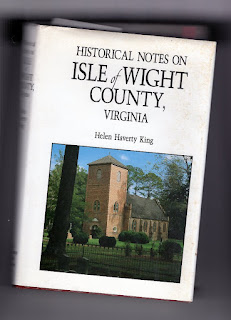
In her famous book on the history of Isle of Wight County, Helen Harverty King wrote the following:

'The county was in desperate circumstances by the end of 1863. The season had been bad, almost the entire slave population was gone, the call came for more recruits for the army, the insecurity of persons and property was made greater by frequent enemy visits and there was a great scarcity of necessities for life on the home front."

 Isaac’s three children with his first wife Malinda Pretlow were Robert, Ada, and Moses, all who have been well documented.  Robert married Cassandra Daughtry, and had 10 children; he stayed in the Isle of Wight area.  Ada  married Jacob Ely, and after she died, Jacob married her half-sister Lucerne Holleman, a daughter of Isaac and Ann.  Moses married first Eugenia Randal/Randolph, and after she died, he married her sister, Ann Eliza Randal/Randolph.

Above on an excursion in Isle of Wight County, Virginia in 2012 are left to right: Tammy Hunt, Cyndi Barnett, Doris Knox, Robert Royal and in the background, Sandi Royal. Tammy is a descendant of Isaac and Malinda; Cyndi, Doris and Sandi all are descendants of Isaac and Ann Gray Holleman. Robert is Sandi’s husband.  They are all standing on Proctor’s Bridge overlooking the Blackwater River, not far from the ancestral farms of the Binfords, Pretlows and Hollemans.

Census records have been fruitful in uncovering Isaac’s story, with one exception.  We cannot find Isaac and family anywhere in the 1870 census that would explain where they moved to after Ft. Monroe.  


Why did they request transportation to Nansemond county, southeast of Isle of Wight, instead of back to Isle of Wight?  

All comes well, though, in the 1880 census and farm schedule, where Isaac, Ann, and family owned a 50-acre farm in the Windsor district of Isle of Wight.  They had a total of 10 children:  Luzerne, Roxanna, or Roxie, Addie Lou, Nonnie James, Isaac Thomas, Sr., Jeremiah, Joseph, Joshua Sr., John H. Sr., and Joanna. 

Recent examination of Isle of Wight land tax records revealed that Isaac paid tax on his farm located 9 miles south of the county courthouse until 1897, and we know that he fathered daughter Joanna, also in 1897.  His land entry was entitled “Holleman, Isaac, estate” in 1898, so we can safely assume he died in 1897 or 1898.  Ann shows on the 1900 census as a farmer, owning her home, and widowed.   Further land tax records continue to refer to the farm as Isaac’s estate.

This story of Isaac Holleman and his remarkable life in Isle of Wight county, Virginia, shows resilience, persistence, and honor in achieving his freedom in ways we find difficult to fathom.  

He survived slavery twice, gained emancipation, survived the Civil War, Reconstruction, and Jim Crow.  Isaac’s proximity to Fort Monroe, Virginia and Isle of Wight, Virginia illustrate the geographical, political, and historical connections of slavery in our Holleman family.

Isaac’s children’s stories continue, with descendants Black and White uncovering and sharing them.  Perhaps we can share them later. -Susan G. White 


Friday, December 31, 2021

The Saga of Isaac and Ann Gray Holleman of Isle of Wight, Part 1

by Susan Gallier White

Susan G. White of Virginia is one of the more scholarly writers of  Holleman/Holliman family history of our generation. What follows is the first article of several of the latest information into the fascinating story of an unlikely 19th Century couple, Isaac and Ann Gray Holleman of Isle of Wight County, Virginia. 

In her research, Susan had consultations with Nonnie Holliman and Sandi Royal, who descend from Isaac and Ann, and Troy Jenkins who descends from Isaac's first wife, Malinda Pretlow.  At this site, earlier articles on Isaac and Ann Holleman were published in September 2012 and May/June 2013 by yours truly.  Mrs. White's work greatly enlarges our knowledge of this American story.

Susan wrote August 2016 at this site of her ‘ahead of their time’ Holleman and Faison ancestral grandmothers.  Susan also attended the Spring 2016 Holliman/Holleman in Isle of Wight and later the Spring 2019 Hollyman ancestral exploration in England. - Glenn N. Holliman


Above, Susan and I converse at our opening session of the May 2019 Hollyman gathering in Moreton in Marsh, England.  Back right is cousin Lindsay Holliman, descended as were all Hollimans present, from 15th Century Cuddington, Buckinghamshire, England.  Lindsay lives in Edenborough, Scotland.

Isaac Holleman, a Black man, owned by Josiah Holleman, was born into slavery in 1818 at Mill Swamp district, Isle of Wight County, Virginia.  Emancipated in 1836, he was enslaved again in 1848 to Richard Urquehart, to help pay Josiah Holleman’s estate debts. 

During the Civil War, he fled with his family, including his White wife Ann Gray to Fortress Monroe, Virginia when it was commanded by Union General Benjamin Butler.  Butler, a career Massachusetts politician, regarded Black runaway slaves as contraband, and refused to return them to their owners.  Contrabands by the tens of thousands experienced freedom wherever Union Armies marched.  

One such family was named Holleman.

The 1830s Holleman house is on the original land purchased in 1684 at Mill Swamp, Isle of Wight County, Virginia by Christopher Hollyman, (1618-1691) founder of most of the Hollimans (various spellings) in the United States. This picture taken in 2016 as Hollemans/Hollimans/etc. gathered from all over the country.  The home is owned by Billy Joe Holleman.

After the war, Isaac requested and was granted transportation for himself and his family to Nansemond County, Virginia, in October 1865. He settled in Isle of Wight County, bought a farm of 35 acres, where he lived with his second wife, Ann Gray.  Isaac’s date of death is unknown. His story is only recently discovered by White Holleman descendants but has been in the oral history of his Black family handed down by generations.

 Freed persons with Union Soldiers at Fortress Monroe during the Civil War.

The distance between Mill Swamp Road, Isle of Wight, Virginia, and Fortress Monroe, Virginia is about 36 miles.  The elapse of time between 1619, when slaves were first brought to Jamestown, Virginia and 1818, when slave Isaac Holleman was born, is almost 200 years.

Holleman ancestors were part of that distance and time span beginning in May 1650, when Christopher Hollyman came to Isle of Wight County, Virginia from Bedfordshire, England.  

Thirty-four years later, at age 66, Christopher patented 1020 acres of land in the Mill Swamp area.  The son of an inn keeper and shoemaker, Mr. Holleman undoubtedly succeeded beyond his wildest dreams.  He died at age 73 and divided his plantation which bordered Surrey County among his four sons. Tobacco barns were recorded in his will but no slaves. 

The slave economy grew slowly in the 1600s, but exports of Africans in bondage exploded in 18th Century Virginia.  It was in the 1700s when most likely the ancestors of Isaac arrived in Virginia.  This tragic plantation economy ironically supported many founders of the new United States – for example, Patrick Henry, Thomas Jefferson, George Washington, James Madison and James Monroe.

Fortress Monroe, Hampton Roads, Virginia in the 19th Century where Confederate President Jefferson Davis was imprisoned in chains after the Civil War.  The Isaac Hollemans at the same fort experienced the opposite – freedom!

Four generations after Christopher’s death, one of his second great grandsons, Josiah Holleman, lived on the patented land, in the northwest corner of Isle of Wight, near Mill Swamp.  

Reflecting the growth of human bondage as a norm, Josiah owned 9 slaves on the 1810 Isle of Wight census; no other information listed.  One year later, he bought Negro woman Harty and Negro girl Levinia in a complicated 3-way transaction.

For decades, the plantation economy built on slavery at Mill Swamp prospered, but eventually farming practices at the time depleted Virginia soil and led to economic destress such as experienced when Josiah Holleman died in debt in 1840s.  This situation would affect the future of Isaac. - Susan G. White

Part II of the Saga of Isaac and Ann Gray Holleman by Susan G. White follows in our next blog.  


Thursday, November 7, 2019

Fifty Years Ago Revisted, Part 4

by Grace A. Holliman 

A Reflection after the Visit

 There is a picture of my father standing near an ammunition box in front of his living quarters in Vietnam with one of the ladies who kept the offices clean.  Growing in the ammunition box on the far right are marigolds. The marigolds were planted by a tall, thin young soldier named Leo who left Vietnam before his one-year tour was over due to the death of his father. 


Below, a close up of Leo's marigolds.  They bloomed from October 1969 to at least late January 1970 when Dad returned home.   My father watered these marigolds after Leo’s departure, thus keeping alive a fragment of growth and beauty in an area devastated by gunfire, rockets and Agent Orange.  


Fifty years later, on sunny day in late August 2019, I witnessed a reunion. These two men, brought together briefly in a foreign country by forces beyond their control, reunited once again in a small town in Iowa. 

In human life, fifty years is a long time. It is a long time to suffer or to thrive. I believe it is human nature to experience both. One might assume that my dad’s reunion with Leo was spent reliving their time together in Vietnam, but that’s not what happened. 

Instead, they talked about all that had occurred since Vietnam. I discovered that both my father and Leo had been schoolteachers. They pursued hobbies and were active participants in their communities. Leo is an amazing cook (my dad is an amazing eater!) and we enjoyed pasta salad, fresh tomatoes and Iowa corn for lunch. 
The tears and hugs between my Dad and Leo were not due to sadness or grief from the past.


Right, Leo, Tom and Grace in the garden.

Their emotions appeared to be expressing appreciation - appreciation for the fifty years of life that was now behind them, appreciation for having had the time to contribute knowledge, beauty and kindness to the world and for not allowing the tragedy of war and the trauma of untimely deaths to have hindered their ability to experience lives of fulfillment.

I believe Leo and Dad shed tears of gratitude, knowing that so many did not have the chance to reunite as they did, fifty years after the war. - GAH

Wednesday, November 6, 2019

Fifty Years Ago Revisited, Part 3

by Glenn N. Holliman

The Visit 

Soon Leo and I were swapping stories and catching up on our respective histories.  Tom elaborated on their shared hobby of collecting antiques and how they both ended up moonlighting in fine arts auctions. Daughter Grace listened politely taking in every word, probably thinking about what she would share with her grandchildren someday.  

Both Leo and Tom had long careers in education teaching English and social studies.  We had much to share exchanging stories and what we had learned from life. 

Tragically, only six weeks after his father’s death in 1969, Leo’s mother died of cancer.  Leo, not unsurprisingly, had to cope with the bitterness of time lost in the last year of their lives.... like soldiers of every war, Leo had his sacrifices.


As evening approached we moved to the garden. The white vino disappeared and soon another bottle was opened!  Conversation flowed as easily as the wine.

Right, Tom and Leo.

Grace presented Leo and Tom one of her hand made all natural candles that they could light for Christmas.  My wife Barb had prepared a framed 1969 picture of Leo (below) and me in our jungle uniforms posing on the steps to brigade chaplain's office, our quarters.


Well, that triggered the tears as a couple of old fellas stared back at a faded color representation of ourselves as very youthful soldiers in a time and place now very far away. 

In right back ground is an ammunition box with marigolds sprouting out of it.  Leo took some flower seeds from home and planted them in Asian soil.  There they took root, and started blooming.  Sadly a few weeks later Leo was called home for his Father's funeral.  After he left, the marigolds continued to grow and flower bringing a bit of cheer to homesick G.I.s.

That evening we lingered over dinner.  Leo had prepared elegantly wrapped gifts for us - a exquisite Nippon bowl for Grace and a pair of European crystal colored wine glasses for Barb and me.  All made it safely home including a one hundred year old miniature souvenir scotch bottle.

 
Right, Leo in 1969 prepared a late night snack over two watering cans.  Note the Big Red One patch on his sleeve.  The uniform is of that era.


Below,  He set the table for another dinner in 2019 in Iowa.  Tom and Grace in the kitchen prepared the meal.  The decor is no longer Army green but one that reflects a passion for the decorative arts.


The next morning, Leo and Tom took a walk and Grace a mile or so run through the town.  Already an early chill swept over the Great Plains.


After a long brunch, we adjourned again to the garden gradually moving to a lingering goodbye for it was time for us to go.  Leo and I had our pictures taken by his marigolds just as we had decades ago.


All of us hugged as we said goodbye, family to family, Leo and I experiencing something of a time gone but etched in our souls as long as we shall live.

As Grace and I slowly drove away, some thing flashed through my mind, that venerable refrain that old soldiers never die, they just fade away.  Overly sentimental yes, but a telling reminder that days are always growing fewer.

It had been good, very good to visit with Leo Wiley and learn of his long and useful life in service to his community.  Thanks Leo and Tom for our chance to rediscover yesterday and find comfort in today.

Next blog, some reflections from Grace

Sunday, November 3, 2019

Fifty Years Ago Revisited, Part 2

by Glenn N. Holliman

The Arrival

So two generations have come and gone since my plane went wheels up at Long Binh, Vietnam on January 31, 1970.  Wheels down in August 2019 on this trip was a landing in Minneapolis where my daughter Grace was there from Virginia to meet me.  We caught a Twins baseball game and the next morning drove our rental car south.  Minnesota has lakes, 10,000 according to their license plates.  We passed a lot of them and plus huge fields of corn and soy beans.

Daughter Grace Holliman, born four years after I returned from Vietnam war. One of our favorite pass times - watching professional baseball.


We noticed Minnesota’s largest candy store (probably the world's hugest!).  The parking lot, several football field sizes, overflowed with cars.  Later an ethanol plant and a kitchen counter factory slipped by.  And more corn fields and lots of silos.  Obviously, we had arrived in a major food belt of America.

We motored our last few miles to see Leo Wiley and his long time friend, Tom.  Their town is tiny, largely devoid of people under the age of 50.  Grace lowered the mean age but I immediately sent the statistic soaring in the opposite direction.  It had been 50 years or say 600 months since my time in the Army.


Leo and Tom’s beautiful 'Arts and Craft' style home (pictured above)  sits literally at the end of town. Their lawn, immaculate and dazzling with flowers in well designed beds, borders (I am not exaggerating) miles and miles or rather thousands of acres of corn and soy beans.  The next morning I stood in the middle of the street and spied on the horizon a dozen or so farm silos. If green is your favorite color, Iowa in August is for you!


Oh yes, one could also stand in the middle of the street for almost as long as one would desire to do so.  A car might come by every hour or it might not.  


The sheriff did mosey by once AND waved.  That would not happen back east!  It was a nice feeling.

Although later it did dawn on me that someone might have reported another senior citizen in town with out-of-state license plates that probably needed checking out.  But I really don’t think so. 

As we drove up Leo and Tom's house, both came out and greeted us.  Leo and I hugged and  shed a tear or two.  I think I said something silly like we should get together every fifty years, and he quickly agreed.


Below in August 2019, a half century since Viet Nam service.  


He is still thin, tall, and like me a little stooped but he essentially looks the same. However, I have changed considerably, mostly around the middle.   I would have recognized Leo anywhere.

Grace and Tom took pictures.    It was great to see Leo Wiley and meet Tom (in the orange shirt), both retired school teachers.  We went inside and started talking and talking and listening and listening.


Next blog the Visit!