Showing posts with label Fayette County. Show all posts

Friday, June 14, 2024

Where did James Grantson Holliman Live? (1750-1836)

 by Glenn N. Holliman and Sally Campbell

Background

James Grantson Holliman’s great-grandfather, Christopher Hollyman (1618-1691), gave up his home in Bedfordshire, England, and sailed the dangerous Atlantic with his sister, Judith.  They arrived in Jamestown, Virginia in 1650.  Judith married and disappeared from history.  Chris farmed, married, and, by his death, had accumulated over 1,000 acres in Isle of Wight County.

Christopher divided his land among his four sons.  One of them, Richard, chose to stay in the area and expanded his share of the family's legacy by acquiring land in Surry County.  His son, Samuel Holliman (1707-1789), inherited his grandfather’s adventurous spirit and relocated to Edgemore County, North Carolina.  Years later, possibly due to the depletion of his land from years of tobacco farming, Samuel moved again, this time to Johnston County, North Carolina. 

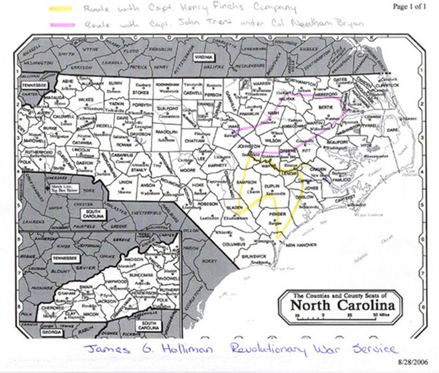
This map was passed along to this writer by the late Rhodes Holliman, Ph.D. It shows in yellow and purple markings where James Grantson Holliman performed his militia service during the American Revolution when he lived in Johnston County, North Carolina. For a copy of his pension application, one may visit Hollyman Tree (Holyman Heritage Group) at Ancestry.com or www.bholliman.com, a virtual archive of associated family materials.
Either in Edgemore or Johnston County, James Gantson Holliman came into this world in 1750 and died in 1836. After service in the North Carolina Militia during the American Revolution, he followed in his ancestors' footsteps and moved to newer, richer farmland. 

James purchased property in what is now Union County, North Carolina, and Lancaster County, South Carolina. There, he prospered. His sons Charles, Warren, and Cornelius married, but like their father, other ancestors and tens of thousands of young Americans, continued the westward movement. Their destination was Fayette County, Alabama. Warren would move on to Arkansas after a few years in Alabama.

Cornelius received a free land grant for his service in the War of 1812.  Perhaps the other brothers migrated in order to establish larger, more productive farms.  Sally reminds us that in order to move family, stock, tools and supplies in a wagon train, migrants had to have a certain amount of cash or trade goods. One did not start a new farm and house penniless.  The people left behind were either financially established, impoverished, or elderly like James Grantson Holliman. His daughters did not move to Alabama.  They stayed in the Carolinas most probably to care for their father in his final months.

New Research

Sally Campbell, a descendant of James Grantson Holliman, has searched land records and traveled the countryside of Lancaster, SC and Union, NC counties to discover precisely where he farmed and raised his family. James owned properties on both sides of the state borders, which confused his descendants as to whether they were South or North Carolinians. 

He took an oath in Anson County (now Union County) for his Revolutionary War service.  In his 80s, it appears that James had a disability, and he went to Monroe (Courthouse), NC, rather than Lancaster (Courthouse), SC, because there were fewer creeks to cross by cart and horse. Does this research clarify the location of his legal residence?  Perhaps his descendants can claim citizenship from either state!

 Sally’s research reveals:

 1. James owned property along Lynches Creek, the boundary between Lancaster and Chesterfield, South Carolina counties.  Anson County, North Carolina, was divided later, and James' property was in what is now Union County.

 2. James also owned land in South Carolina adjacent to Paul Plyler at the fork of Wild Cat Creek, on the south side of Great Lynches Creek, and on the south side of Pole Cat Creek.

 3.  Paul Plyler, a major property owner, had possession of South Carolina land on both sides of Otter Creek and Little Otter, a branch of Lynches Creek, and Wild Cat Creek.

 This map prepared by Sally shows Monroe, NC where James took his Revolutionary War service oath.  Underlined in red in North Carolina is the Pole Cat Creek property area.  In South Carolina underlined in red is Otter Creek. 

This is a close up of the map.  Tradesville, nearer than Monroe, NC, to Holliman property, probably was the village of choice to purchase supplies.  Pole Cat and Otter Creeks are underlined west of the Lancaster and Chesterfield County lines—the county line defined by Lynches Creek.  

Building on the thoroughness of Sally’s research, I pulled up a map that the late Walter Holliman did in the early 1990s before the internet era. Walt, whose family donated his research to this writer, reinforces Sally’s work. He, too, identified South Carolina creek branches where Hollimans and Plylers lived. At the top of Walt’s map, he also shows there were Holliman and Blakeney properties on the North Carolina side.


All three of these families, or at least some of their offspring, moved to Fayette County, Alabama, where some of descendants live to this day.  Cornelius Holliman received his Alabama land as a grant from War of 1812 service.

I want to thank Sally for reaching out to provide this information, her interpretations and catching typos. Not only was James Grantson my fourth GGF, but his neighbor Paul Plyler is also my fourth GGF because his daughter, Elizabeth, married Cornelius Holliman, my third GGF. This story affirms what historians have written: neighbors married neighbors, and neighbors often migrated in families in America’s westward movement. It appears that the Carolina neighborhood caught ‘Alabama Fever’.

Sally Campbell is a descendant of both Cornelius Holliman and Charles Holliman, double-descended from James Grantson Holliman.  Below is her story. - GNH

My parents were from Texas and stationed in Washinton DC during WW2, and that is where I and my twin sister were born.  After WWII, they moved to a suburb of Philadelphia PA, where I grew up.  I graduated from Simmons College in Boston, and married and moved to NY state for 10 years.  Then my husband and I moved  to Charlotte NC, with our three children.  I worked in Computer Services for UNC-Charlotte for about  fifteen years, then my husband and I bought a cruising sailboat which we sailed to the Bahamas and back for 3 or 4 winter months almost every year for 20 years.  

I have always been interested in family history then was started in researching names, dates when I interviewed my paternal grandmother about her 8 siblings. I wish I had interviewed all my grandparents.  I knew my maternal grandfather Elijah J. Holliman was born in Fayette, Fayette County,  north western Alabama.  I discovered Newells' History of Fayette County, which mentioned that Cornelius and his wife Elizabeth Plyler were from South Carolina. I found 'The Plyler Genealogy'  by Monroe, NC.author Herman Starnes.  With the Internet it was easy to communicate with the late Maxine Wright of Arkansas. - Sally Campbell


The sources for this article are based on land abstracts from the book 'Some South Carolina County Records Vol. 1 by Brent Holcomb, printed in 1976, pages 143 through 195, and 'Lancaster County South Carolina, Union County North Carolina metric Topographic Map' by the US Geological Survey printed in 1986.


Saturday, January 21, 2017

Blakeney Families of West Alabama

by Glenn N. Holliman

Poetry from a Blakeney, an Associated Family of the Alabama Hollimans

The Blakeneys who immigrated from South Carolina to Alabama have a storied history.  Originally of patrician blood from Ireland (far right, one direct ancestor lies buried in Westminister Abby in London) and revolutionaries in the American War of Independence, a branch of this family lived for generations as neighbors of the Hollimans in Alabama. Both families arrived as pioneers in west Alabama in 1830s and intermarried over time.

Two important Holliman genealogists, father and son, Cecil R. Holliman (1902-1986) and Rhodes B. Holliman (1928-2014) researched in great detail both their Holliman and Blakeney lines. Belzy Ann Blakeney Baker (1859-1960) was a grandmother of Cecil Holliman, a prodigious researcher of all his family lines.   

Below, five generations of Hollimans gathered in Fayette County, Alabama in 1956.  The baby, C. James Holliman, b 1953, is now a physician and author of numerous books on emergency trauma treatment. He practices at Hershey Medical Center in Pennsylvania and lectures literally all over the world on his specialty.


As I have written before, the family of Rhodes Holliman have loaned me the manuscripts of a voluminous research which I have been scanning and uploading to a virtual archives at www.bholliman.com .  There, among 1,500 items, one will find over eighty manuscripts on the Blakeneys and their histories, often compelling and fascinating. 


Some of the material archived has come from James Reed Blakeney originally of Pickens County, Alabama who now makes his home in Georgia.  Reed is a writer and a darn good one.  Several years ago in this space, I reviewed his compelling novel "Sipsey'' named after the river that flows through west Alabama and by the original frontier farms of the Blakeneys and Hollimans. 

Borrowing from real life, Reed wrote of a great, great grandfather, an owner of African-American slaves, and who as a widower fell in love with one of his female servants. Two children were born of that relationship during the time of the Civil War.  In the 21st century, Blakeneys of both races have attended joint family reunions in Fayette County, a testimony to the complexity and richness of the American experience.

Reed has recently published another book entitled "Cotton Fields, Poems from the Fields", a work of both lyrics and memories of growing up in Alabama in the 1930s and 40s.  Reed literally is of the last generation that 'chopped cotton' before the motorized cotton baler arrived to revolutionize Southern farming and life.  Part biography, part poetry and part a history of social change as a family leaves an Alabama farm, I found this work fascinating. 

For example, Reed writes in the introduction of a time before electricity arrived in the rural South - 

"We read and wrote by kerosene lamp light.  Our primary contact with the state of world affairs was a battery powered radio and two periodicals - the Saturday evening Post and the Progressive Farmer.  The battery powered radio was reserved for the Saturday night renderings of The Grand Old Opry out of Nashville, Tennessee and evangelistic sermons from far away places like Del Rio, Texas.

Oh yes - I do remember the cotton fields...the plowing, the hoeing, the picking...all done with mule power and hand power and the ever-present knowledge that economic survival depended on that one crop."

One of his poems, a salute to his hard-working father, ends with these words,

'That life was hard - but in a way
Better than mine is today
At dusk - he heard the Whippoorwills'

Thanks to my second cousins, Dr. Jim Holliman and Glenda Norris,  I have become an archivist for the Blakeneys. Again the archives, free to all, is located at www.bholliman.com. 

Additional manuscripts from Hollimans, Blakeneys and all other allied families welcome.

And it has been a delight to know Reed and to read his works. If you read 'Cotton Fields" you too may listen for the Whippoorwills this spring. - GNH at glennhistory@gmail.com

"Cotton Fields", "Sipsey" and a fictional account of a crime in Georgia entitled "A Mulberry Summer" can be ordered directly from Blakeney Associates, P.O. Box 846, Social Circle, GA 30025.  "Sipsey" is $20.  A Mulberry Summer is $15, as is "Cotton Fields' - plus $3 shipping.


Sunday, August 4, 2013

From the Galaxy of Holliman Cousins - Blakeneys Continued

by Glenn N. Holliman

More on the Blakeneys, a branch of the Alabama Hollimans....

Below, two distant cousins by marriage, Reed Blakeney of Social Circle, Georgia and yours truly, met last springtime.  I am holding a copy of Reed's excellent work, Sipsey, a historical novel based on the life of Thomas Blakeney (1807-1896) of Newtonville, Fayette County, Alabama, a book we examined in our last article.

Unlike a similar work, Margaret Mitchell's famed Gone with the Wind, Reed's tome has not yet been snatched up by Hollywood, but I frankly think Sipsey is a better read.  This too is a story of the Old South, not a romance of fancy, exaggerated fiction, but rather a gritty, sometimes violent, sometimes loving, always anguished and accurate portrayal of the antebellum South that passed slowly from an 1830s Alabama frontier to the turbulent years of a Civil War.

Below, Reed in his working room where the background wall posts photos of his Blakeney ancestors.  The Blakeneys and Hollimans lived on neighboring farms in 19th Century Fayette County, Alabama and intermarried on occasion.

Below, one of Reed's most famed ancestors was Thomas Blakeney, the inspirational character for Sipsey.  Thomas Blakeney entered life 1807 in Chesterfield County, South Carolina, the son of Revolutionary war hero, Captain John Blakeney who rode with Frances Marion.  

He moved to Alabama prior to 1831, and married Sarah Roberts (1807-1861) about 1831 in Tuscaloosa.  This couple had eight children, one being William Blakeney, who died 1863 in the War.  

Thomas remarried Martha Nevins in 1862 from which there were no more children.  He prospered in Fayette County, owning 2,800 acres, a cotton gin and at one time seven slaves.  Thomas died June 2, 1896 in Newtonville, Alabama. However, there is more to Thomas Blakeney's story, a fascinating chapter of passion, cultural turmoil and redemption.  With the research of Dr. Rhodes Holliman, we will take this story further in the next article.

This and the Blakeney's ties to the Alabama Hollimans and descendants will be explored in the next posting. 
 
Have questions about Holliman family history? You are invited to join the Hollyman Email List at Hollyman-Subscribe@yahoogroups.com and the Hollyman Family Facebook Page located on Facebook at "Hollyman Family". Post your questions and perhaps one of the dozens Holyman cousins on the list will have an answer. For more information contact Tina Peddie at desabla1@yahoo.com, the list and Facebook manager for Hollyman (and all our various spellings!). Mrs. Peddie can assist also in any DNA research.

Since early 2010, I have been publishing research and stories on the broad spectrum of Holliman (Holyman) family history at http://hollimanfamilyhistory.blogspot.com/ . For stories on my more immediate family since the early 20th Century, I have been posting articles since early 2011 at http://ulyssholliman.blogspot.com/ .

Let's save the past for the future! If you have photographs, letters, memorabilia or research you wish to share, please contact me directly at glennhistory@gmail.com. Several of us have an on-going program of scanning and preserving Holyman and related family records. Write please and tell us of your items. Thanks to the Internet, we are able to scan, upload to the web (with your permission) and return the materials to you.

A seminar is to be held at the Rose Hill Inn, Fayette, Alabama, October 18 and 19, 2013 for more serious students of Holliman and related families.  Just write me for more information. GNH