Showing posts with label John Thomas Holliman. Show all posts

Thursday, November 22, 2012

From the Galaxy of Holliman Cousins and Great Uncles and Aunts, 2

by Glenn N. Holliman

This continues the series on Dr. Rhodes B. Holliman and his ancestors and associated families....I am grateful to him for access to his historic photographs of Fayette, Alabama and family.

Below James Monroe Holliman (1878-1938), third son of Civil War veteran, John Thomas Holliman (1844-1930).  The photograph below is dated 1896, when James was 18, three years away from marriage to Anne Elizabeth Baker.  They would have two boys who lived to maturity - Cecil Rhodes Holliman and Charles Baker Holliman. 


The year before James married Anne Elizabeth Baker, the Baker family which lived in Newtonville, Alabama posed for this photograph which caught the a southern family in 1898 wearing their Sunday best.  Note James Mutius Baker on the far right in wing tip collar and hat.


Back row, left to right: Frances Hillman Baker, George Washington Baker, Anne Elizabeth Baker, Belzy Ann Blakeney Baker, Georgia Bell Baker (babe in arms).  Front row,  left to right: Guyton Baker, Pearl Baker, Frederick Coleman Baker, Montie Lea Baker, Allie Mac Baker, James Mutius Baker.


Below, the Fayette County, Alabama courthouse in 1898.  It was destroyed in the town fire of 1911.


Fayette in 1898 was still captured by the cotton culture of the old South as this picture taken in front of the Court House suggests.  Family farmers all over the nation suffered in the 1890s giving rise to the Populist movement which flowered briefly and then faded in Alabama. 
 
Two of James's brothers would work as farmers all their lives. Not James. He first practised law in Fayette, Alabama serving as county solicitor in the 1910s. A horrible fire swept through Fayette in 1911 destroying much of the downtown.

The fire, the inability to advance in a political career running as a Republican in the solid Democratic South and the lure of the Magic City of Birmingham, must have moved James to make an important move around age 40. As with millions of other Americans, north or south, James Monroe Holliman would head to the big city. 

In the future more on James Monroe Holliman and his brother,  however, next post, back to England and our European roots....

Wednesday, July 20, 2011

The Hollimans of Alabama

by Glenn N. Holliman

Back to the 19th Century...A Series of Articles on the Hollimans and Related Families of Fayette County, Alabama

One of the more unusual stops on our April 9th, 2011 excursion was a visit to memorial for some Hollimans who fought in the Civil War.  While not a burial spot, a well-meaning distant cousin ordered and set up near the William Bailey Holliman home a series of memorial stones honoring James Franklin Holliman, John Thomas Holliman, Uriah Holliman and Elijah Holliman.  


Future generations, please be aware many of the dates are incorrect and some facts are wrong on the stones.
Surveying the memorial stones are left to right, Joey Holliman, Tommie Holliman Allen, Faye Gardner, Jeanette Holliman and Tyler Duckworth.  A front view of the stones reveals an old barn in a collapsed state in the background.  Pictured below are Bill Holliman and Robert Holliman.


The date on John T. Holliman's stone is incorrect.  He died in 1930.  While these are not grave sites, one notes that several of these persons did not come home.  Elijah Holliman died not at  Petersburg, Virginia, but rather at La Grange, Georgia of typhoid fever. He is buried there having served with the 56th Alabama Partisan Rangers.  Uriah Holliman died in Okalona, Mississippi along with his son, Charles Daniel Holliman.


                                                                James F. Holliman is NOT buried in this plot but in the Stewart-Holliman Cemetery.
                                                                  Uriah Holliman was born on July 6, 1816, in Lancaster County, SC. He married Mary "Polly" Lucas in
Tuscaloosa County, AL on Aug. 31, 1836. Performing the ceremony was the Rev. John Walters. Mary was 17 years old. The couple later settled southwest of Bluff in Fayette County, where government land records show that Uriah received patents for more than 320 acres in the late 1850s. Uriah joined the Confederate Army in 1861 at the age of 45! He was Pvt. Uriah H. Holliman, Co. B of the 9th Alabama
Battalion of Volunteers, 26th Regiment, CSA.

He died of measles and pneumonia at Okolona, Chickasaw County, MS, on May 8, 1862, attended by his wife until death. Their son, Charles Daniel Holliman, same military unit, same place, died on May 12, 1862, of the same diseases. Their grave sites are unknown but probably in the Confederate Cemetery in Okolona, MS. Fayette County, Alabama. - Information provided by Dr. Rhodes Holliman, great, great grandson of Uriah Holliman.


I leave this blog up as a caution to those who stumble on the stones near Bluff, Alabama sometime in the future.  They are not accurate.

Plan now to attend the Holliman and Associated Families Genealogical Round Table at the Fayette County, Alabama Civic Center, 10 am to 3 pm, Saturday, October 15, 2011. For information and reservations for lunch, contact Glenda Norris at gnorris@bcbsal.org or Glenn Holliman at Glennhistory@gmail.com.  Sessions to include Tracing the Holymans from England to Alabama, Holliman Farm Sites in Fayette County and sharing of information on Associated Families.  All invited!


More Holliman sites of Fayette County in the next post.

Tuesday, June 7, 2011

The Hollimans of Alabama

by Glenn N. Holliman

Back to the 19th Century...A Series of Articles on the Hollimans and Related Families of Fayette County, Alabama

The Visit to Caine's Ridge, a Family Excursion in 2011

Lecturing on family history near the burial sites of this paternal and maternal grandparents is 91 year old H. Bishop Holliman (in purple shirt with cap).  As a boy he used to visit John Thomas and Martha Jane Walker Holliman, his paternal grandparents at their last home near the Fayette train depot.  One of his memories is sitting on their porch on the south side of town watching the trains come into town.

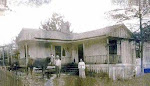
Below in a photograph taken in either 1928 or 1929 are John Thomas and Martha Jane Walker Holliman standing in front of their home in Fayette.  John would died in 1930 and Martha Jane in 1931.  The young man sitting on the porch in a white shirt and tie on the far right is 10 year old Bishop Holliman!


Cleaning the Caine monument is Glenda Norris using shaving cream.  When gently scrapped off, the cream reveals difficult to read letters.  Glenda credits her Uncle Rhodes Holliman for the process. In the background are Robert Holliman and Faye Gardner.


Bishop Holliman's father was Ulyss Holliman (1884 - 1965) who grew up in Fayette, married Pearl Caine (1887 - 1955) in 1906, and removed to Jefferson County, Alabama in 1917 in search of increased income for  his growing family.  Pearl Caine's grandparents, William Ellison and Melissa Anthony Caine, lie buried under the gravestone above.  It was Pearl's grandfather who gave the land for the church.

The journey to explore Holliman and their families continues in the next post....


Plan now to attend the Holliman and Associated Families Genealogical Round Table at the Fayette County, Alabama Civic Center, 10 am to 3 pm, Saturday, October 15, 2011. For information and reservations for lunch, contact Glenda Norris at gnorris@bcbsal.org or Glenn Holliman at Glennhistory@gmail.com.  Sessions to include Tracing the Holymans from England to Alabama, Holliman Farm Sites in Fayette County and sharing of information on Associated Families.  All invited!

Tuesday, May 31, 2011

The Hollimans of Alabama

By Glenn N. Holliman

Back to the 19th Century...A Series of Articles on the Hollimans and Related Families of Fayette County, Alabama

April 9, 2011 distant cousins from six states gathered in Fayette County, Alabama to discover and rediscover ancestral grave sites.  The picture below was taken at Caine's Ridge Baptist Church cemetery where lie John Thomas and Martha Jane Walker Holliman and members of the associated family of Caine.
Left to right, Bishop Holliman (Indiana), Glenn Holliman (Pennsylvania), Bill Holliman (Mississippi), Robert Holliman (Tennessee), Joey Holliman (Alabama), Norman Holliman (Tennessee), Wally Allen, Jean Holliman, Tommie Holliman Allen, Faye Gardner, Lenwood Holliman, James Franklin (Frank) Holliman, Vonceil Duckworth, Tyler Duckworth (all from Alabama) and Jeanette Holiman Stewart (Texas). The photograph was taken by Glenda Norris, organizer of the excursion.


The earthly remains of John Thomas and Martha Jane Walker Holliman lie side by side at Caine's Ridge, a few miles south of their former home in Fayette.  The story of John Thomas Holliman is told in its sad glory by one of his great grandson's Rhodes Holliman in this blog, February and March 2010.  Please go to the Archives function and to seek the articles.


More next posting on the Holliman and their associated families in Fayette County, Alabama.


Plan now to attend the Holliman and Associated Families Genealogical Round Table at the Fayette County, Alabama Civic Center, 10 am to 3 pm, Saturday, October 15, 2011. For information and reservations for lunch, contact Glenda Norris at gnorris@bcbsal.org or Glenn Holliman at Glennhistory@gmail.com.  Sessions to include Tracing the Holymans from England to Alabama, Holliman Farm Sites in Fayette County and sharing of information on Associated Families.  All invited!

Friday, March 19, 2010

John Thomas Holliman, A Survivor and Casualty of the Civil War


In the previous posting, John Thomas enlisted in the Confederate Army and engaged in a number of battles. As the fall of 1863 approaches, he has been in the Army for a year and a half and has had no leave or furlough. The Union Armies of Grant and Sherman have pushed deep into the South, and Lee has been repulsed at Gettysburg. The Southern cause has become desperate.


Photo courtesy of Glenda Norris, a great, great grand daughter. Grave is located at Caine's Ridge Baptist Cemetery, Fayette County, Alabama.


UNBEARABLE ENDURANCE, Part II
by Dr. Rhodes B. Holliman of Dublin, Virginia.
This article first appeared in Southern Times, Magazine of Tuscaloosa and West Alabama, issue No. 124.

John Thomas was now without shoes or winter clothing and the severe winter of 1863 - 1864 was closing in. The 41st Infantry Regiment marched from Tyner’s Station to Knoxville, a distance of over 100 miles.

The attack on the Union fortifications at Knoxville was a catastrophe forcing the 41st to retreat toward Bean’s Station over icy ground in freezing rain and snow. At this point John Thomas had no blanket, coat or shoes. He was leaving bloody tracks with every step. A battle at Bean’s Station on December 14th left the 41st with about 350 men and officers: about 1/3rd the original enlistment. Winter encampment was made at Morristown, TN, and the Regiment marched into Bristol, VA, in April of 1864. They soon marched north to Abingdon where they boarded a train on April 16th for Richmond.

Their next campaign began at Drewry’s Bluff on the James River south of Richmond: an effort to prevent Union gunboats from sailing up to the Confederate capitol. The victory at Drewry’s Bluff would become “the finest hour” for the 41st AL. On June 17th, the 41st moved into the trenches at Petersburg for the exhausting 9 month siege to follow. John Thomas would endure the unrelenting rifle and artillery fire until Feb. 1865.

No words can describe the carnage of events in the trenches at Petersburg. During this time he would see two of his cousins from Co.B seriously wounded and one killed. He participated in the effort to bury his cousin from the trenches of Gracie’s Brigade but was thwarted by Union sniper fire. He and 2 other cousins dragged the body at night to the Confederate burial ground in Old Blanford Cemetery near the spot of the Crater Explosion and finally accomplished their mission while dodging Union rifle fire.

On February. 15th, 1865, John Thomas was near death from starvation and exposure in a frozen wasteland. He still did not have shoes, a coat or blanket. He and two of his Company buddies, Sgt. Miles Bobo and Pvt. John Anders South, pooled their money ($17 Confederate) and bought a pone of cornbread being peddled by a free black woman in the trenches. They ate it, put up a white flag on a ramrod and walked over into the Union lines. The Federal Archives state that John Thomas was sent to Washington, D.C., given the oath of allegiance , and then sent to Holly Springs, Mississippi, to await discharge. This statement is correct for Bobo and South but John Thomas’ fate was totally different. This writer is in possession of a note written by a post-war confidant of John Thomas that reads:

“In Co. H - 41 Ala at Petersburg Va. On Feb 15 1865 about dark - went over to Union. John South, Miles Bobo. Carried Gard (sic) House that night - Asked by officers to disclose conditions and were carried from post to post disclosing conditions in Conf. (Gracies Army) Was in U S Army about 1 week. Was then sent to Washington and took Oath - was sent to Baltimore Md - then throug (sic)Pa to Indianapolis Ind & stayed in Inda (sic) about 6 mo - war closed.”


John Thomas was furloughed, really indentured, to a farmer in Indiana and he promised to stay and “make a crop”. Good to his word, he stayed until the fall of 1865. He had earned enough to purchase new shoes and, to limit the wear, he tied the shoelaces together, slung them over his shoulder and, to quote his exact words, “came on home.” He walked cross country, alone and barefoot, about 600 miles to his home in Fayette County in west Alabama!

John Thomas did not receive a single furlough during his 3 ½ years of service. He hated the War and frequently declared it was “a rich man’s war and a poor man’s fight.” He was held in contempt by some of his neighbors for the remainder of his life for his surrender.

His brother, Lt. James Franklin, after release from Johnson’s Island Prison in June, 1865, opened a one room school in the northwest part of the county and enrolled 8 grades of children and adults. John Thomas, at age 21, tried schooling for about a week but quickly withdrew. After his experiences of the previous 3 ½ years, school was not for him.

His first marriage in 1867 produced 3 children, only one of whom, a son, lived to maturity. His wife died in 1872 from “childbed fever” (septicemia) giving birth to their third child, a stillborn infant. He married again in 1875 and produced 5 sons. He was a profound victim of post war traumatic stress and his countenance and personality reflected this condition until his death on July 12th, 1930, from prostate cancer, at age 86.

He had been subjected to unspeakable visions of death and hardship. He was denied a veteran’s pension in his old age and died in poverty. He is buried next to his second wife in Caine’s Ridge Primitive Baptist Cemetery on State Route 159 just south of Fayette, AL. From his 6 sons, there are 6 branches of the Holliman family who have enjoyed life because their ancestor was prudent enough to recognize when death was imminent and the mission was doomed to failure.

The 41st AL went on to fight at Hatcher’s Run and the retreat to Appomattox where 98 of the original 1,284 stood ready to answer the final roll call.

In reading the campaign history of the 41st Alabama, one recognizes the futility of the endless marching and the confusion of battle plans created primarily by lack of communication between combat units. It will never cease to be amazing that logistics and tactics could coordinate and the endurance and sacrifice of the individual soldier was beyond comprehension.

Friday, March 12, 2010

John Thomas Holliman, A Survivor and Casualty of the Civil War


In this posting, Dr. Rhodes Holliman examines the Civil War life of one of the sons of Uriah and Mary Polly Lucas Holliman. Many of you reading this are descendants of John Thomas Holliman (1844-1930). Others will recognize John Thomas as a distant cousin, a great grandson of James Grantson Holliman (1750-1836).


Whatever your relation, this life of John Thomas captures the pathos and violence of war, and its difficult aftermath. Note the sad reality as John Thomas assembled with his regiment in Tuscaloosa only one week after his father and brother died following the Battle of Corinth, Mississippi.


UNBEARABLE ENDURANCE, Part I
by Dr. Rhodes B. Holliman of Dublin, Virginia.
This article first appeared in Southern Times, Magazine of Tuscaloosa and West Alabama, issue No. 124.


(John Thomas Holliman, ca 1900)

John Thomas Holliman was born on April 23, 1844, in Fayette County, Alabama. He was the fifth child of 13 of Uriah Holliman and Mary Polly Lucas Holliman. In his family, two of his older brothers and his father joined the Confederate Army plus a younger brother and a brother-in-law. Of these volunteers, only two would survive the War: John Thomas and his oldest brother, Lt. James Franklin Holliman of the 58th Alabama Infantry. His was a poor, backwoods, farming family who never owned slaves but who stood ready to defend their homeland.

We will never know the motivation that drove John Thomas, his father and 3 brothers to join the Confederate Army. Peer pressure, community pressure, the excitement of travel away from the farm, a patriotic resolve to defend the homeland and their way of life, a distorted view of what combat would really be like and no idea of the privations that lay ahead could have influenced their decisions. John Thomas and his siblings had never been more than 25 miles away from home.

The fallacious idea that war would be fun and exciting and would be over in a few weeks pervaded the minds of so many volunteers of that time in both Union and Confederate armies. The Holliman boys were basically illiterate, and they had no background in the study of history and the horrors of war. As far as we know, James Franklin Holliman was the only member of this family group who could read or write.

At age 18, John Thomas joined Company H of the 41st Alabama Infantry Volunteers as a Private in April, 1862, in the town of Fayette. He would never be promoted. The 41st was made up of volunteers from Tuscaloosa, Greene, Fayette, Perry and Pickens counties, with Fayette County enlisting the most men in Companies B (88), H (132), and I (110). This was 26 % of the 1284 volunteers in the 41st from all counties.

The 41st was assembled in Tuscaloosa, AL, on May 16, 1862, to begin training. The sudden crowding of these men who were accustomed to living on isolated farms remote from individuals with contagious disease, and the subsequent exposure to polluted water, poor rations and unsanitary conditions of camp life, created an environment for an epidemic (measles, typhoid, pneumonia). There was no effort made to quarantine contagious individuals because the microbial source of infection was not discovered until the work of Pasteur and Koch in the late 1800s.

From May through July there were many deaths due to disease so that the first engagement at Chattanooga, TN, in August, 1862, found only 700 men fit for duty. John Thomas fought skirmishes along the Tennessee River in the fall and was hotly engaged in the carnage of Stones River (Murfreesboro, TN, campaign) in early January, 1863. Thereafter, the 41st was deployed along The Army of Tennessee Defense Line at Manchester, Allisona, Tullahoma and McMinnville with frequent skirmishes through the spring of 1863.

In an effort to reinforce troops in the Mississippi Campaign, on May 23 rd, the 41st was transferred by rail to Chattanooga, Atlanta, Montgomery and Mobile, Meridian and Jackson. Arriving too late to be of help at Vicksburg, the 41st was outstanding in the Second Battle for Jackson, MS. After a month long rest, the 41st retraced its steps to Chattanooga. John Thomas was yet to face the blood bath at Chickamauga on Sept. 20th and the following siege of Chattanooga.

The 41st left their positions on Missionary Ridge on November 19th and marched to Tyner’s Station to join Gen. Gracie’s brigade for the assault to retake Knoxville. Little did they anticipate that Union forces would overrun Missionary Ridge on November 25th whereupon John’s brother, Lt. James Franklin, was captured and imprisoned for the remainder of the War in the Confederate Officer prison camp on Johnson’s Island in Lake Erie near Sandusky,Ohio.

Part II of the war travail of John Thomas Holliman continues with the next posting.