Wednesday, August 25, 2010

When We Were English, Part XVI

by Glenn N. Holliman

Connecting Cuddington Holymans to Cholesbury Holymans and Tring Holymans
Note: Cousin Jeanette Stewart recently shared in a Holliman chat room information on the Holyman and Weedon (Wedon) families of Hertfordshire, England from the English Origins of New England Families. Before reviewing her excellent research, I had been preparing the article below which echoes and strengthens her findings. In future postings, I will attempt to weave her public work into the growing narrative of the Holymans in Tring and Cuddington, England in the 16th and 17th centuries. My thanks to Jeanette, Joe Parker and all for making available to the larger Holliman, Holleman, Hollimon, etc. families their increasing knowledge of our historic roots.

Last spring my cousin Maxine Wright, a relentless researcher in pursuit of Holliman origins, mailed me the following information of one Richard Wedon, who lived in Botley, a small village near Cholesbury and Tring. As one can read in the first paragraph of this p. 187 of The Register, published 1954, Richard had to pay a fine in 1567 for breaking the head on another man's servant. Hmmm....

Richard must have matured because nine years later, in 1576 he married Jayne Holyman in Cholesbury, near Tring. The information below states that this Jayne Holyman was from 'a yeoman family of good standing in Cuddington', descendents of Bishop John Holyman, whose life we have reviewed in previous blogs.

Several other items leap out at us. Richard and Jayne had a son named James who evidently immigrated to Rhode Island! Did James join a cousin named Ezekiel of Tring in Rhode Island?One remembers that Ezekiel Holyman, an Anabaptist, baptised Roger Williams the founder of Rhode Island!

Notice that Richard Wedon writes a will in 1618 (it is probated in 1624, presumably the year of his death). The will is witnessed by William Holyman. Double click to enlarge.

Now the issue grows more complicated. Above we have Jayne Holliman married to Richard Wedon. Below in another section of the Register, we have a John Holyman appearing in marriage in 1593 and dying a few years later. Goodbye to this John who had no children.

However, now William Holyman, the eldest son of another William Holyman, appears again (noticed who witnessed Richard Wedon's will), baptized June 1583 and his sister Priscilla February 1584/5. They have a brother named Ezekiel.

This Ezekiel according to many web sites and those who have researched Baptist Church history is the Ezekiel who sailed to Massachusetts and helped found Rhode Island!


Notice in the next paragraph an Ann Holyman married another Wedon May 1586, and is noted as a probable daughter of Leonard Holyman and a sister of Jane Holyman.

Confusing? Yes, but stay with me. In the next blog, we are going to examine Leonard Holyman and his offspring. In web sites, Leonard is listed as the father of Ezekiel Holyman.

So, two thoughts emerge:

1. Leonard Holyman and other Holymans of Tring and Cholesbury, including Ezekiel, are indeed descendants of Bishop John Holyman of Cuddington.

2. Bishop John Holyman, a devout Roman Catholic, therefore is probably a great or great great uncle or cousin of Ezekiel Holyman, who was religiously antithetical by 180 degrees, to his prominent descendant, an Anabaptist in America! For those interested in religious history this is an amazing journey for a family. One generation burns Protestants at the stake; another helps establish the Baptist Church in Rhode Island.

So are all these interesting Holymans our direct ancestors? Ancestors, most probably yes; direct, we still do not know.

The elusive John Holyman, who died in Virginia in 1650 and is named in various web sites as the father of Christopher Holliman, Sr. (whom we know is the father of the American Hollimans), still has not appeared in the Tring records many of us have researched.

More in the next posting on resolving this mystery. Is our Christopher Sr. really from Bedford, Bedfordshire, another 30 miles or so up the road from Tring? Stayed tuned for more research....

Monday, August 23, 2010

When We Were English, Part XV

Making Sense of Our Cloudy and Confusing English Past
by Glenn N. Holliman
This gargoyle on the parish church at Tring, Hertfordshire, England represents the challenges to discover our Holliman roots. The 'past', this gargoyle, seemingly does not wish to tell us what we long to hear....who are our ancestors? Photos by Barbara Holliman

Indeed, new research provided by cousins Maxine Wright and Joe Parker is moving the focus of our search from Tring to Bedford, Bedfordshire, England, approximately 35 miles to the north.

In the meantime, I continue to share some findings in Buckinghamshire and Hertfordshire, about 25 to 30 miles northwest of London. Below is a map of the villages where Holymans lived in the 16th and early 17 centuries: Cuddington, Tring, Cholesbury, Berkhamstead and Aldbury. They are overshadowed in a yellow marker. Double click to make larger.


The gargoyle at the top of this posting is from the Tring parish in the photo below.

In the photo above, I stand in front of the Tring, Hertfordshire parish church, which has been reconstructed several times since its 11th century founding. The present structure was erected in 1470. In this sacred space in England some of our distant ancestors probably worshiped and their remains may linger in the ground behind me.

After visiting the Tring parish church a first time in 2005, my wife and I stepped down the block to visit a charity shop (seeking yet more royal coronation ware, a vice of mine). The kind clerk showed us the local telephone book. Yes, seven or eight Hollimans were listed in the local exchange. Hmm… Later we motored to a pub for roast lamb and red wine (and I remember little more that day!).


Next posting, we continue to explore the villages and paperwork that connects Holymans in Cuddington to Cholesbury and Cholesbury to Tring and Tring to Berkhamsted and Aldbury.

Some new insights published via email by cousins Jeanette, Joe, Maxine, Betty and others continue to add to the tapestry that is emerging concerning our English roots. My continuing thanks to them for sharing.


Monday, August 9, 2010

When We Were English, Part XIII

by Glenn N. Holliman

Leaving the Lovely Village of Cuddington

Below a photograph of sheep grazing on a Chiltern hillside near Cuddington, Buckinghamshire. This pastoral scene is typical of the landscape around Tring, Cholesbury, Aldbury and Berkhamstead where the name Holyman pops up in parish registers and legal documents in the 17th and 16th centuries.

The folk of Cuddington, including Peggy Cattell and Caroline Stonham, were kind and generous with their information on the Holyman family. Below is Nancy Cattell who showed us around the parish church and village. Notice the thatch cottage on the right. It dates to the 1500s. The last reproduction (bottom photo) gives some idea of what an English cottage looked like in the 1600s, something akin to how our ancestors were domiciled.


Next we try to connect some ancestral dots....

Tuesday, August 3, 2010

When We Were English, Part XII


The Holyman Farm of Cuddington has Secrets to Reveal


by Glenn N. Holliman

To the left is a typed family tree of the Holyman farm prepared by its present owner, Caroline Stonham.


Below is an 19th century description of the farm from the Buckinghamshire County Museum. In the 1800s a Mr. Scott owned the property. Double click to enlarge. Photos by Barb Holliman.


Below is a wing of the 1698 thatched cottage on the Holyman Farm.


Next post, we say good bye to our eventful visit to Cuddington....

Wednesday, July 28, 2010

When We Were English, Part XI

by Glenn N. Holliman

More on the Holyman Farm, Cuddington, Buckinghamshire, England

In the past few posts, I have been sharing information and photographs of a Holyman farm, described in some English sources as a former 15th century manor house. In the photo below is a contemporary plaque attached to one of the barms, now a residence. This sign celebrates the name of the farm and its most famous namesake, Brother John Holyman (1495 - 1558), a monk and later the Rt. Rev. John Holyman of Bristol. Photo by Barbara Holliman


Below from The Monuments of Buckinghamshire is a description of the 17th century thatched cottage that we have featured in previous posts (see archives). Click twice and the manuscript will enlarge.

The current owner of Holyman Farm, Mrs. Caroline Stonham, has prepared the following family tree of the Holyman family and others that lived on the property. Perhaps it is of some use to those studying deeply into our English past. Through it one may be able to connect the family to our other English ancestors reportedly from Tring and/or Bedford. Where there are no last names, insert Holyman. Again, click twice and the document will enlarge. Photos by Barbara Holliman


Next posting, more research on our English roots....

Friday, July 23, 2010

When We Were English, Part X

by Glenn N. Holliman

Continuing the Search for our Ancestors in England

In the above 17th century thatch cottage lived great nieces and nephews of The Rt. Rev. John Holyman who was born on this farm in 1495. Numerous legal papers and research tell of the family. Below are copies of research from Caroline Stonham, current proprietor of the Holyman Farm in Cuddington, Buckinghamshire. Click on the documents to enlarge them.

Page 1

Page 2
These documents may be of use to any Hollimans who research our English roots....unfortunately the names of John Holyman (1572 - 1650) and Christopher Holliman (1631? - 1691) have not appeared in documents from the Holyman Farm. The search continues for our direct ancestors....

Wednesday, July 21, 2010

When We Were English, Part IX

by Glenn N. Holliman

Bishop John Holyman's Will, 1558


In my recent postings, I have been chronicling the life and times of The Rt. Rev. John Holyman, probably a distant uncle of our Holliman family. During my recent visit to the village of Cuddington, Buckinghamshire, England, this photograph (below) was taken of Mrs. Caroline Stonham and myself in the back garden of her 17th century thatch cottage.

What is remarkable about this cottage is that it rests on the Holyman farm, and Holymans used to live in the residence in this photograph!


In an earlier posting, I dropped in a photograph of the location of the old 'manor' house where 16th century Holymans lived, approximately 200 yards from where Caroline and I are sitting.
We are reviewing Holyman papers she has collected in the twenty years she has lived on the farm. She is a geography teacher and has a keen appreciation of the history of her home. She kindly shared of her research and gatherings with me, allowing my wife to photograph the many documents. With her permission, I now share them with you.

One of the papers we reviewed is below. It is the 1558 will of Bishop John Holyman. It is a transcription but it does contain a bit of Shakespeare era English. Being celibate, John had no children, but he did have servants whom he remembered and he left funds to colleges and the parish where he is interred. Notice he left funds to pray for the repose of his soul. For one who had been a monk, and had taken a vow of poverty, he left a sizable estate although no land.

If one places the cursor over the document and clicks, the will should enlarge for easier reading.

Page 1

Page 2

This will was transcribed under the direction of Bob Hollyman-Mawson of Wales, for whom we all are indebted.

Next posting, more on the Holyman farm and family documents in Cuddington, Buckinghamshire, England....

Tuesday, July 20, 2010

When We Were English, Part VIII

by Glenn N. Holliman

The Turbulent Life of The Rt. Rev. John Holyman, Installment 5

The life of John Holyman reached a climax during the reign of Queen Mary Tudor, or 'Bloody Mary' as she was termed by Protestants. Nancy Cattell of Cuddington, Buckinghamshire, England concludes her story of this distant ancestor.

The west entrance to the Bristol Cathedral with a quintessential Royal Post Box in foreground. From 1554 to 1558 The Rt. Rev. John Holyman occupied this Episcopate. Photo by Glenn Holliman

"Upon the accession of the Catholic Mary, daughter of Catherine of Aragon, John Holyman was appointed Bishop of Bristol, obviously as a reward for his support of her mother. Once again Holyman was into the limelight for now the Protestants who had supported Kings Henry VIII and Edward VI were to be tried. Bishop Holyman was included in the commission that tried Latimer, Bishop of Worchester and Ridley, Bishop of London. They were found guilty of heresy. In 1554, Holyman also participated in the disputation of Archbishop of Canterbury, Thomas Cranmer."

All three Protestant bishops were burned at the stake at Canditch in Oxford for their 'heresy'. The above woodcut is of Cranmer's death from the famous Fox's Book of Martyrs. In Bristol from 1554 - 1558, five more Protestants found martyrdom as 'candles' for Protestantism. In fairness to The Rt. Rev. John Holyman, he is reported to have opposed such actions, but they did occur during his episcopate.

"In 1558, Mary died and was succeeded by the Protestant Elizabeth. So once again the tables were turned and the Catholics were now put on trial. Bishop John Holyman avoided a violent death, as he died
of natural causes a month after the accession of Queen Elizabeth I. His burial took place at Hanborough Church."

"I am so amazed that anyone born in the 16th century in what must have been at that time the most obscure of little villages should have produced a man who was at the centre of all the important happenings of that tumultuous time." - Nancy Cattell, Cuddington, Buckinghamshire, UK 2005

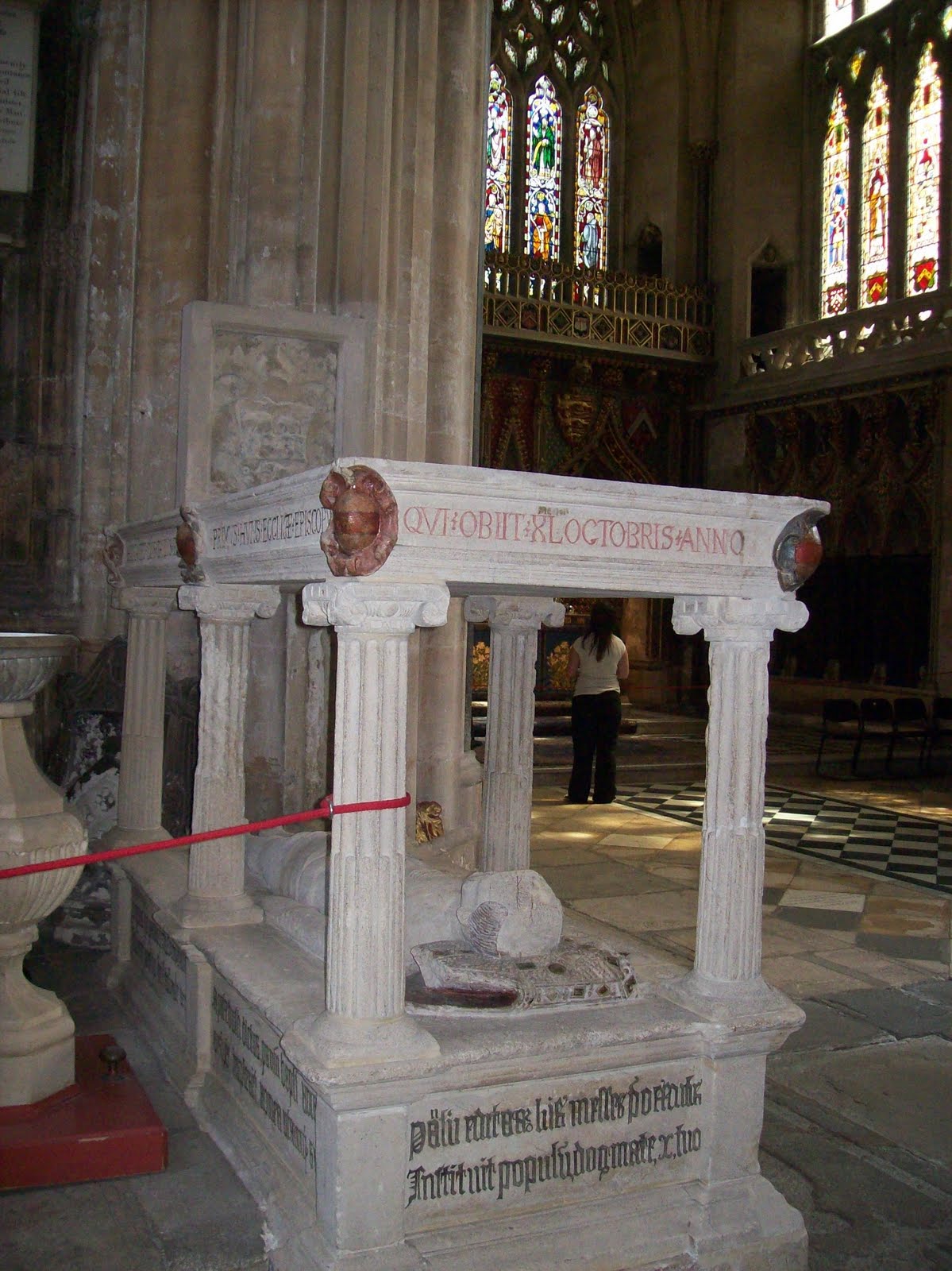
Paul Bushe, the first Bishop of Bristol received an ornate tomb with effigy (photo below of Cathedral sanctuary).


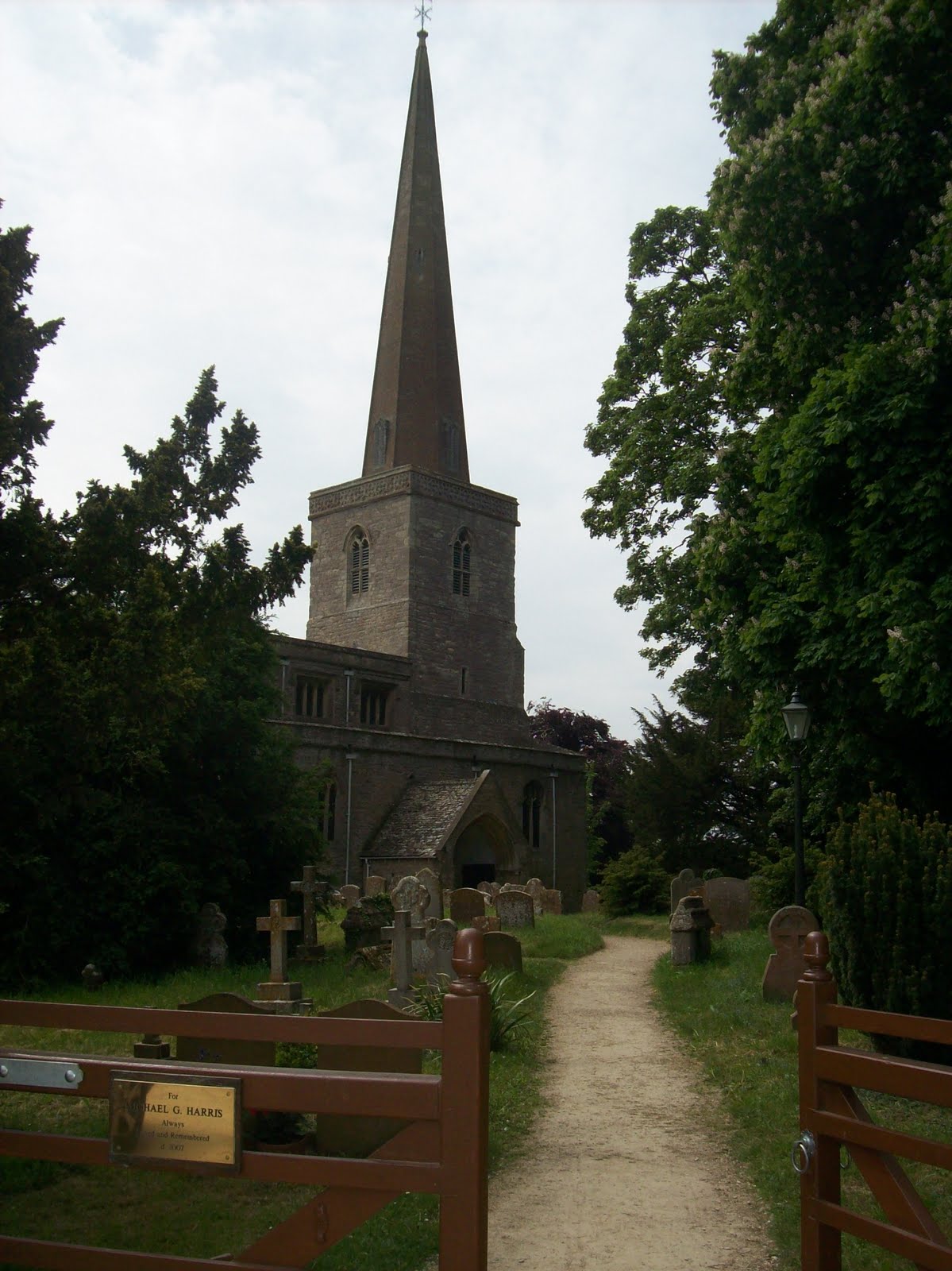
But the second bishop, much more controversial and in disrepute at his death, lies buried in Long Handborough in his former parish church. John Holyman's remains lie under or near this 16th century memorial (photo below) in the small village parish near Oxford. Photos by Barbara Holliman


Next post, a visit to the Holyman farm in Cuddington, Buckinghamshire....

Saturday, July 10, 2010

When We Were English, Part VII

The Turbulent Life of The Rt. Rev. John Holyman, Installment 4
by Glenn N. Holliman

During the last years of Henry VIII and the reign of the boy king, Edward VI, our John Holyman served as priest at Long Handborough, near Oxford, and later vicar at Wing, near Tring, Hertfordshire.


The name John Holyman appears (above) on this list of rectors who have served the parish in Handborough. This roster hangs on the church wall. There is an error; John Holyman was the second, not first Bishop of Bristol.


The photo of the book to the left of Archbishop Thomas Cranmer is the latest in many excellent works on this pivotal priest during the Reformation. Some of the activities of our Bishop of Bristol are recorded in Diarmaid MacCulloch's biography which was published Yale University Press in 1996.


During the English Reformation, out went certain Roman traditions and services and in came a more simplist style of worship and church decorations. English, not Latin, became the language of the pulpit and altar. Cranmer wrote the first Anglican Church prayer books, the model and language which survives even into the 21st century in the American Episcopal Church.

Discretion must have been his middle name.


However, one of his distant descendants practices an indiscretion, standing in the 15th century pulpit where John Holyman preached in the 1540s in Long Handborough. Photo by Barbara Holliman, wife of the bogus preacher.


Next posting, we continue with the paper on ancestor John Holyman (1495 - 1558) presented by Peggy Cattell of Cuddington, Buckinghamshire, England.


Friday, July 9, 2010

When We Were English, Part VI

The Turbulent Life of The Rt. Rev. John Holyman, Installment 3
by Glenn N. Holliman

Historian Nancy Cattell continues her paper on Cuddington, Buckingshire resident John Holyman.

"While in London Brother John embroiled himself in not just Reformation issues but also the marriage crisis of King Henry VIII (1581 - 1547). Henry had decided that must ask the Pope to grant him a divorce from his first wife, Catherine of Aragon. He claimed that because she had been his brother's widow he should not have been given the dispensation to marry her. This 'sin' was smoting him."
This likeness of King Henry VIII is in the Cathedral at Bristol, England, the Cathedral from which Bishop John Holyman presided 1554 to 1558. Photo by Barbara Holliman.

"This after 20 years of marriage, but of course the real reasons for his desire for a divorce were (a) that Catherine had not provided him the son he wanted and (b) much more important - he had fallen desperately in love with Ann Boleyn and wanted to marry her."

"The Pope refused Henry's request and good Catholic that he was Brother Holyman started preaching in favour of the validity of the marriage to Catherine (photo right). This was a very courageous act or if you like, a very foolhardy one for Henry did not approve of criticism."

Catherine is the mother of Queen Mary Tudor.


"Holyman must have made a discreet move from London otherwise he would surely have lost his head - one book I read told me that his abbot did and certainly the Abbey was dissolved during Thomas Cromwell's 'displacement'. "


Anne Boyleyn, the mother of Queen Elizabeth I, photo left.


"As we know when the Pope refused to grant the divorce, Henry cut the Church in England off from the Roman Catholic Church and thus the Church of England came into being. Henry declared himself the head of the Church and so obtained his divorce from his new Archbishop Thomas Cranmer."

"Brother John Holyman left London and sought refuge in Long Handborough, near Woodstock where he became the rector (and kept his head and kept it down)."

The parish church in Long Handbourgh stands today between Oxford and the historic town of Woodstock, the home of Blenin Palace and the birthplace of Sir Winston Churchill.

Next posting, more on the career of Bishop John Holyman....